

Iran Energy Shock Supports Boom in Renewables and Electrification


(Bloomberg) -- The world’s hunger for electricity, as demand rises almost everywhere, will lead to solar becoming the dominant source of power early next decade, according to new analysis from BloombergNEF.
Surging demand from data centers, population growth, rising incomes and more battery-powered vehicles are all boosting demand for electricity, researchers wrote in BNEF’s annual New Energy Outlook on Tuesday. The report concludes that rapid electrification is set to accelerate the transition to clean energy.
“So far this decade, the world has suffered three substantial shocks to the energy system: the Covid-19 pandemic, the war in Ukraine and, most recently, the conflict in the Persian Gulf,” the analysts wrote. “Successive energy market shocks could be a boon for the energy transition as some countries look to decouple from imported fossil fuels and bolster their energy security.”
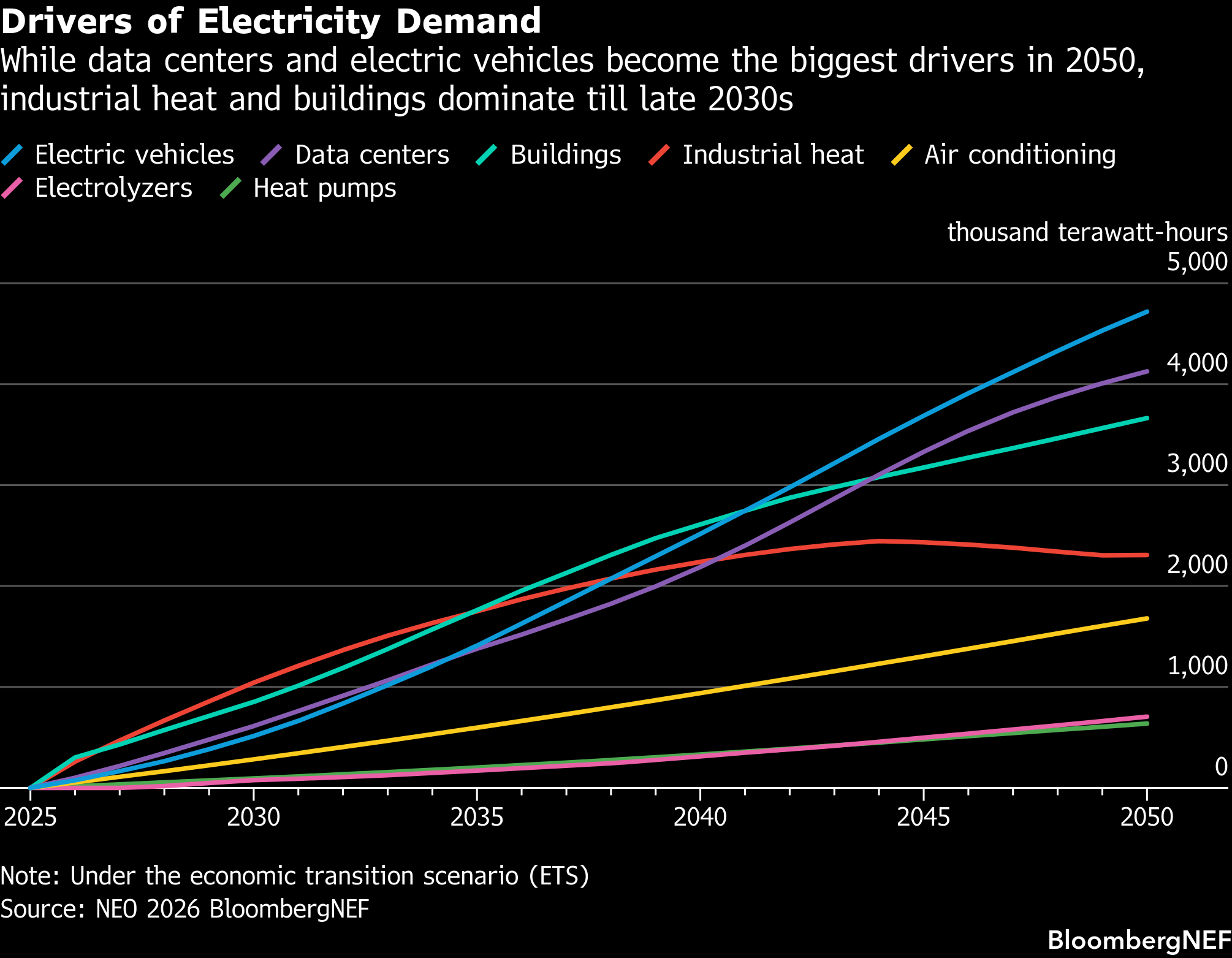
BNEF’s analysis is based on two potential future outcomes. The Economic Transition Scenario (ETS) is based on what is most likely to happen based on prevailing economic forces. The Net-Zero Scenarios (NZS) assumes climate policies are the main driver — in other words, it is underpinned by what governments have said they committed to at the Paris Agreement to lower emissions.
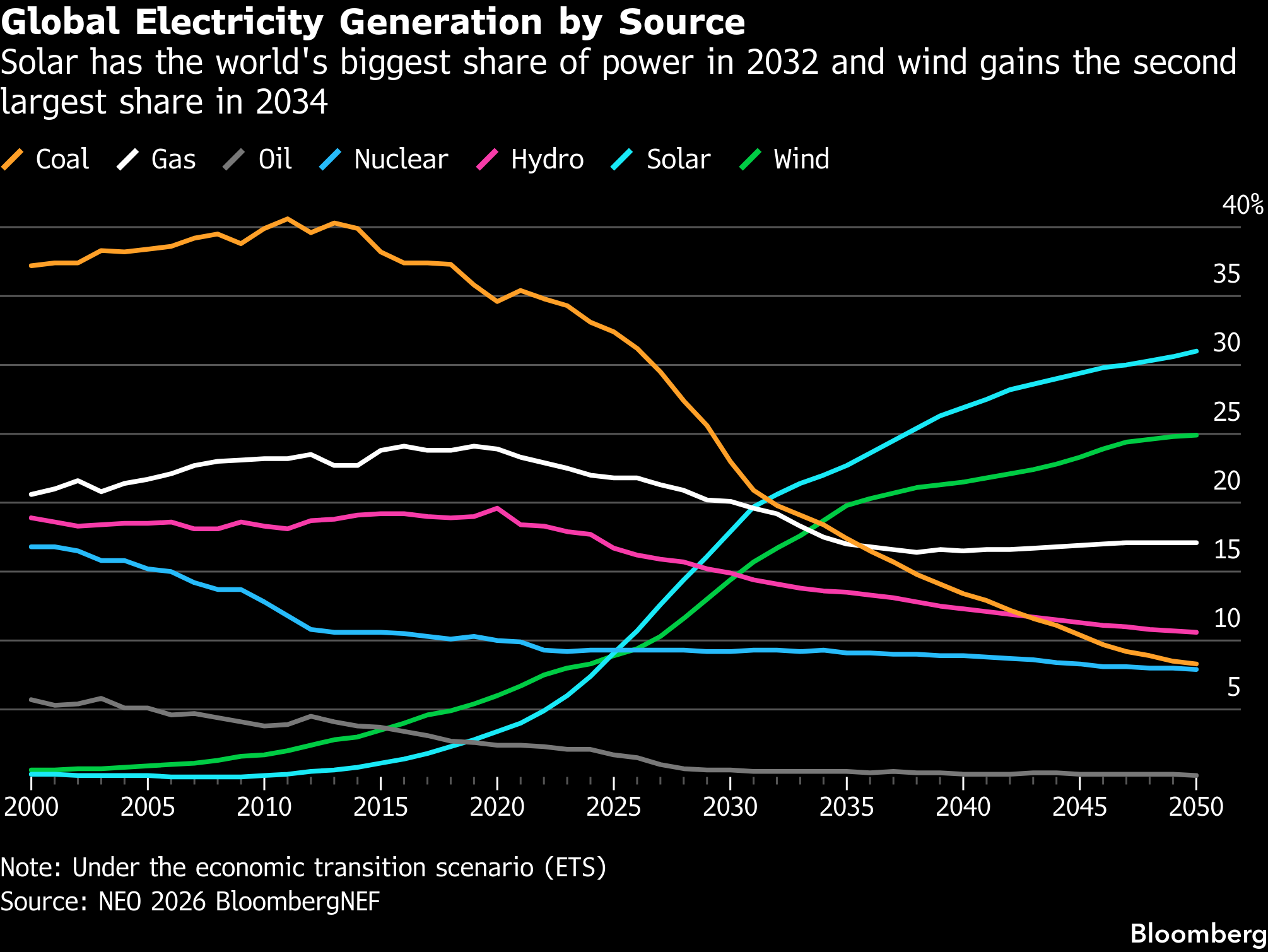
In the ETS, where green policies exist but governments aren’t prioritizing them, solar and wind power both continue to increase their share of the global power mix. Solar becomes the largest contributor in 2032, while wind becomes the second largest in 2034, both displacing coal which is currently at the top spot.
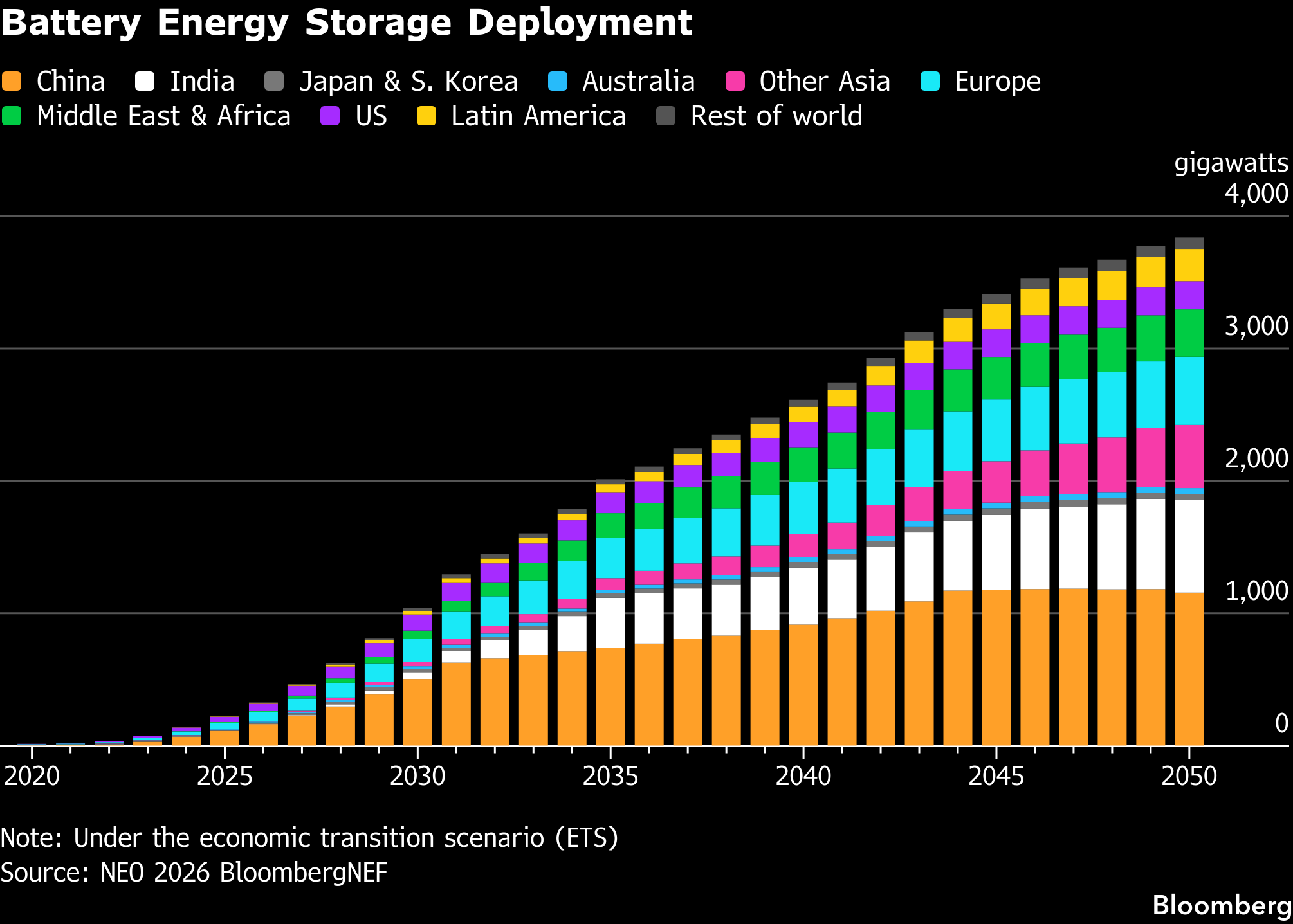
This increase in renewable energy is supported by the deployment of batteries, which will be needed to store clean electricity for times when the sun doesn’t shine and the wind doesn’t blow. BNEF increased its projection for global energy storage from 220 gigawatts in 2025 to 2,000 gigawatts by 2035. While China is expected to see the biggest share of battery deployment for the next few decades, the ETS scenario also forecasts huge demand in India and Europe starting in the 2030s.
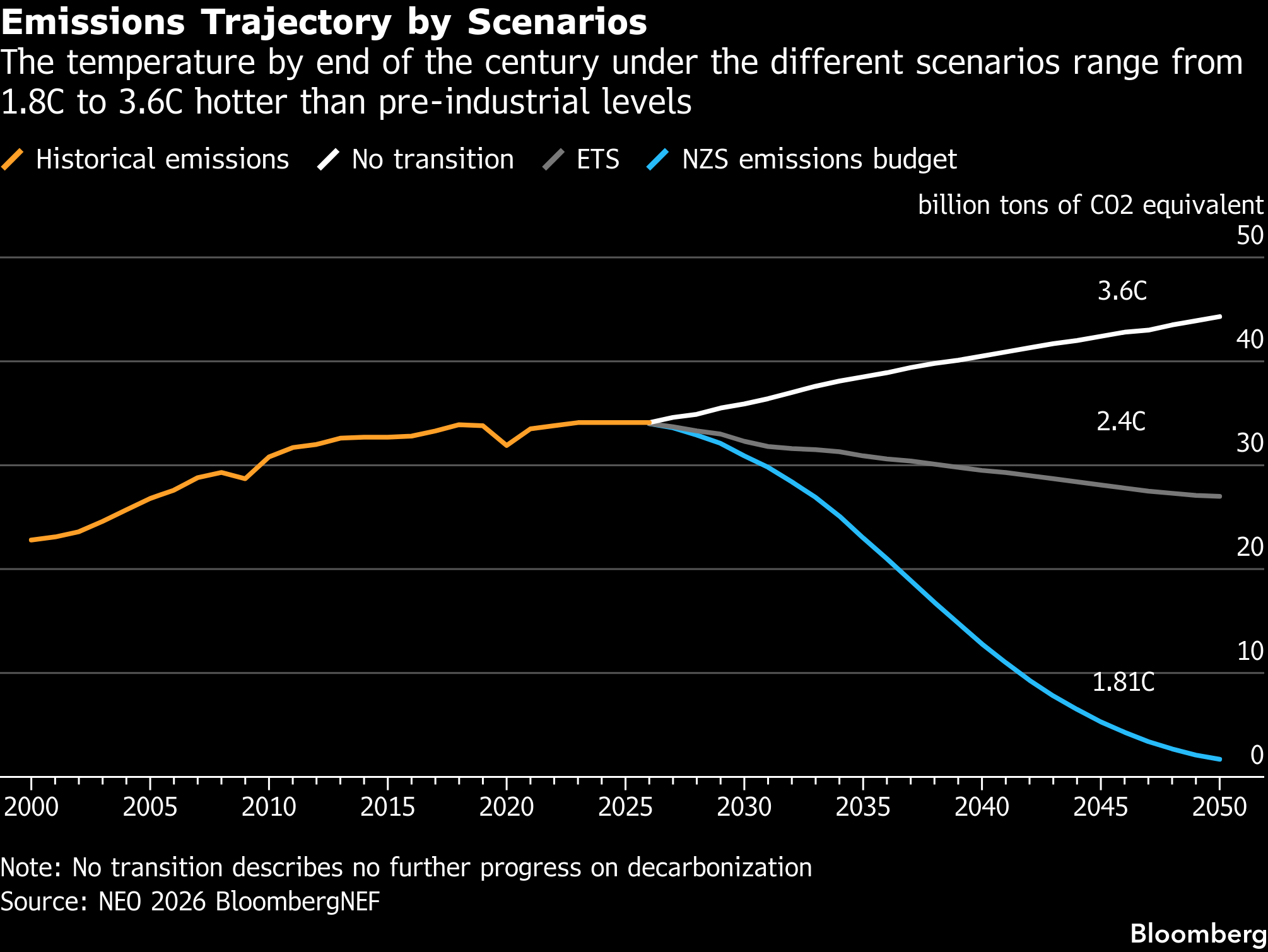
BNEF’s analysis, based on recent carbon emission trends, shows that the world is on track to miss the most ambitious goal of the Paris Agreement to keep global temperature rise below 1.5C from pre-industrial levels. Under the ETS, the planet will heat up 2.4C by 2050, with emissions from two of the three biggest polluters — India, Southeast Asia and Latin America — continuing to rise. China, the world’s biggest emitter, will see its emissions fall, after having peaked in 2025.
Even if the world reaches net-zero emissions by 2050, the projected warming by the end of the century is likely to be above 1.8C, higher than the 1.75C BNEF projected in 2024.
Other major takeaways from the report:
-
Both scenarios will see increasing spend on the energy transition. In the ETS, investments are set to rise 34% from $2.3 trillion in 2025 to $3.1 trillion average annually for the rest of this decade. The NZS requires a doubling to $4.8 trillion in the same period.
-
In the ETS, oil demand peaks around 2029, driven by electrification of road transport. Gas demand continues to rise through 2050 and becomes the biggest source of primary energy by the 2040s, displacing oil.
-
Despite almost $500 billion of equity investments in next-generation climate technologies, such as carbon removal, advanced batteries and geothermal, none have yet to mature to the commercial stage.
©2026 Bloomberg L.P.








