

Energy security and China’s scale to drive hydrogen investments to $3.2t by 2060


A long-term global focus on energy security and accelerating demand in China will drive the growth of the hydrogen sector by 100-fold from today’s levels, according to DNV’s Energy Transition Outlook Hydrogen to 2060 report. Overall hydrogen volumes will grow by 170% and will see cumulative investments of $3.2 trillion to 2060. China is set to lead that expansion, accounting for 35% of new hydrogen production and use over the forecast period, the report said.
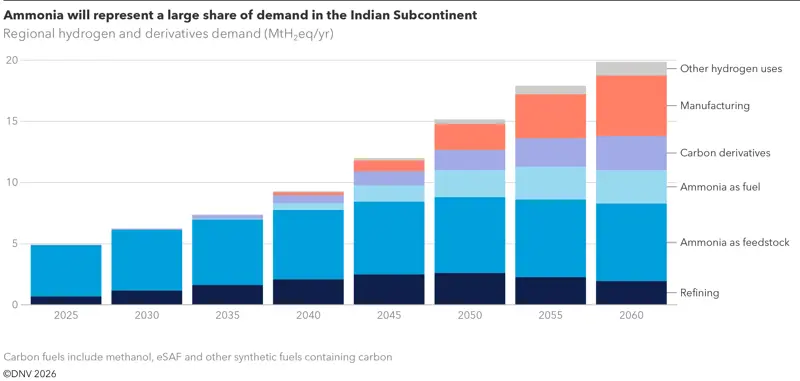
The uptake for clean hydrogen is expected to be strongest in emerging demand sectors by 2060, led by steelmaking (18% of total clean hydrogen use), aviation (18%) and maritime (15%). The established demand sectors, fertiliser and methanol, are also decarbonising large parts of their supply chains and are each expected to account for around 13% of clean hydrogen use, DNV said.
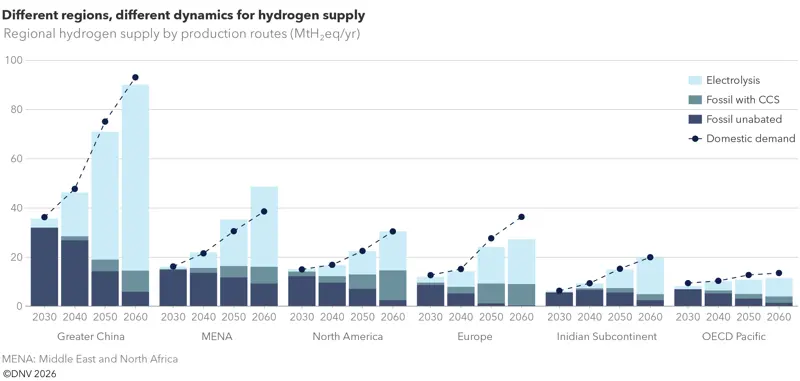
The report also captures the several challenges faced by the hydrogen industry in recent years. DNV has revised down its 2050 hydrogen outlook by 35% since its previous hydrogen forecast in 2022, primarily due to what it said was a lack of policy support which has led to early ambition failing to convert to large-scale projects. The forecast also reflects continued progress in electrification technologies, which has reduced hydrogen’s role in some sectors previously expected to adopt it.
Energy security becoming a decisive driver
“The hydrogen industry is poised for growth, but it is a fragile stance. Hydrogen completes the most difficult aspects of the decarbonisation drive that so many nations have committed to. In driving fossil dependency out of critical sectors, hydrogen also contributes meaningfully to energy security. It is time for policymakers to study carefully the practical progress that has been made and to act decisively,” said Ditlev Engel, CEO, Energy Systems at DNV.
DNV forecasts that half of new renewable electrolysis-based capacity added by 2030 will be installed in Europe and China. China holds 60% of global electrolyser manufacturing capacity and it will couple this with its solar and wind capacity to become the dominant global renewable hydrogen producer.
Energy security will likely emerge as a decisive driver of hydrogen investment and policy, as governments in energy importing countries seek to reduce exposure to volatile fossil fuel markets and protect critical industries. The current geopolitical situation is accelerating final investment decisions, with 10 Mt/yr of renewable electrolysis-based capacity added by 2030 on top of 1.5 Mt/yr installed in 2025, DNV said. Additionally, instability in the Middle East will likely boost coal-based hydrogen used for ammonia and fertiliser production in the medium-term to maintain food security.
DNV also warned in the report that growth depends on closing a safety confidence gap and documenting emissions reductions credibly. Stronger standardisation and whole-system approaches to safety, verification, and certification are needed to build trust and enable substantial investment capital.
“Going forward, it is about fine-tuning the regulations, implementing these in legislation, and verifying safety concepts, documenting technical performance, and certifying emission reductions. That is how renewable and low carbon hydrogen can make a difference for hard-to-electrify sectors,” said Magnus Killingland, Global Segment Lead Hydrogen.