

Macron’s G7 Legacy Hangs on Fickle AI Funding and Data Centers


(Bloomberg) -- With less than a year left in office, Emmanuel Macron wants to be remembered as the French president who put Europe back in the technology race.
His decade-old ambition to turn France into a “startup nation” never fully delivered. Now Macron sees a second chance by positioning France as Europe’s artificial-intelligence powerhouse, leveraging the nation’s abundant supply of nuclear energy for data centers. He convinced Softbank Group Corp. to invest as much as €75 billion ($86 billion) in French projects.
His advisers have dubbed the AI effort “Project Marengo,” a reference to Napoleon Bonaparte’s victory over an Austrian army in 1800 at the battle of the same name, won through speed and decisive action. Marengo was also a political victory, securing Bonaparte’s hold on power.
The stakes for Macron this late in his rule are more about legacy. As France grapples with rising unemployment and public debt that has swelled during his presidency, the president could use a win. The Group of Seven summit in the French Alpine resort of Evian on June 15-17 will offer him one of his last opportunities on the global stage to showcase his technological ambitions.
“For Macron, who has pitched himself as a modern president since 2017, it’s also a matter of symbol,” said Sylvain Bersinger, a Paris-based economics consultant. Yet with the economics of data centers unclear and a presidential election looming next year, “the issue here is political uncertainty,” he said. Many of his likely successors “will likely claim to throw Macron’s legacy through the window.”
Macron’s pro-business agenda of corporate tax cuts, labor-market reform and streamlined procedures for industrial projects was halted when he called snap elections two years ago, and lost his majority in the lower house of parliament. Promoting France as an AI hub has thus become central to his economic narrative, particularly as his broader effort to “reindustrialize” the country has largely failed.
Macron has invited a group of technology executives including OpenAI’s Sam Altman, Anthropic’s Dario Amodei and Demis Hassabis of Google DeepMind to a lunch on the summit’s final day, according to people familiar with the matter who asked not to be named discussing internal planning.
Entrepreneurs from the UK, Japan, India and Germany are due to attend along with French tech champion Mistral AI, with the goal to demonstrate alternatives to the US giants.
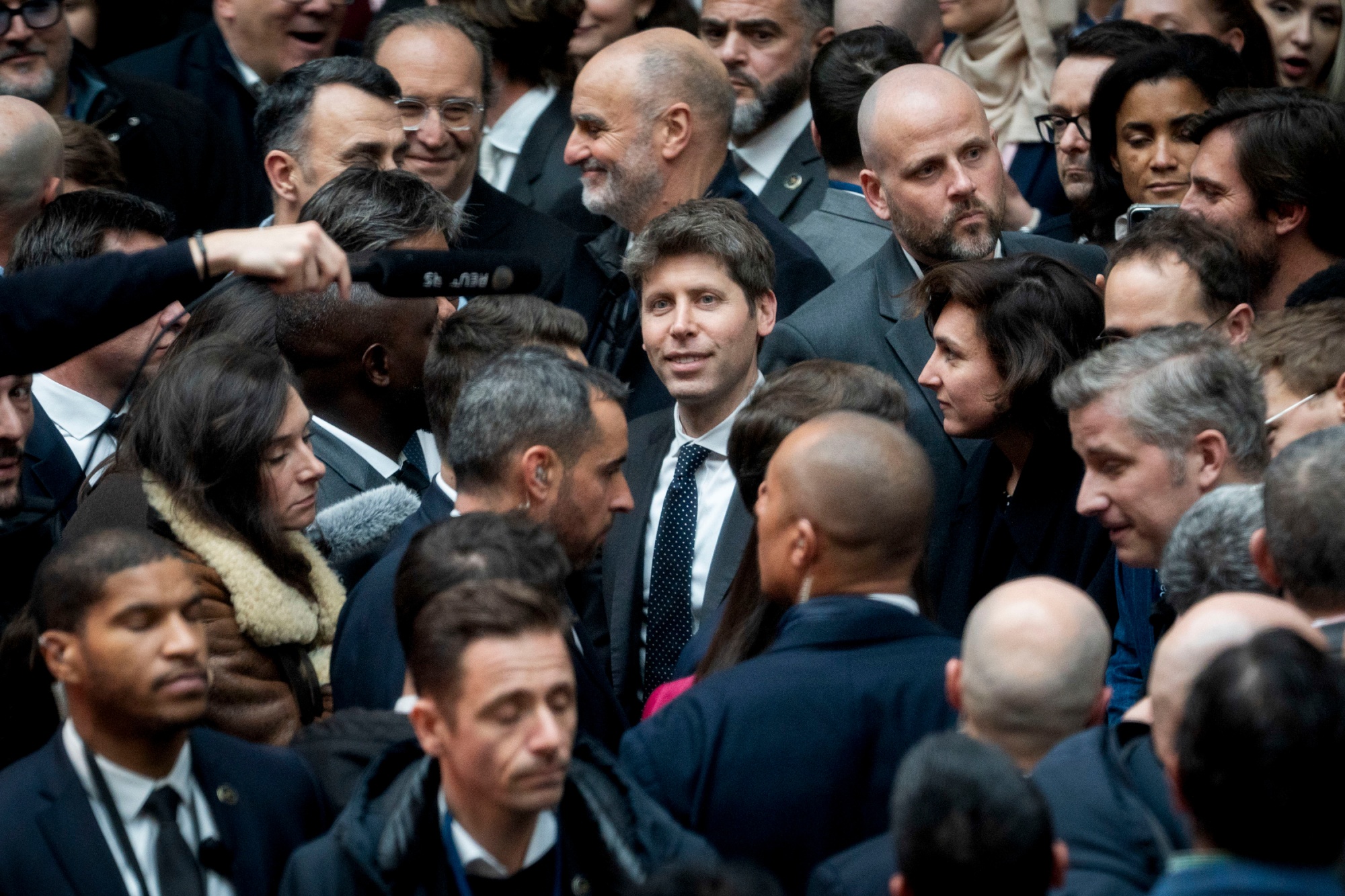
Chris Lehane, OpenAI’s policy chief, said Macron was one of the first world leaders to treat generative AI differently than prior tech waves, like social media, and marshal public resources into the sector. The executive, who is also attending the G7 event, praised the French president for his AI summit last year, a policy event Macron refashioned from focusing on safety to “AI Action.”
“It fundamentally changed the conversation in Europe,” said Lehane. “And I believe he’s approaching the G7 in a similar vein.”
Ahead of the summit, Macron will join Indian Prime Minister Narendra Modi at an AI-focused gathering in Nice on the French Riviera. The event builds on Macron’s efforts to deepen technological ties with India, which have become a key pillar of his strategy to diversify away from the US and China.
Last year, Macron hosted Modi for the AI summit in Paris, where he unveiled €109 billion in investment commitments aimed at helping Europe compete with President Donald Trump’s Stargate infrastructure project. Among them was a pledge from MGX, a United Arab Emirates fund, in an agreement Macron personally negotiated with President Sheikh Mohamed bin Zayed. One year on, the project’s projected capacity was just doubled to 3GW. Macron has also made attracting Indian students to France a priority.
Macron’s ‘intuition’
For years, he has argued that Europe must avoid becoming a “vassal” of the US, yet France remains heavily dependent on American technology. Even the French intelligence service relies on US software providers including Palantir Technologies Inc., the Florida-based data analytics and AI company chaired by Peter Thiel. The data centers built in France will likely rely on US chips and cloud services.
Still, Macron can tout his early belief in the sector’s promise, and France’s ability to capitalize on it. France’s AI strategy, unveiled in 2018, the year after he took office, “stemmed from President Macron’s intuition that France had everything,” said Clara Chappaz, the country’s AI envoy, who lists mathematicians, carbon-free nuclear energy and a growing startup sector.
The president has sought to cultivate domestic champions, personally welcoming French AI pioneer Yann LeCun back to Paris after his departure from Meta Platforms Inc. to launch a startup.
Mistral, launched three years ago by ex-Google and Meta scientists, has become Europe’s best and perhaps only shot at competing with the likes of OpenAI and China’s DeepSeek. Macron weighed in to encourage France’s top corporate companies to partner with its AI champion. Mistral CEO Arthur Mensch is a frequent visitor to the Elysee, and a central player in Macron’s push to establish France on the AI map.

In Europe, Germany’s AI champion Aleph Alpha was bought by Canada’s Cohere, meaning France is competing principally with the UK. But where London has a high concentration of research, AI jobs and offices of US big tech firms, France’s energy grid and supply of cheaper power is proving to be a defining asset. OpenAI said in April that it was pausing its data center project in the UK, citing energy costs and regulation, much to the chagrin of the British government.
France was Europe’s top destination for foreign investment in 2025 in terms of projects for the seventh consecutive year, ahead of the UK and Germany, according to consultancy EY, boosted by energy, defense and AI — albeit the UK was No. 1 for jobs created.
Yet the future of France’s AI promise remains uncertain.
French law prevents Macron from seeking a third term in 2027, and no clear successor has emerged. Two former prime ministers from his political camp are positioning themselves to inherit his movement, while parties on the center-left continue to debate how to unite behind a candidate. Further to the left, Jean-Luc Mélenchon has called for the “decolonization of technology” from US influence.
Polls suggest that the right-wing National Rally, or RN, is likely to reach the presidential runoff whether represented by Marine Le Pen or Jordan Bardella. The party has supported measures to simplify permitting and accelerate data-center construction, and has recently courted business leaders, but investors remain unclear how it would approach the broader investment climate in government.
“The difficulty with the RN is that they often change their mind, one day being pro tech, and the next being protectionist and slamming globalization,” said Bersinger.
Red More: What France’s Broken Politics Mean for Its Economy: QuickTake
There are other reasons for caution. Last year, cloud-computing startup Fluidstack Ltd. pledged €10 billion to build a major supercomputing facility in France before abandoning the project. A planned investment by US chipmaker GlobalFoundries never progressed despite substantial public subsidies. SoftBank’s ability to rally the financing for its many AI commitments is another unknown.
Meanwhile, resistance is beginning to emerge at the local level. Data centers require vast amounts of electricity and water for cooling, can pressure local housing markets and, critics argue, generate relatively few jobs compared with traditional industrial projects.
Questions are growing about competition for energy resources. The three sites in northern France envisioned under SoftBank’s plans would together require nearly twice the output of the most modern French nuclear plant.
Macron has sought to address those concerns, pledging back in 2022 that state-owned utility EDF would build up to 14 new reactors.
Four years later, all his efforts are poised to yield a lasting legacy, or turn into yet another unfulfilled promise.
©2026 Bloomberg L.P.








