

EU Rush to Seal 2040 Climate Deal Faces Dilution Threat


(Bloomberg) -- The next stage of Europe’s climate transition hangs in the balance, with ministers meeting in Brussels to hash out a deal on the emissions cuts they expect to deliver in the next decade.
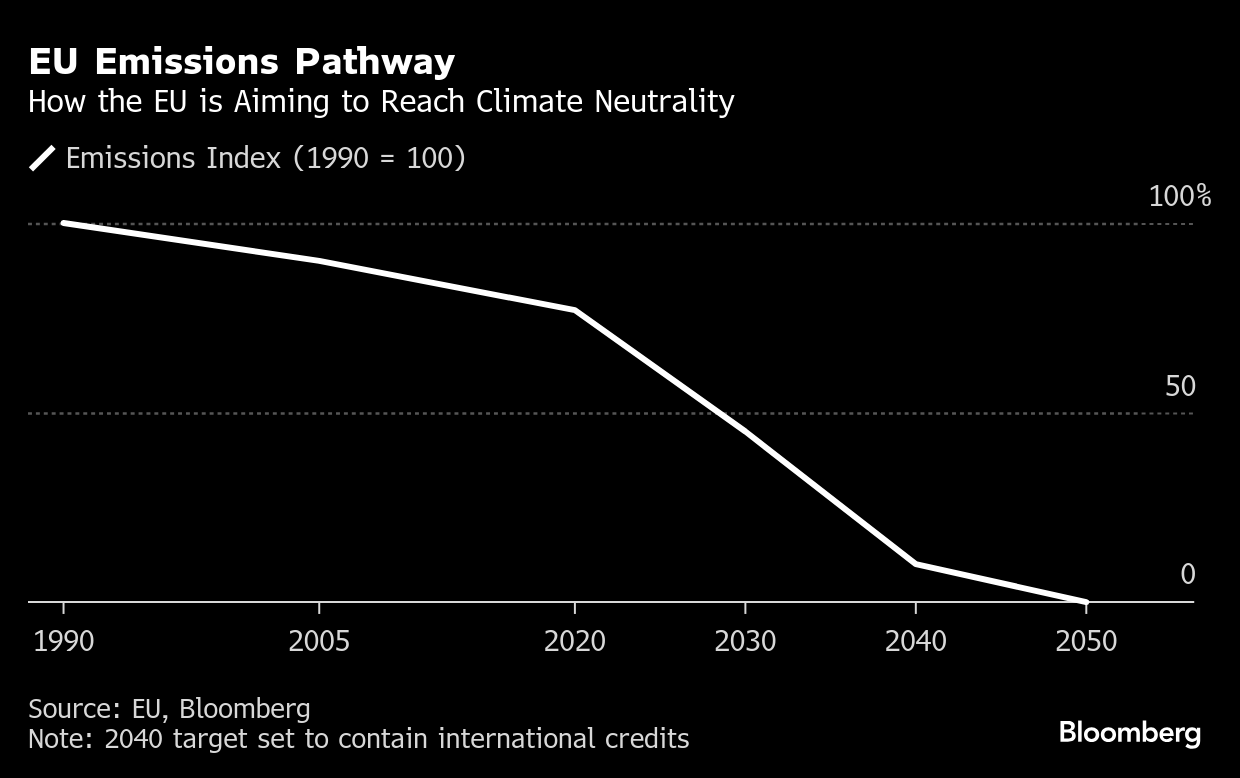
The aim is to secure backing for a goal to cut emissions by 90% by 2040 relative to 1990 levels, as well as sign off on an updated climate pledge to submit to the United Nations, just days before the COP30 summit is due to kick off in Brazil.
Even with assurances over support for key industries, such as steel and cement, a number of European Union countries said they will oppose the target or demand more concessions. The broad consensus on climate action that prevailed five years ago has splintered, giving way to trade protectionism and policies that seek to counter the impact of rising energy costs.
The Czech Republic reiterated its opposition to the 90% target on Tuesday amid concerns about the costs of the transition and a lack of thorough analysis of the impact on various sectors. Hungary and Poland also said they would seek additional flexibilities.
“We do think that we need realistic targets, we do think we need to take into consideration European competitiveness,” Aniko Raisz, Hungarian state secretary for environmental affairs, told reporters before the ministerial meeting.
The plan proposed by Denmark, which is chairing today’s talks as the holder of the EU’s rotating presidency, is to secure a broad majority for the 2040 target and then use it as the basis to agree the UN pledge. An ambitious position on both would show that the EU is still a leader in the fight against global warming, in a marked contrast to the US under President Donald Trump.
Support for the goal of cutting emissions by 90%, and the conditions that underpin it, requires a qualified majority of the EU’s 27 member states. The bloc has traditionally sought to secure backing for new goals from as many member states as possible, while ensuring that the biggest nations, such as France and Germany, are on board.
If an agreement is reached, member states will negotiate with the European Parliament and the European Commission on the final goal. It will be an intermediate objective between two already existing binding targets: net-zero emissions in 2050 and a 55% cut by 2030 compared with 1990 levels.
“The European Union bears responsibility for global climate protection,” German Environment Minister Carsten Schneider said in a statement on Monday, adding that Germany supports the 90% target. “Europe can and will demonstrate that strong climate protection and a strong economy go hand in hand.”
France has secured concessions from the commission, the bloc’s executive branch, on steel and language on technical neutrality, a term often used to open the door to more nuclear power. The EU is also set to make changes to a controversial new carbon market that covers emissions from heating and road transport, known as ETS2, to limit price rises for consumers.
One of the most divisive issues is likely to be the use of international credits generated under Article 6 of the Paris agreement. Poland wants to increase the limit for credits to 10% of the bloc’s baseline net emissions in 1990, compared with the 3% proposed by the European Commission. Some other nations also want to bring forward the starting date for their use from the currently proposed 2036.
Environmental lobbies are also concerned about a review clause that could bring into question the 90% goal for 2040. In a paper circulated to member states last week and seen by Bloomberg, France called for a reinforced mechanism to take into account how much CO2 is being absorbed by natural sinks, potentially leading to a 3% reduction in the goal if removals prove insufficient.
“We are at a critical time where we need to set the direction for the European Union’s path towards climate neutrality and we need to agree to a 2040 climate target,” Sweden’s Climate Minister Romina Pourmokhtari told her counterparts in Brussels. “We need to go to COP with a strong message to get others aboard.”
The EU has already missed key deadlines to submit its climate pledge to the UN and Tuesday’s discussions will likely mark the last opportunity to do so before world leaders meet in the Amazonian city of Belem on Thursday and Friday.
(Updates with comments from ministers from fourth paragraph.)
©2025 Bloomberg L.P.








