

Iran War Gives Xi The Chance to Rekindle Gas Sales With Trump


(Bloomberg) -- As the leaders of the world’s two largest economies meet in Beijing, energy markets will be watching closely for any breakthrough in a dispute that has reshaped global fuel flows: China’s tariffs on US oil and gas.
Shortly after President Donald Trump announced sweeping tariffs in February last year, Beijing retaliated with levies on US energy — 15% on liquefied natural gas and 10% on crude oil. The result was an almost immediate halt in imports of both fuels.
In theory, the US and China should be natural energy partners. The US is the world’s largest LNG exporter and top oil producer, while China is the biggest buyer.
Now, the Middle East crisis may be shifting the calculus. The closure of the Strait of Hormuz has disrupted roughly a fifth of global oil and seaborne gas exports, driving prices higher. For LNG, China has been forced to sharply reduce imports following disruptions to Qatari supply, which accounted for about 30% of its deliveries last year. That could create an opening for US fuel to fill part of the gap.
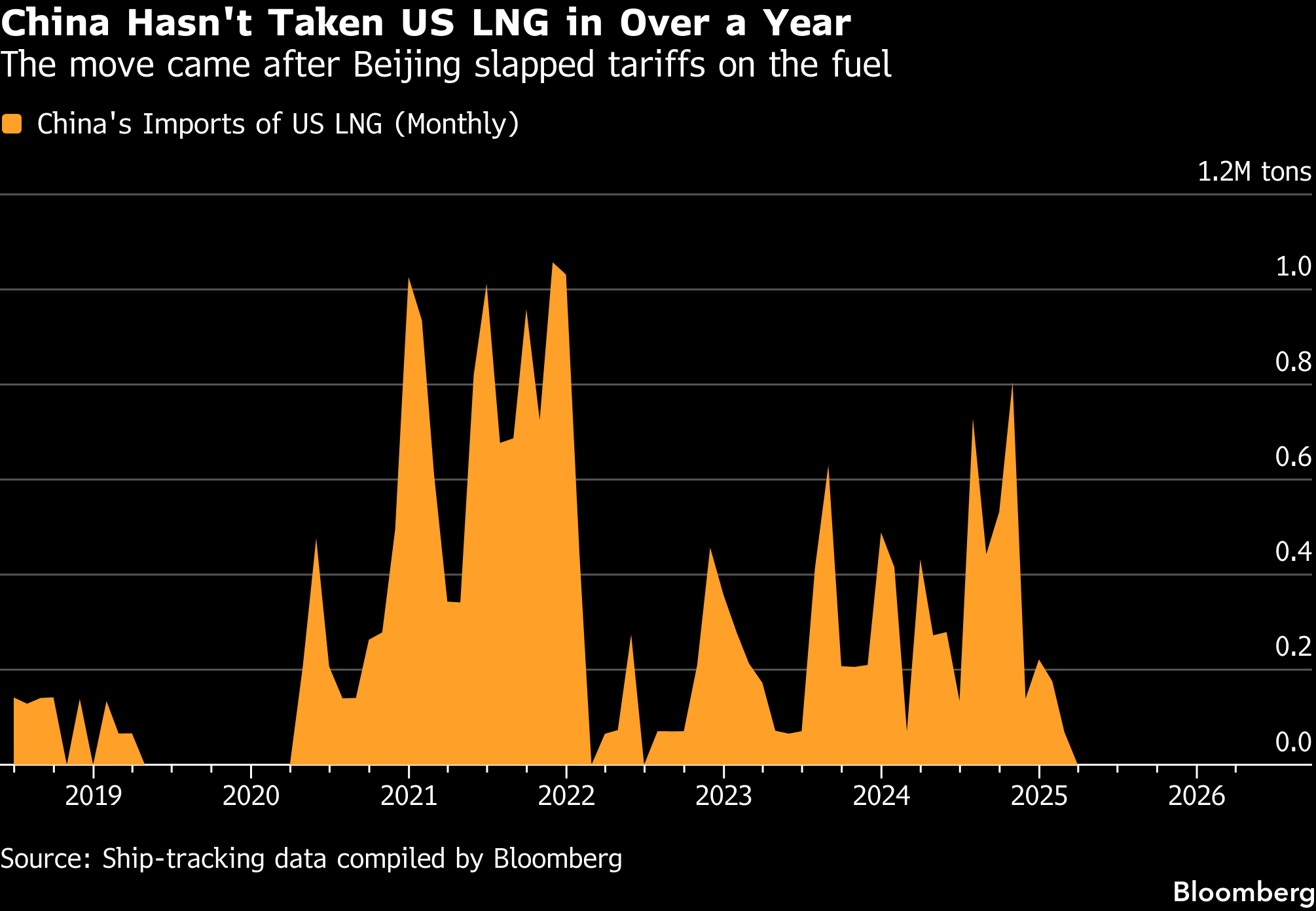
A thaw would also benefit the US, where LNG developers are racing to secure long-term buyers. Chinese demand, with its scale and relative consistency, is viewed as critical to underpinning multi-decade export projects.
“China offers the world’s most predictable demand growth, providing the scale needed to anchor these US infrastructure investments,” Liu Jia, chief expert at the Economics & Technology Research Institute, a think tank at China National Petroleum Corp., told China Daily.
LNG could be one area where China meaningfully increases purchases as a result of the presidential summit.
US export capacity is set to double by 2030, and Chinese companies such as CNPC already hold long-term contracts with existing projects. If Beijing drops its tariffs, buyers could opt to absorb those cargoes domestically instead of diverting them to Europe and other Asian buyers, which is the resale strategy they adopted after the levies were imposed.
Existing Contracts
China has already contracted around 28 million tons per year from current and future American LNG projects, with deliveries scheduled to ramp up by the end of the decade. But Chinese companies have stopped signing new deals with US facilities since the trade war kicked off last year.
Boosting American shipments could make sense. China’s record additions of renewable power require reliable backup to manage intermittency, a role that still depends in part on natural gas. Still, China’s willingness to lift tariffs will depend on what it gets in return, and it remains unclear what concessions the US is willing to offer.
That leaves the chances of a deal uncertain. No major US energy executives were slated to accompany Trump on the trip, and Chinese buyers have spent years diversifying supply after the lessons learned from Trump’s first presidency and his habit of using trade as a political lever.
Energy featured prominently in Trump’s previous visit to China almost a decade ago, accounting for more than half of the $250 billion in announced agreements. Most, however, were non-binding and ultimately fell apart, including an $84 billion pledge by China’s largest coal company to invest in shale gas in West Virginia and a $43 billion venture tied to an Alaskan LNG export project.
On the Wire
Renewable energy manufacturer Jinko Solar Co.’s recent decision to sell control of its Florida facility extends a multi-billion dollar retreat from the US by China’s clean technology firms.
Nouveau Monde Graphite Inc. expects to formally green-light plans this week to build one of North America’s few graphite projects, as countries seek to weaken China’s dominance over the critical mineral.
Solar-plus-storage is gaining on gas in markets including China, according to BloombergNEF. Costs for energy storage systems have fallen so rapidly that they can now help solar plants provide power at parity with gas in some markets.
A Chinese oil supertanker appears to have exited the Strait of Hormuz as it sails toward an area where the US has enforced a blockade, ahead of talks between US President Donald Trump and counterpart Xi Jinping.
This Week’s Diary
(All times Beijing)
Thursday, May 14
- China to release April aggregate finance & money supply data by May 15
- US President Donald Trump visits Beijing for summit with China’s Xi Jinping
- China petroleum IT conference in Beijing, day 2
Friday, May 15
- US President Donald Trump visits Beijing for summit with China’s Xi Jinping
- China petroleum IT conference in Beijing, day 3
- China’s weekly iron ore port stockpiles
- SHFE’s weekly commodities inventory, ~15:30
©2026 Bloomberg L.P.