


The rising imperative for digital engineering in the oil and gas industry

Jun 08, 2026


The oil and gas industry is entering one of the most consequential periods of transformation in its history. Market volatility, rising operational complexity, ageing infrastructure, workforce shortages, and increasing pressure to improve safety and sustainability are forcing organisations to rethink how they design, operate, and maintain assets. Against this backdrop, simulation-powered digital engineering has emerged as a strategic necessity — no longer an optional modernisation effort, but a prerequisite for competitiveness, resilience, and long‑term value creation.
Digital engineering unifies high‑fidelity multiphysics simulation, system modelling, artificial intelligence (AI)‑enhanced analytics, and digital twins across the full asset life cycle. This approach creates a continuous digital thread between design, operations, and maintenance — turning engineering insights into data-driven decisions.
Why digital engineering, and why now?
The oil and gas industry faces a new generation of challenges that exceed the capabilities of traditional engineering processes. Assets are becoming increasingly complex, with interdependent mechanical, thermal, fluid, electronic, and control-system behaviours that cannot be accurately evaluated using isolated tools. This complexity is particularly evident in deepwater systems, liquified natural gas (LNG) infrastructure, electrified and automated production environments, and integrated subsea–surface architectures. As a result, organisations must adopt methods capable of capturing system-wide interactions early in development.
At the same time, uptime remains a critical executive-level metric because even a brief interruption in operations can lead to dramatic revenue losses, heightened safety risks, and cascading supply chain disruption. Simulation-powered digital engineering provides the ability to detect failures earlier, analyse issues more thoroughly, and model a full range of “what-if” scenarios before a change is made in the field. This makes it possible to convert reactive maintenance into predictive strategies, strengthening reliability while reducing downtime and operational costs.
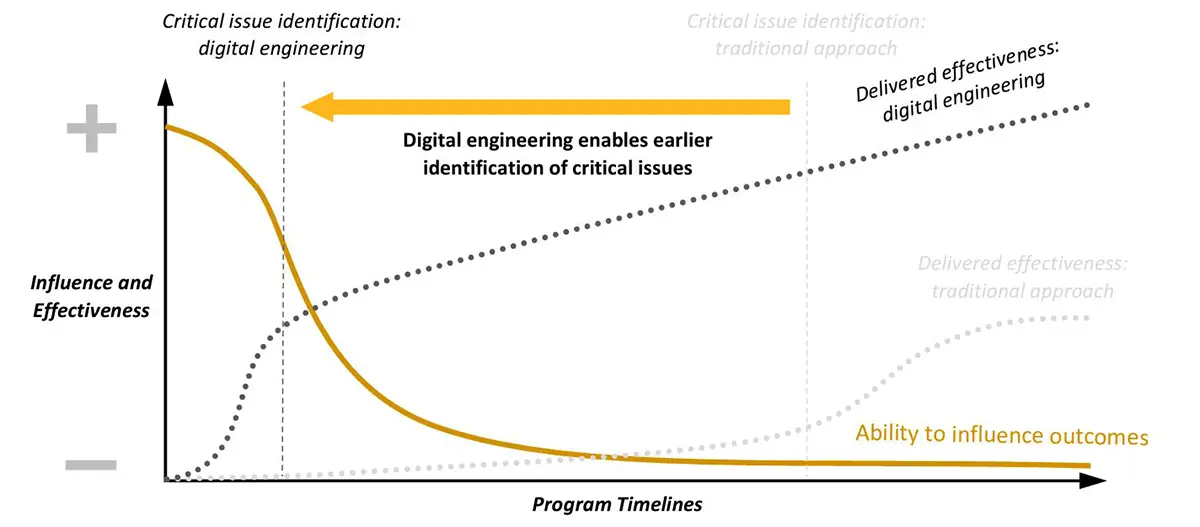
Finally, market pressures are forcing companies to deliver projects faster and more efficiently. Budgets are tightening, energy transition goals are accelerating, and competitive dynamics demand rapid innovation. Digital engineering enables organisations to reduce physical prototyping, streamline engineering workflows, and evaluate far more design variations in less time. Together, these conditions make digital engineering not simply advantageous but essential for competitiveness and long-term resilience.
The role of AI, reduced-order models, and GPUs
AI is reshaping engineering by dramatically accelerating analysis and enabling predictions that were previously too slow or costly to compute. AI models trained on simulation results and field data provide immediate insights into system behaviour, enabling engineers to evaluate performance trends, identify operational anomalies, and optimise designs in near real time. When physics-based simulation is combined with machine learning, organisations can use hybrid models that retain the accuracy of high-fidelity solvers while delivering the speed necessary for operational decision-making.
Reduced-order models (ROMs) extend these benefits by transforming detailed multiphysics simulations into lightweight representations that run in seconds. These models preserve essential physics while enabling rapid scenario testing, real-time digital twin execution, and deployment in the cloud. ROMs are particularly valuable for operators who must assess system stability, evaluate degradation, or test process upsets without relying on computationally intensive full-order simulations.
Solvers accelerated with graphics processing units (GPUs) further unlock new engineering possibilities by drastically reducing simulation runtimes. Workflows that once required hours on CPU-based systems can now be completed in minutes using modern GPU architectures. This performance boost enables engineers to run larger meshes, more detailed multiphysics models, and more extensive design explorations without compromising accuracy.
Together, AI, ROMs, and GPU acceleration make rigorous, high-fidelity analysis scalable and operationally relevant.
A path forward for the industry
As companies face economic uncertainty, shifting energy policies, and ongoing pressure to optimise production, simulation-powered digital engineering provides a unified framework for designing systems, validating performance, and responding to operational
changes with greater confidence and speed. Organisations that adopt these capabilities gain the ability to predict failures before they occur, optimise asset life, and orchestrate decision-making using accurate, data-driven insights.
Energy Connects includes information by a variety of sources, such as contributing experts, external journalists and comments from attendees of our events, which may contain personal opinion of others. All opinions expressed are solely the views of the author(s) and do not necessarily reflect the opinions of Energy Connects, dmg events, its parent company DMGT or any affiliates of the same.