

Oil Slumps Below $100 as US, Iran Agree to Two-Week Ceasefire


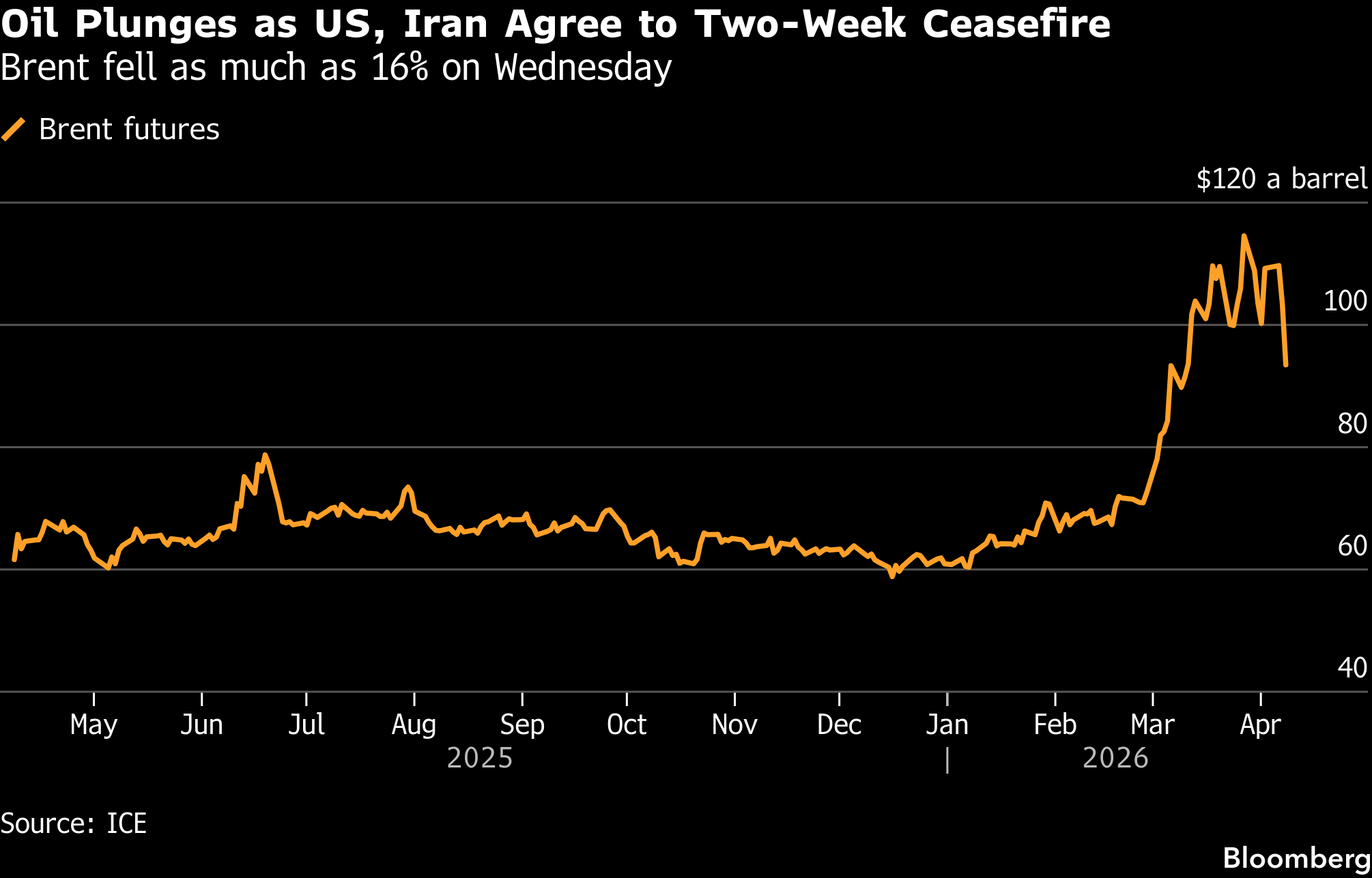
(Bloomberg) -- Oil plunged below $100 a barrel after the US and Iran agreed to a two-week ceasefire that’s expected to halt the American-Israeli military campaign in exchange for Tehran reopening the Strait of Hormuz.
Brent fell as much as 16% before trading around $94 a barrel, while West Texas Intermediate slumped the most in almost six years and was last near $96. President Donald Trump said the ceasefire is subject to Iran reopening the strait, and will allow an agreement “to be finalized and consummated.”
Iran accepted Pakistan’s ceasefire proposal, with safe passage through the strait possible in coordination with the nation’s armed forces for two weeks, Foreign Minister Abbas Araghchi said. Israel also agreed to the pause in fighting, according to a White House official.
The current plan includes allowing Iran and Oman to charge fees on ships transiting through the Strait of Hormuz, the Associated Press reported, citing a regional official. The US will help with traffic buildup in the waterway, Trump said. US and Iranian delegates are invited to meet in Islamabad on Friday to further negotiate a “conclusive agreement,” Pakistan Prime Minister Shehbaz Sharif said on X.
“It would take something truly tremendous for us to get back down below $80 a barrel,” Jason Schenker, president and chief economist at Prestige Economics LLC, told Bloomberg TV. “But almost anything going wrong in these ceasefire talks could very quickly put us back above $100.”
Refined product prices also fell, with benchmark European diesel futures dropping as much as 23% — their biggest decline in more than four years. Futures tied to Abu Dhabi’s flagship Murban crude dropped 19%, the most since the contract’s launch in 2021.
The near-complete closure of the vital waterway — which normally sees the transit of about a fifth of the world’s oil and liquefied natural gas — has roiled energy markets, with WTI still up more than 40% since the conflict started at the end of February. The curtailment of shipments is expected to leave more than 9 million barrels a day of oil output from key Middle Eastern producers shut in during April, according to US government estimates.
“This was a market that had been starved of good news,” said Josh Gilbert, an analyst at eToro Ltd. “We’ve seen an instant selloff in crude, pulling back 16% to under $100 as markets price in the prospect of the Strait of Hormuz reopening. It goes to show how much geopolitical risk was baked into crude, and how quickly it can unwind when there’s a credible path to de-escalation.”
The de-escalation saw volumes surge. Around 240,000 Brent contracts changed hands in the first hour of trading of the global benchmark, while a typical session may see just a few thousand lots within that time period.
Physical traders remain cautious, waiting for clearer signs the ceasefire will hold before seeking cargoes from the Gulf. Meanwhile, shipowners said they needed to see vessels safely exit the region before sending in tankers. At present, there are more than 800 ships that have been trapped by the war.
“Oil can fall further as key details of a ceasefire deal are provided to the market,” said Vivek Dhar, an analyst at Commonwealth Bank of Australia. “How much Iran pushes its hand will be closely watched and may limit further material falls in oil prices.”
Trump’s ceasefire announcement came about 90 minutes before his initial deadline for Iran to reopen the strait or face a massive bombardment. The lead-up was marked by military escalation and bellicose threats from the US president, including a post saying “a whole civilization will die tonight.”
Earlier in the day, American forces struck sites on the Islamic Republic’s Kharg Island similar to those that were hit in a round of attacks last month, but didn’t target energy infrastructure, according to US officials.
©2026 Bloomberg L.P.