

Glencore’s Traders Score Big Profits as War Rattles Energy Markets


(Bloomberg) -- Glencore Plc’s trading team made bumper profits as the Iran war roiled global commodity markets, with surging prices helping to put the firm’s marketing unit on course for one of its best-ever results.
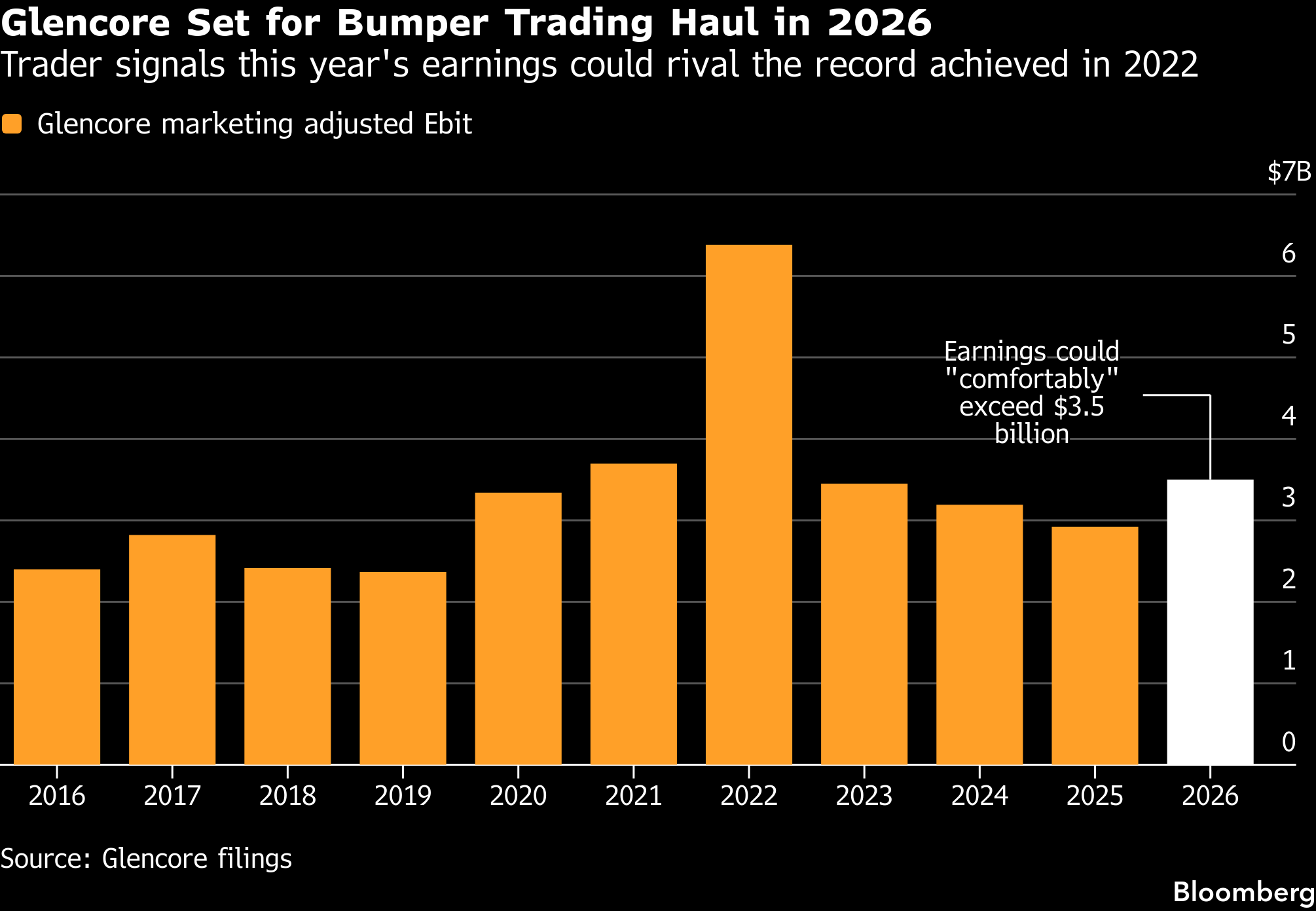
Based on its first-quarter performance, full-year core earnings from the company’s trading unit would “comfortably” exceed the top end of its long-term guidance, which is set at $3.5 billion, Glencore said in a trading update on Thursday.
The business made $2.9 billion last year, and earnings significantly above $3.5 billion would put it on course for its best result since a record haul of $6.4 billion in 2022.
Commodity-trading houses are reaping bonanza profits as the conflict creates huge dislocations across energy markets, with immediately-available cargoes of oil and fuel products trading at huge premiums after the near-closure of the Strait of Hormuz triggered a global race to secure physical oil.
Industry leader Vitol Group told banks it made about $2 billion in the first quarter, Bloomberg reported earlier this month, while Trafigura Group, the second-largest oil trader and leading metals trader, enjoyed two of its best-ever quarters in the six months through March.
A rise in metals prices is also boosting Glencore’s mining business, with a rally in copper, zinc and coal helping to offset the impact of higher fuel and sulfuric acid costs on its industrial operations, it said.
“While the Middle East conflict has created numerous dislocations, particularly around the supply of crude, refined products and sulphuric acid, our energy marketing business has supported the supply of fuels to our assets,” Chief Executive Officer Gary Nagle said in a statement. “Although the impact of the conflict on our industrial business was limited in the first quarter, recent and emerging impacts are now manifesting.”
The company produced nearly 200,000 tons of copper in the first quarter, up 19% year-on-year, as it benefited from higher grades at mines in Africa and South America. Steelmaking coal production dropped 22%, while energy coal output fell 2%, the company said.
Cobalt production plunged 39% to 3,700 tons, mainly due to the Democratic Republic of Congo’s introduction of an export-quota system in late 2025. After administrative delays, Glencore exported the greater part of its 2025 quota in the first quarter, with the balance exported this month.
Glencore’s shares were 0.8% higher as of 8:30 a.m. in London, as oil rallied and global equity markets traded lower on the risk of a further escalation in the Iran conflict.
(Adds chart and additional details from eighth paragraph.)
©2026 Bloomberg L.P.