

China’s Crowded Solar Industry Pivots to New Areas of Growth


(Bloomberg) -- China’s solar industry is tacitly admitting something it has feared for years: it doesn’t know how to escape chronic overcapacity that has weighed on profits.
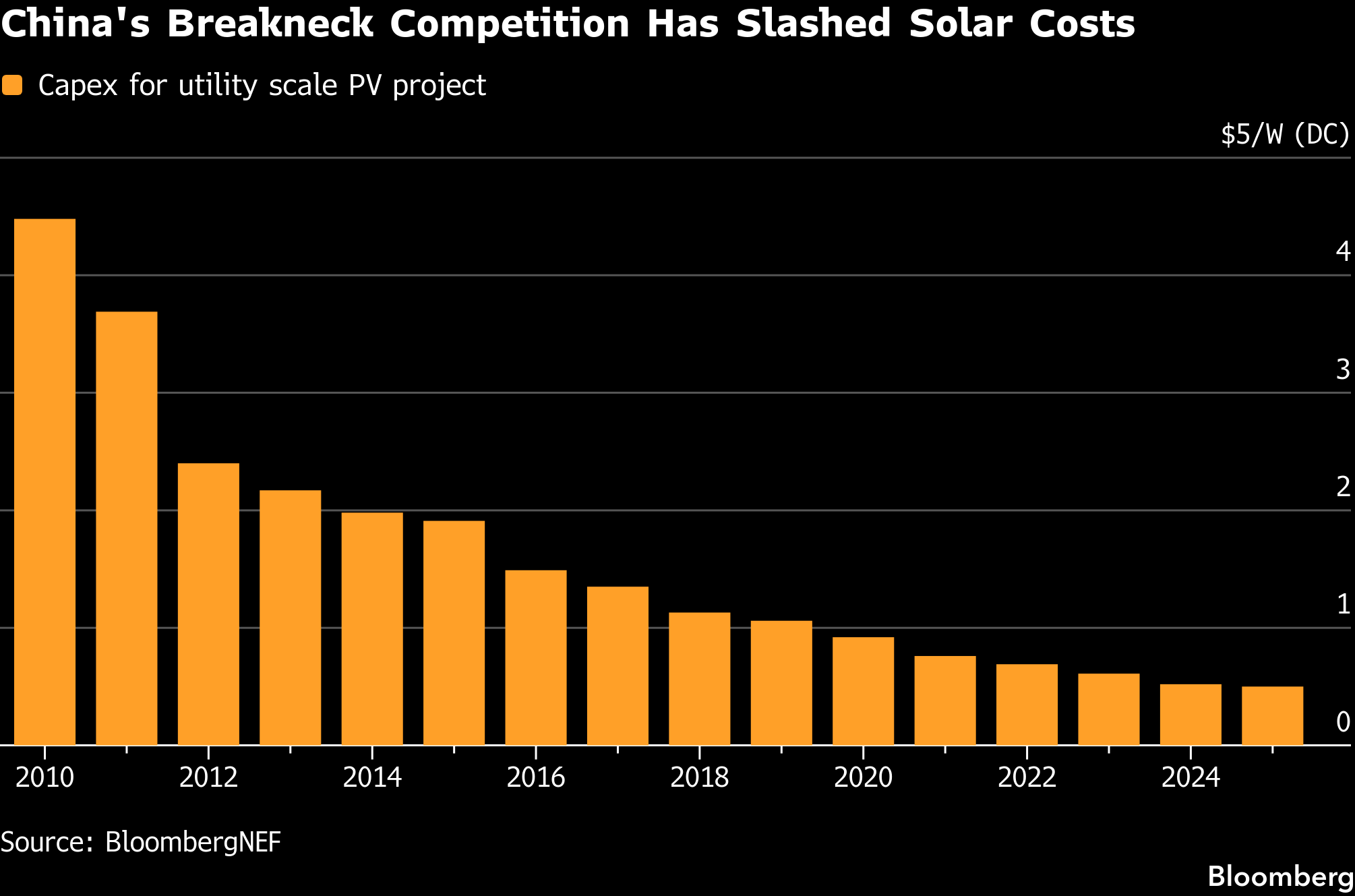
The main message from executives at the world’s largest solar conference in Shanghai this week was an acknowledgment that the sector should shift to new areas of growth, like batteries or even projects in space. A relentless race to outdo rivals has created a glut of manufacturers that, while helping drive down solar-panel prices and fueling a global clean-energy boom, has left producers mired in losses for more than two years.
“The entire industry is locked in a zero-sum game, with only one outcome — fighting in the mud leaves no winner,” Zhu Gongshan, chairman of GCL Technology Holdings Ltd., said at the SNEC PV+ conference. “The past strategy — centered on expanding production, cutting prices, and chasing scale — has reached its physical limits.”
Chinese solar companies have proposed a number of measures over the last few years in an attempt to reduce output and set a price floor. Their efforts, however, have been unable to curb excess capacity or deliver a meaningful recovery in prices.
Against that backdrop, executives are now focusing increasingly on energy storage as a potential escape route. The traditional concept of a standalone solar manufacturer will gradually fade as companies seek to capture growing demand for batteries, particularly from power-hungry data centers, said Zhu.
Longi Green Energy Technology Co., China’s largest solar-panel maker by market value, entered the storage business only late last year. The company is now aiming for a storage division that will grow to the same scale as its solar business within about five years.
Still, the rush into batteries has prompted concerns that the industry could repeat the mistakes that led to today’s solar glut. Several executives at the conference cautioned that investment is already pouring into energy storage at a pace that risks creating another oversupplied market. The government has also delivered such warnings.
“All those who are involved in solar are now focusing on energy storage,” Shi Zhengrong, founder of Suntech Power Holdings Co., said during a panel discussion. “I don’t know whether this is a good thing or a bad thing. But looking at the current trend, it makes me feel a bit scared.”
Some executives are looking even further ahead. GCL’s Zhu pointed to space-based solar power as a potentially vast source of future demand.
While the concept remains largely theoretical, solar panels deployed in orbit could support about 200 gigawatts of demand from space-based data centers over the next decade, Dennis Ip, an analyst at Daiwa Capital Markets Hong Kong Ltd., wrote in a note earlier this year.
In a more speculative scenario, lunar artificial intelligence facilities could eventually create more than 10,000 gigawatts of demand — roughly equivalent to current global electricity consumption.
Thirteen founding members, including GCL, Trina Solar Co. and several research institutes, used the opening day of the conference to launch the Space Energy Development Alliance. But industry groups caution that such projections remain far removed from commercial reality. The China Photovoltaic Industry Association, the main solar lobby, has said that most space-solar technologies are still confined to laboratories or early-stage testing.
Key Data Points:
- Polysilicon prices in China resumed a decline this week, with a shift in market sentiment driven by high inventory pressure and changing supply expectations, according to a weekly note from the China Silicon Industry Association
- Prices fell as much as 1.7% in the week through Wednesday, with the most expensive N-type material retreating to 34,700 yuan ($5,122) per ton
- Output in June is expected to rise to 91,000 tons, while demand from downstream wafer producers is estimated at 87,000 tons
- Wafer prices were steady in the week through Thursday, with the most expensive N-type G12 product priced at 1.17 yuan per slice
- Solar cell prices were at 0.31-0.33 yuan per watt and module prices at 0.71-0.75 yuan per watt, both unchanged from a week earlier
What Happened This Week:
- Jinko Solar Co. said it signed 10 agreements during the SNEC PV+ conference to provide modules to China, the Philippines, Bangladesh and Pakistan
- Co. didn’t provide details of the total volume of those orders
©2026 Bloomberg L.P.








