

China Crosses Energy Milestone as Coal Falls Below 50% of Power


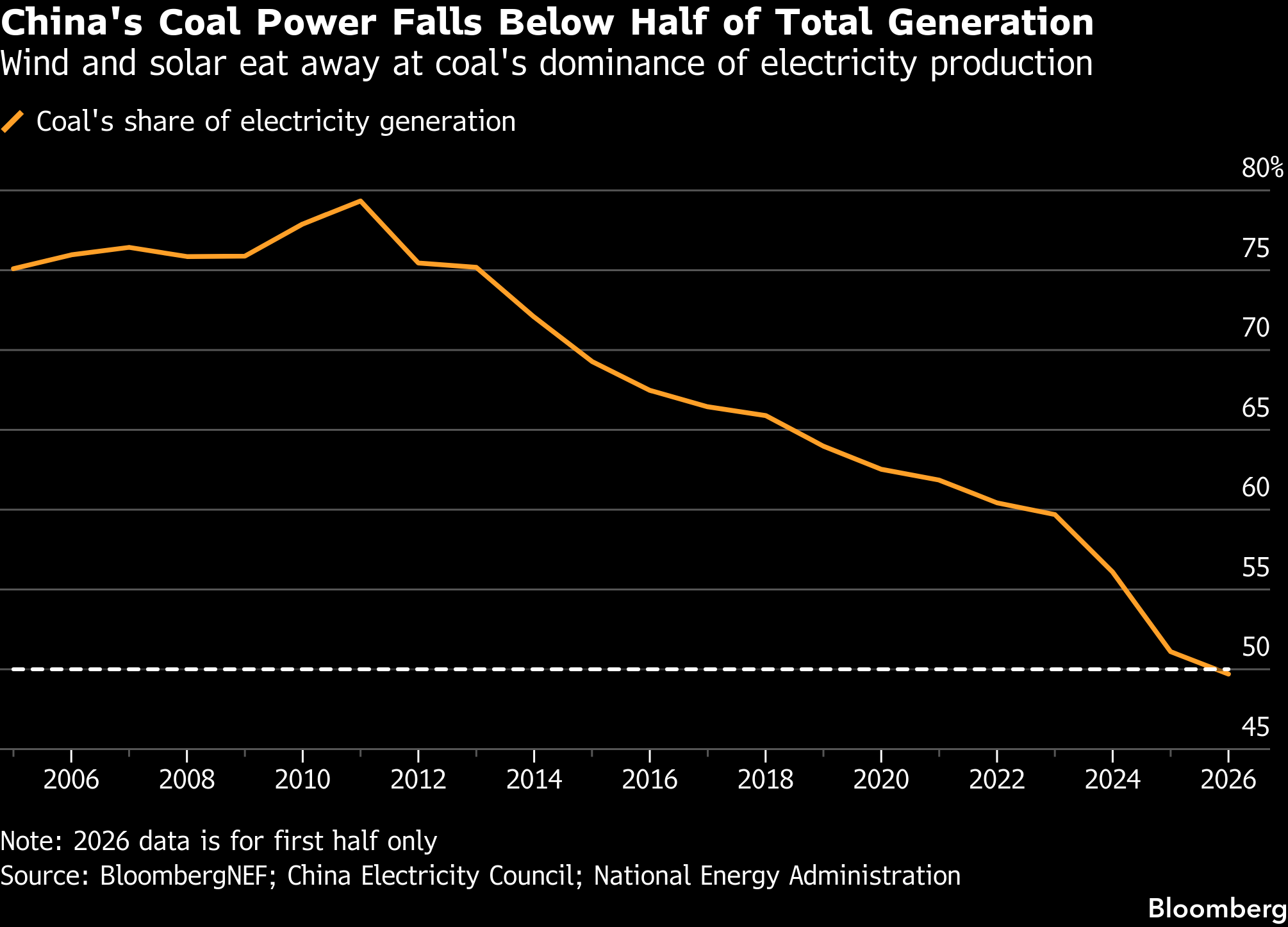
(Bloomberg) -- Less than half of China’s electricity came from coal in the first six months of the year for the first time, a symbolic milestone in the country’s shift toward cleaner energy.
Coal-fired plants accounted for 49.7% of electricity output from January through June, according to the National Energy Administration. Renewable sources supplied more than 40%, with wind and solar alone generating nearly a quarter of the total, officials said at a press briefing Thursday.
China has spent years expanding wind and solar, while keeping coal at the heart of its power system to avoid electricity shortages. The country is the world’s largest greenhouse gas emitter and burns more coal than the rest of the world combined, but is also the biggest producer of renewable energy. Any lasting shift away from coal would carry implications well beyond China’s borders.
“This is a phased achievement resulting from the long-term replacement of fossil-fuel generation by non-fossil energy, marking a new breakthrough in China’s green and low-carbon energy transition,” said Xing Yiteng, deputy director-general of the administration’s Department of Development and Planning.
Even so, coal use is still rising in absolute terms. Output from thermal power plants increased in the first half as electricity demand grew, partly driven by high-tech manufacturing, electric-vehicle charging and data centers. Coal’s share fell as cleaner sources expanded even faster.
The rapid expansion of renewable energy is also exposing weaknesses in China’s electricity network. Renewable projects are increasingly being forced to cut output because the grid cannot absorb all the electricity they produce.
Solar utilization fell to 91.4% in the first half from 94.3% a year earlier, while wind slipped to 90.9% from 93.5%, Pan Huimin, deputy director of the administration’s renewable energy department, said at the same briefing.
Beijing is ramping up investment in the power system to ease grid bottlenecks. Spending on grid infrastructure rose 14% in the first half from a year earlier, while investment in energy storage climbed 74%.
Battery systems are also being used more frequently, averaging 1,195 hours of operation in 2025, nearly double the level in 2023.
©2026 Bloomberg L.P.








