

Deutsche Bank Says China Is Energy ‘Winner’ in Age of War


(Bloomberg) -- As war injects extreme volatility into oil and gas markets, the global race for energy security is making China stronger, according to Jacky Tang, emerging markets chief investment officer at the private banking arm of Deutsche Bank AG.
“China is the winner in this war from an economic standpoint, from an energy mix standpoint,” he said in an interview.
The prediction feeds into a complex picture. Bruegel, a think tank, says China’s reliance on oil imports from Iran is set to pose a “severe test” for its energy strategy. At the same time, the country’s status as the world’s largest producer of clean tech puts it in a unique position to help governments now desperate to wean themselves off Middle East imports, according to the Deutsche Bank executive.
Longer term, Tang says “everybody knows” that the world “cannot rely on oil.”
He says it’s a realization that will force a reset in Asia, the biggest importer of Middle Eastern oil. Japan, Korea and India are now all more likely to look for ways to diversify their energy mix, and the equipment needed to achieve that diversification will inevitably come from China, Tang said.
As the conflict in the Middle East veers between existential threats and a fragile ceasefire, volatility in oil and gas prices has skyrocketed. The promise of a two-week break from fighting offered relief on Wednesday morning, with the reopening of the Strait of Hormuz listed as a condition of the deal. Next steps, however, remain highly uncertain.
For now, the Strait of Hormuz remains largely closed, pushing up the price of Brent crude. “The situation remains fluid,” analysts at Goldman Sachs Group Inc. said in a note.
Against that backdrop, governments will continue to work toward energy independence. China, which remains the world’s largest consumer of coal, is rapidly building out its clean-tech sector as part of its goal of achieving energy independence.
Low-carbon sources now account for close to 40% of the country’s electricity generation, compared with about 25% a decade ago, according to a February report by Ember. And renewables make up almost 50% of installed power capacity, Barclays Plc estimates.
“A decade of renewable build-out and electrification have materially reduced China’s exposure to energy shocks,” a Barclays team led by Jian Chang, the bank’s chief China economist, said in an April 8 note to clients. The upshot is that oil and gas are “now playing only a minor role in power generation” for the country, she said.
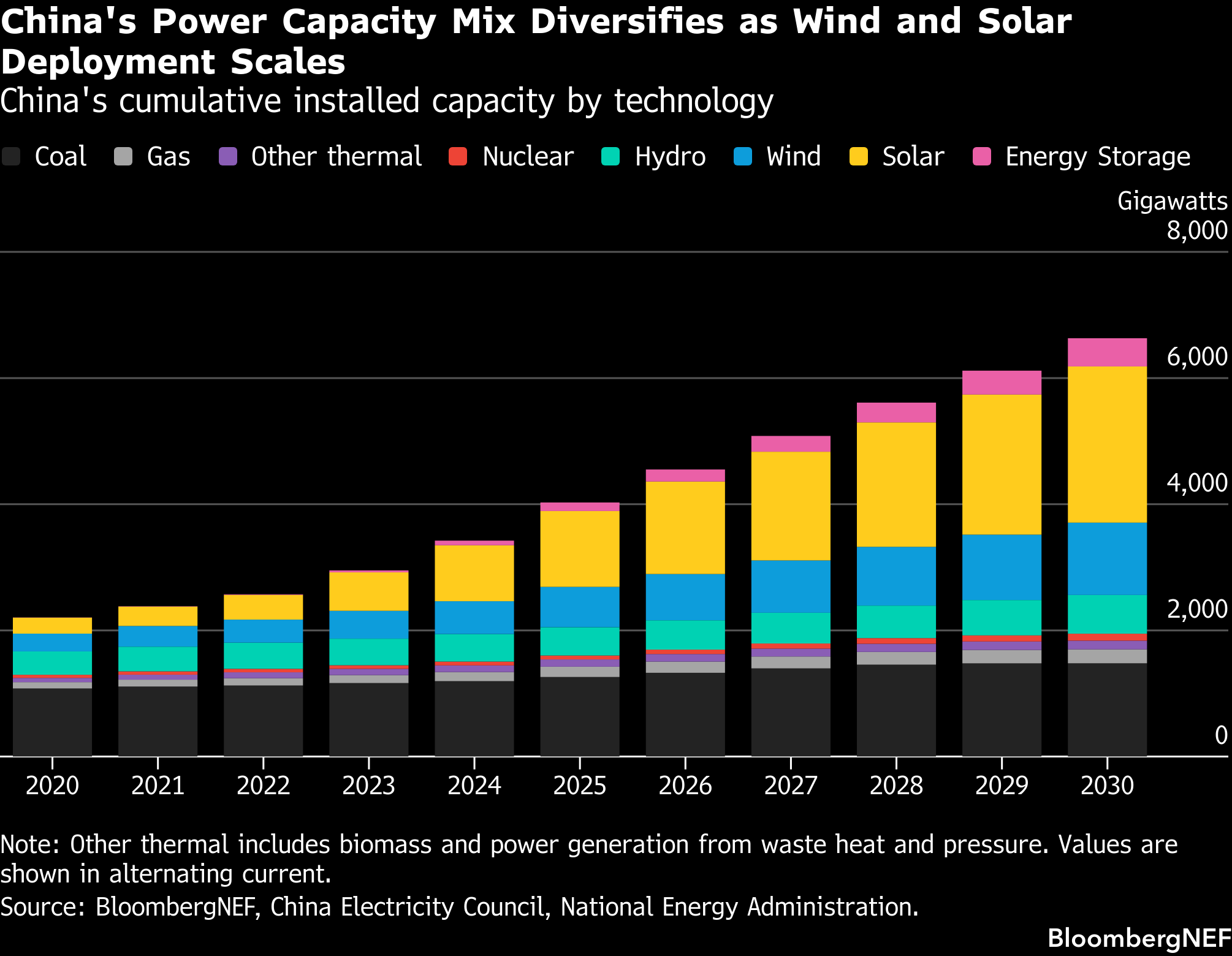
China’s long-term “focus on electrification” is making it more resilient to energy price shocks, according to a Lombard Odier note sent to clients this month. And its build-up of strategic oil reserves has created an effective short-term buffer against rising oil prices, the Lombard Odier note said.
Tang says a new wave of demand for renewable energy would sift out clean-tech winners, after years of hyper-growth drove down prices to levels at which some companies could no longer compete.
“The issue in China is that the competition is fierce,” Tang said. “The winners will be those guys with healthy balance sheets, with healthy fundamentals, with pricing power.”
Equipment exporters with margins that can absorb higher costs — and a cash flow that allows them to do mergers and acquisitions — will fare best, Tang said. He also says Deutsche is advising its private banking customers to seek out companies that are less indebted than their peers.
“For a lot of those infrastructure companies, unfortunately, the gearing ratio is high because they are small cap, and they need money from a bank,” Tang said.
A typical client portfolio tends to have about 10-15% of their Chinese equity allocation in clean energy stocks, he said. “We try not to be massively overweight because there is still a lot of volatility.”
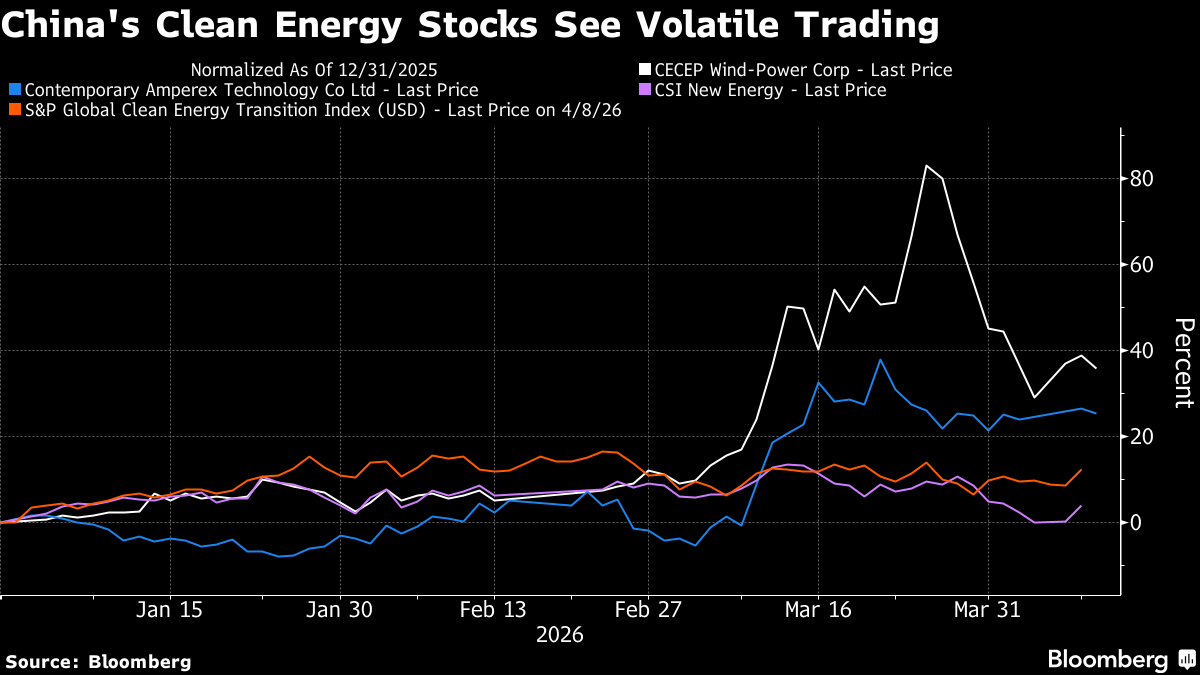
Chinese stocks were among the top performers on the S&P Global Clean Energy Transition Index in the first few weeks of the war, but the gains have since evaporated for most.
Shares of Sungrow Power Supply Co., one of the world’s largest energy storage firms, climbed more than 20% after the Iran war began before shaving off nearly a third of their value due to disappointing earnings.
Wind power generation equipment makers Goldwind Science & Technology Co. and Ming Yang Smart Energy Group have also seen their stocks mostly plunge in recent sessions. Meanwhile, shares of battery giant Contemporary Amperex Technology Co. and electric car maker BYD Co. are still higher by about 28% and 8% in Hong Kong, respectively.
To deal with over-supply in its clean-tech sector, China’s government has embarked on an anti-involution campaign. Its latest five-year plan downplayed the solar sector, and it’s also canceling or reducing export tax rebates on products including solar cells as countries have called out trade imbalances.
“China is quite determined to make sure that prices stay at a competitive level and at the same time, that companies can survive,” Tang said.
(Updates with latest developments in seventh paragraph; adds stocks from 18th.)
©2026 Bloomberg L.P.








