

OPEC+ members agree to third consecutive monthly output increase


OPEC+ has agreed on a modest oil output increase for June in the group's first meeting since the UAE's exit.
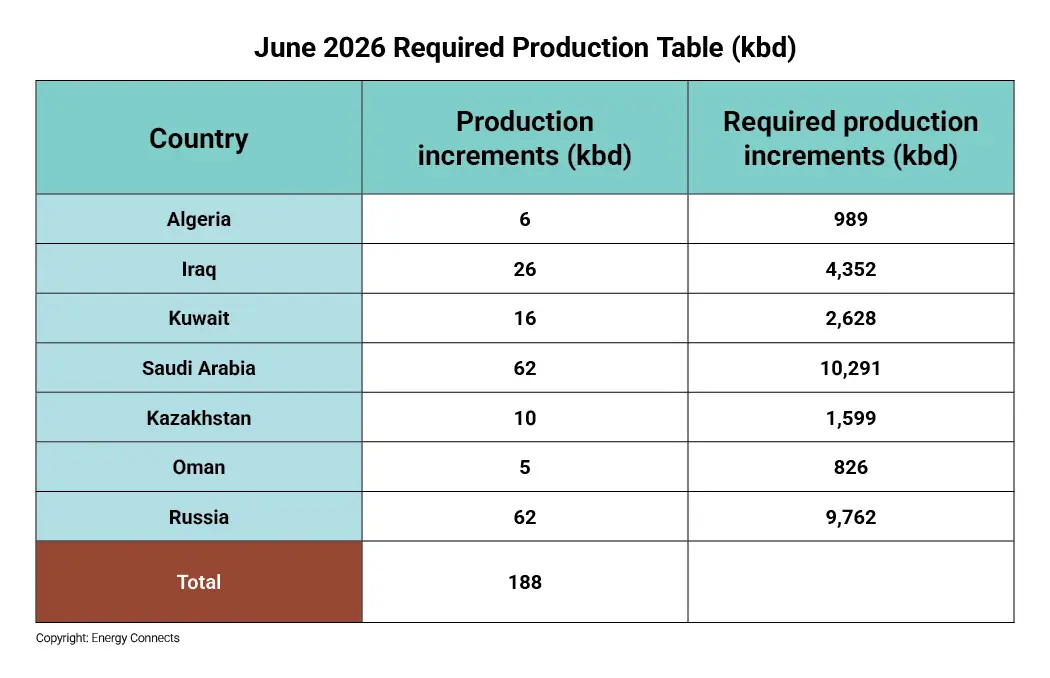
During the May online meeting, seven OPEC+ countries agreed to hike oil output targets by 188,000 bpd next month. The third consecutive monthly increase equals that agreed for this month, minus the share of the UAE, which quit OPEC and OPEC+ on 1 May.
Hike viewed as symbolic
The Iran war ceasefire remains in place, but Gulf oil supplies are still prevented from passing through the Strait.
Analysts said the latest OPEC+ “on paper” increase signals a business-as-usual approach, illustrating the cartel is poised to boost supplies once the conflict ends.
Jorge Leon, analyst at Rystad, said: “OPEC+ is sending a two-layer message to the market: continuity despite the UAE’s exit, and control despite limited physical impact.
“This is less about adding barrels and more about signalling that OPEC+ still calls the shots.”
First post-UAE agreement
Saudi Arabia, Iraq, Kuwait, Algeria, Kazakhstan, Russia, and Oman met on Sunday. With the UAE now out, OPEC+ has 21 members, including Iran, although in recent years only those seven nations plus the UAE — the world’s seventh-largest oil producer — have been involved in monthly production decisions.
Crude oil output from all OPEC+ members averaged 35.06 mbpd in March, down 7.70 mbpd from February, OPEC said previously, with Iraq and Saudi Arabia cutting most due to constrained exports.
UAE also leaves OAPEC alliance
The Organisation of Arab Petroleum Exporting Countries (OAPEC) announced on Sunday that the UAE had also exited the intergovernmental alliance. Formed in 1968 to boost cooperation among Arab oil exporters, it does not set production policies for its members.
UAE state news agency WAM said the UAE’s earlier decision to leave OPEC would enhance its “flexibility to respond to market dynamics while continuing to contribute to stability in a measured and responsible manner.” The UAE reassured it would “continue to act responsibly, bringing additional production to market in a gradual and measured manner, aligned with demand and market conditions”.
Independent oil strategy
Vandana Hari, Founder of Vanda Insights and Energy Connects columnist, suggested that a UAE OPEC exit could hasten post-Hormuz market normalisation, combining the ability to ramp up with export flexibility.
She said it was pumping about 3.4 mbpd before the war began on 28 February and claims a maximum capacity of 4.85 mbpd. Further expansion to 5 mbpd is targeted by 2027. “That spare capacity — freed from the constraints of coordinated output policy — will position the UAE as a key driver of supply recovery following a reopening of Hormuz,” Hari added.
Amena Bakr, Head of Middle East Energy and Opec+ Insights at Kpler, expects the UAE to produce oil well above pre-war levels.
“They want the flexibility of not having a quota … producing whatever quantity they want,” she commented.