

Oil Holds Weekly Gain as Trump Says Iran Blockade Is Working


(Bloomberg) -- Oil held its second weekly gain as US President Donald Trump said he was sticking with a naval blockade of Iranian ports, elevating concerns the vital Strait of Hormuz would not reopen anytime soon.
Brent for July rose above $111 a barrel, while West Texas Intermediate was near $106 — up 12% this week. In a written statement, Iran’s supreme leader Mojtaba Khamenei cast doubt on the likelihood of a deal with the US, vowing not to give up the Islamic Republic’s nuclear or missile technologies, and signaling Tehran would keep control of the strait.
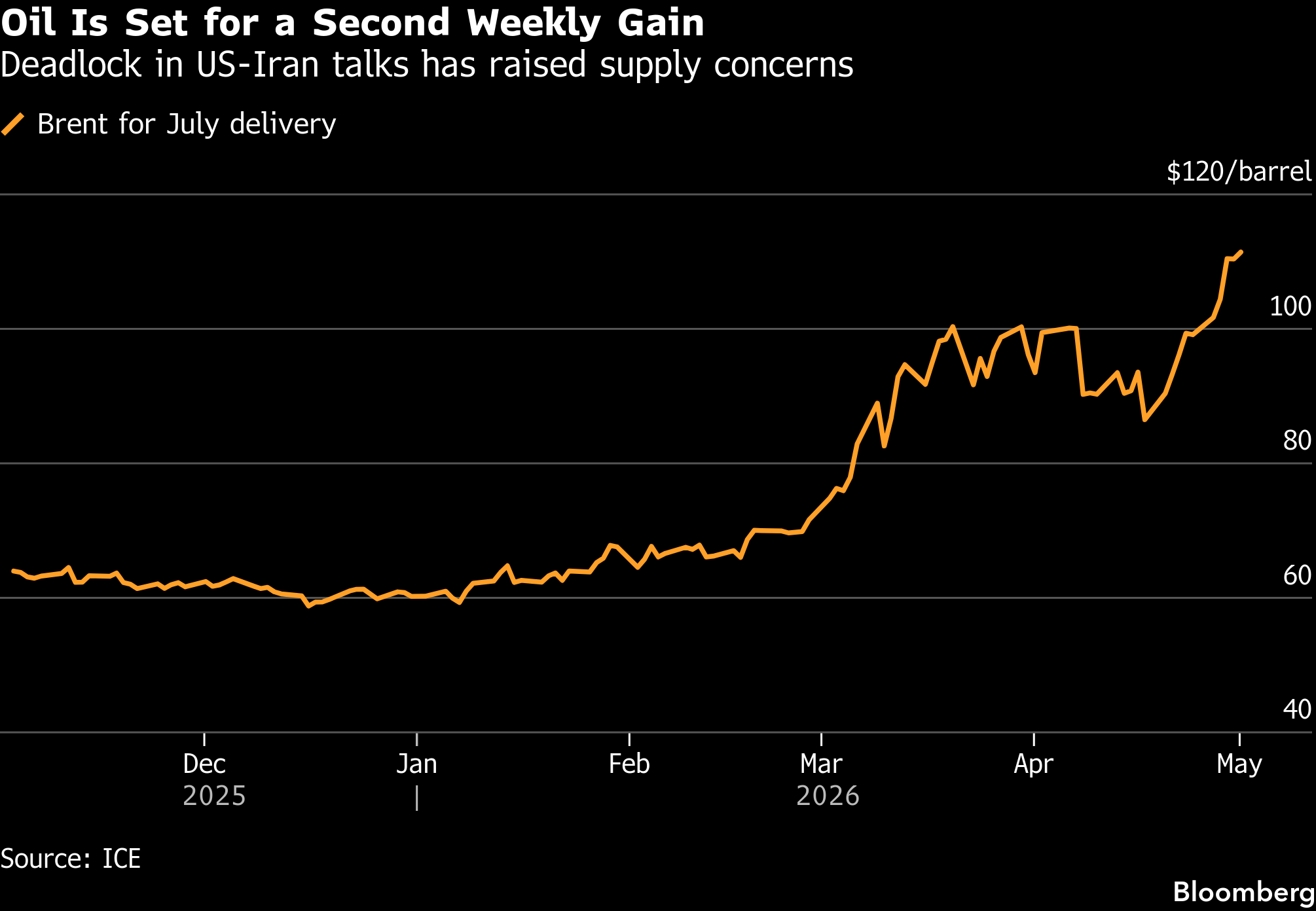
Oil has soared more than a quarter over the past two weeks as the deadlock in negotiations extends the near-total closure of the crucial waterway, which before the war carried about a fifth of the world’s crude. The uncertainty over future supply has seen sharp price swings, and a flattening of the futures curve.
“Selloffs are approached cautiously, but the bandwagon fills up on moves higher,” said Carl Larry, an oil and gas analyst at Enverus. “Every day continues to be an adventure, but also a chance to make money...quickly.”
Volumes were below normal in Asian trading. Markets are closed in many nations — including China, Singapore, Germany, France and Brazil — for Labor Day.
Meanwhile, Japan’s top currency official said authorities in Tokyo are maintaining readiness to intervene in the crude oil futures market, where speculative moves have been affecting the currency. Japan stepped into the currency market on Thursday to buy yen and bolster the currency, according to a person familiar with the matter, which caused the biggest drop in the Bloomberg Dollar Spot Index since January.
ConocoPhillips is warning of imminent “critical shortages” of oil for some nations as the war enters its third month. The supply pinch appears likely to significantly worsen as soon as June, Chief Financial Officer Andy O’Brien told analysts during a conference call on Thursday.
“The markets sort of had a bit of a grace period initially when the tankers that left the Persian Gulf in late February were still on the water; now all of those have reached their destination,” O’Brien said. “We are going to start to see some import-dependent countries potentially start to face critical shortages as we get into the June-July time frame.”
Meanwhile, the gap between paper and physical prices is narrowing as tangible domestic tightness begins to materialize for the first time since the war began. US crude exports surged to a record last week as global buyers tapped American producers for barrels to replace lost supply from the Middle East.
©2026 Bloomberg L.P.