

Oil Edges Up After Plunging on Optimism Over US-Iran Agreement

(Bloomberg) -- Oil inched higher after plummeting on Wednesday, as President Donald Trump said the US is in the “final stages” with Iran.
Brent neared $106 a barrel after sliding 5.6% on Wednesday, while West Texas Intermediate was around $99. Trump’s comments to reporters stoked hopes for a deal between Washington and Tehran that would see a near-term restart of energy flows through the critical Strait of Hormuz.
Conflicting headlines about the status of negotiations have buffeted oil this week, and prices are still more than 40% higher than when the war started at the end of February. Still, traders have consistently priced in the possibility of an abrupt deescalation, including a deal under which Iran reopens the key shipping lane and unlocks millions of barrels stuck in the Persian Gulf.
Though a peace deal with Iran stands to sink prices, “the physical markets are still in disarray,” said Joe DeLaura, global energy strategist at Rabobank. “It takes up to 55 days to get oil from the Persian Gulf to its destination, which means inventories will still be drawing during that period.”
Even if the Iran conflict ended immediately, Middle East oil flows would not fully recover until well into 2027, Abu Dhabi National Oil Co. Chief Executive Officer Sultan Al Jaber said Wednesday. The Strait of Hormuz closure was the most severe supply disruption on record, he said.
Already, global stockpiles of crude oil and products are being drawn down at a record pace this month as the war drags on, curtailing supplies, according to Goldman Sachs Group Inc.
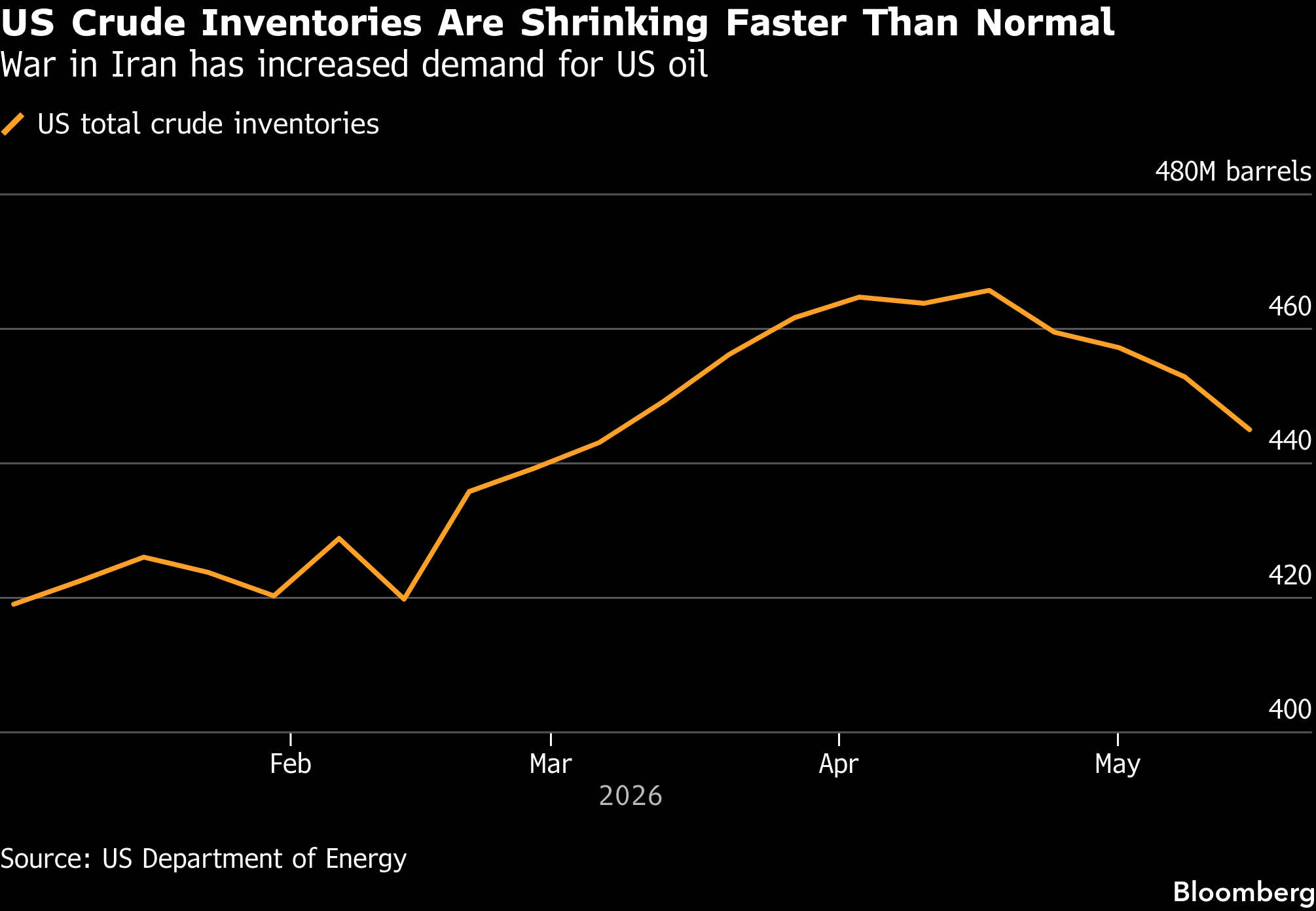
US crude inventories slid by about 7.9 million barrels last week, broadly in-line with earlier estimates from a widely followed industry group. Exports were shy of recent record-high levels, as overseas buyers stock up on American oil to offset disruptions to Middle East supply.
Some nascent signs of higher flows through the strait are also siphoning risk premium out of crude prices. Three oil supertankers appeared to attempt to cross the waterway, the latest in a small uptick in traffic after a relative lull in recent days. Iran claimed 26 ships passed in the last 24 hours, though it has previously suggested far larger transit numbers than ship-tracking indicates.
Trump said on Wednesday “we’ll see what happens” with Iran, adding that a deal will be made or “we’re going to do some things that are a little bit nasty, but hopefully that won’t happen.” He has repeatedly threatened to restart strikes on Iran if it doesn’t agree to his peace terms.
Iran is reviewing the US’s new draft in response to Tehran’s 14-point proposal and is yet to give a response, the semi-official Tasnim news agency reported, citing a source close to the country’s negotiating team. Earlier in the day, Iran warned it would retaliate beyond the Middle East if the US or Israel attacks it again.
©2026 Bloomberg L.P.








