

Jet Fuel’s War Surge Vindicates Airlines That Hedged


(Bloomberg) -- The surge in the cost of jet fuel since the start of the Iran war is highlighting the vast disparity in how well individual airlines protect themselves against a price spike.
It’s not unusual for an oil-price shock to become an existential crisis for some carriers. The Iran war is no different, with the forecast hit to profits so far in the billions of dollars. But there’s a stark difference between those that hedged well, those that hedged poorly and those that didn’t hedge at all.
While airlines including Ryanair Holdings Plc and Air France-KLM have reported that hedging offset some of the price increases, other carriers from US giant United Airlines Holdings Inc. to smaller AirAsia X Bhd are more exposed.
The sticking point for some airlines is that, just like buying home or auto insurance, hedging costs money. Airlines buy derivative contracts that will in theory rise in value, offsetting the increased price of jet fuel. Most of the time, that money goes down the drain when the market is calm, just like a homeowner’s fire insurance. For an industry that often runs on relatively thin margins, that extra cost counts.
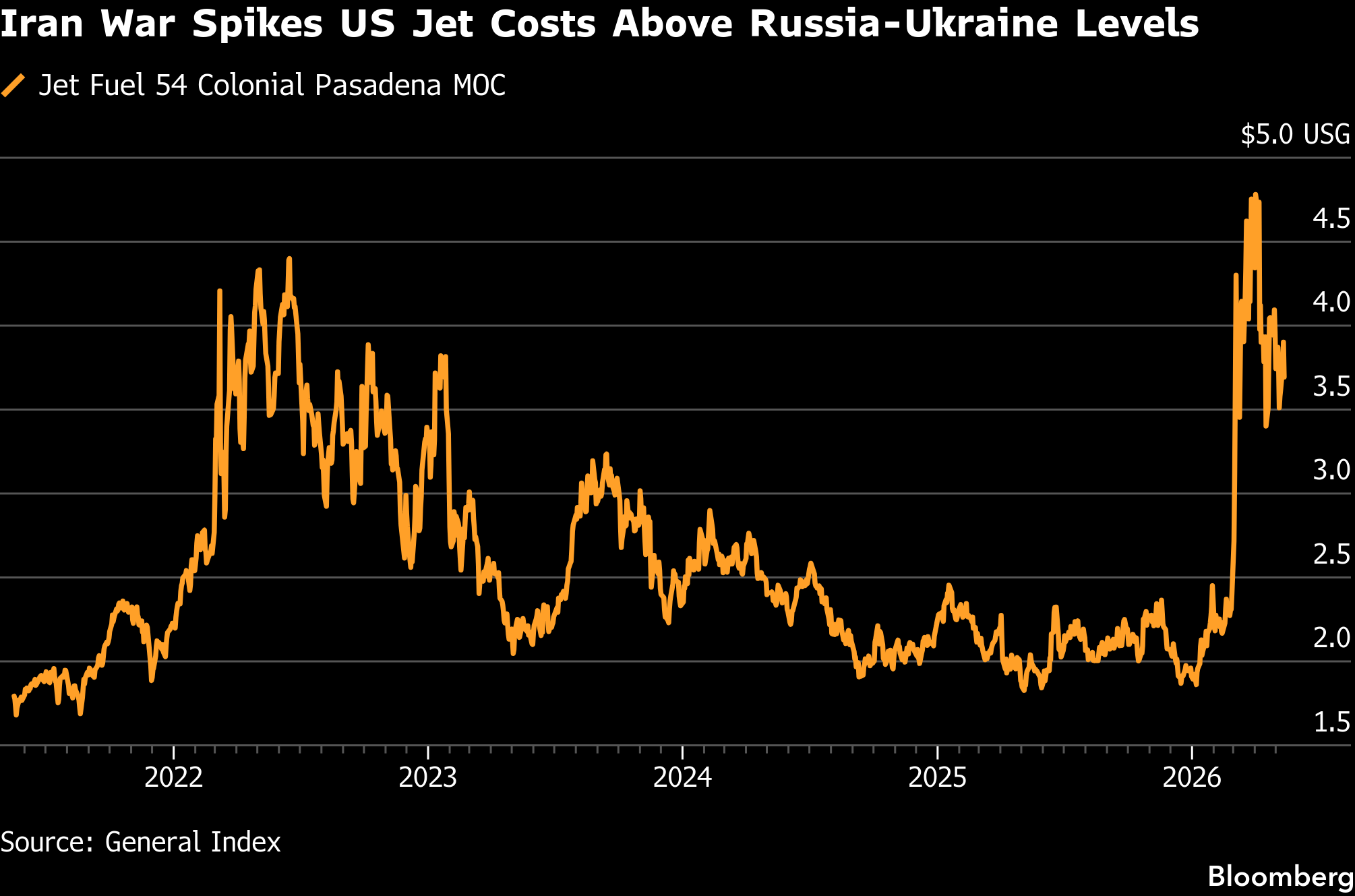
It’s only when supply is squeezed and prices shoot upward that the hedges pay off. Like now, as the war in Iran has jet fuel now trading around $160 a barrel, more than 60% higher than before the war.
While many European and Asian airlines use derivatives to lock in their jet fuel costs, peers in the US have been historically reticent to do so. The level of coverage typically varies among carriers, ranging at the end of last year from 30% to 80% and potentially even higher. Also, the instruments they use for the hedge make a huge difference in how well-protected they are.
“We continue to be well-hedged for the rest of the year,” Luis Gallego, chief executive of International Consolidated Airlines Group, which includes British Airways and Iberia, said on a recent earnings call. “This allows us to protect customers to some extent from the volatility and allows us to take, considered decisions on pricing and capacity.”
So far, the fuel crunch hasn’t been as bad as feared. That’s in part because refineries, particularly in the US, have ramped up output and shipped record volumes overseas, helping fill the supply gap from the Middle East. But while there may be enough barrels to go around, they don’t come cheap.
Ryanair said last week that it currently holds jet fuel and carbon derivatives contracts worth €2.1 billion ($2.4 billion) that are partly a result of a hedging program that locked in 80% of its fuel needs at $67 a barrel. Air France-KLM said late last month that while its fuel bill is likely to rise by $2.4 billion this year at current prices, that’s expected to be about $1.5 billion lower than it would otherwise have been.
The amount of money on the table is enormous. Facing mountainous fuel bills, carriers are passing on higher costs to consumers. Cathay Pacific Airways Ltd. said in late March that hedges on 30% of its fuel haven’t been enough to cover rising costs. The carrier imposed fuel surcharges, some of which have been partly rolled back.
On the other end of the spectrum is AirAsia, which doesn’t hedge. It’s shares have fallen 42% since the war began, the worst-performing member of the Bloomberg World Airlines Large, Mid & Small Cap Index.
Brent Hedging
Some in Europe and Asia hedge using Brent crude oil as a proxy for jet fuel. Typically, oil and its byproducts move largely in tandem as long as the market is relatively balanced between supply and demand.
Brent crude is a market full of buyers and sellers on an exchange — it’s liquid, in market parlance — reducing the costs related to hedging. Hedging using gasoil or even jet fuel itself, sometimes in over-the-counter markets that are far less liquid, tends to cost more.
The problem is when there’s a shock. In March and April, the closure of the Strait of Hormuz cut off supply of jet fuel to the market from Middle East refineries, as well as the types crude oil popular with Asian refiners. That forced some to reduce operating rates, further curbing fuel supply.
“The real killer was crack spreads,” said Zameer Yusof, head of clean petroleum products analytics at Kpler. “Brent crude hedging wouldn’t have protected you from Singapore jet fuel margins blowing out past $100 a barrel — and that’s where Asian carriers’ exposure was concentrated.”
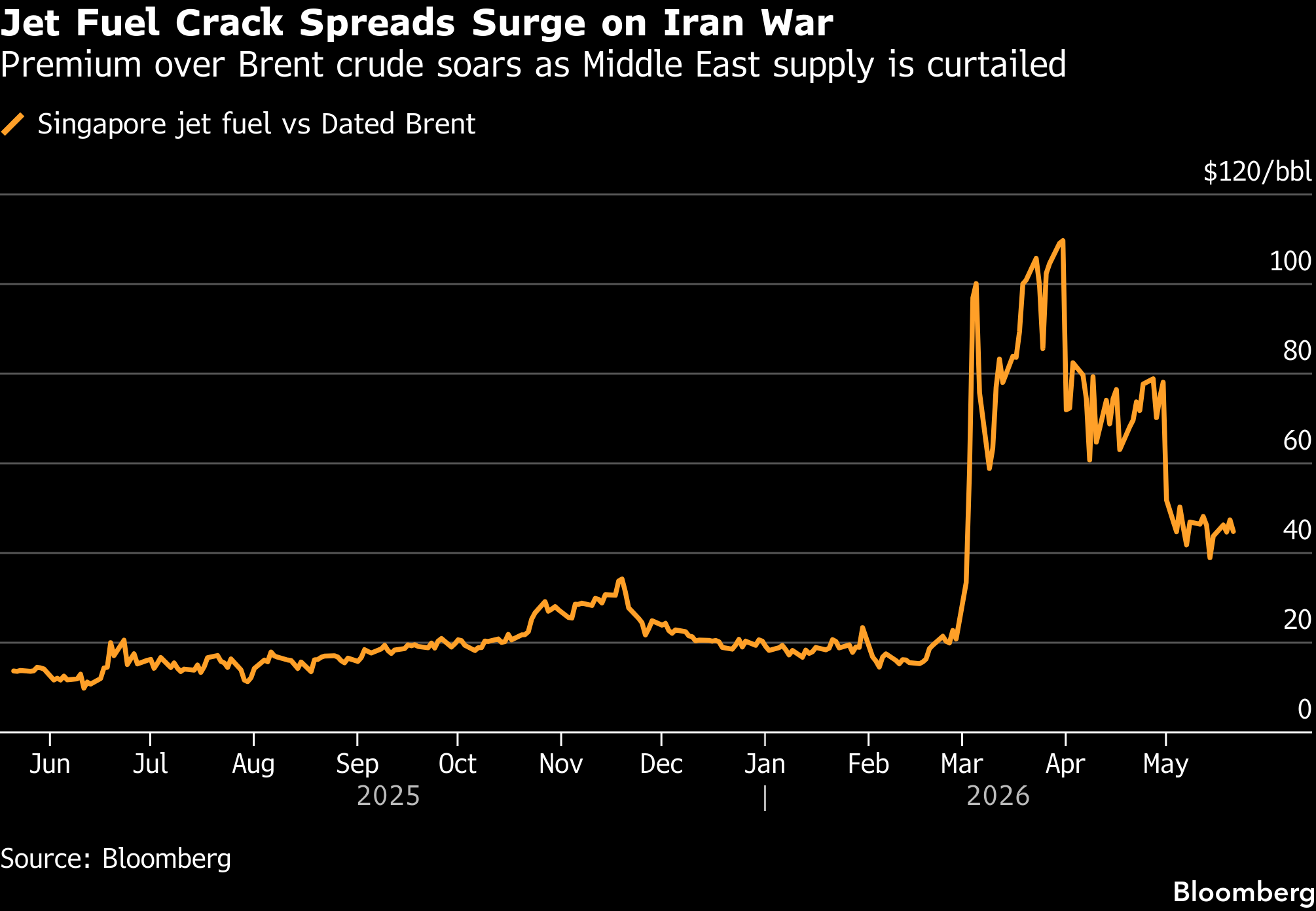
Since jet fuel is a relatively small market, the supply crunch drove prices up as much as 150% in Singapore, for example, compared with the 63% rally in Brent crude futures. As that gap, known as the crack spread, blew out, the gains on the crude contracts bought as a hedge failed to keep pace with the higher physical jet fuel prices that the airlines were having to pay every day.
“If they hedge Brent, they’re not hedging jet fuel,” Michael Leskinen, Executive VP and CFO at United Airlines, said in an earnings call last month, referring to non-US carriers. “The biggest portion of the move in jet fuel has been crack spreads. So I think this experience has proven once again that hedging is a poor policy.”
The crisis has already claimed Spirit Airlines, which wound down operations due to the soaring prices after a government bailout fell through. It might not be the last one, with Ryanair CEO Michael O’Leary warning there may be more corporate “casualties” to come among European airlines if the war continues.
For Southwest Airlines Co., the last major US airline to buy protection, it’s the first fuel crunch they’ve entered into without a hedge for decades. The carrier ended its hedging program last year after deciding that it was too costly to run over the long term.
Southwest said the policy, which began in the 1990s, saved it over $3.5 billion from 1998 to 2008 but that higher levels of market volatility in general meant that the cost of doing so no longer outweighed the benefit.
“Hedging had become very expensive,” Chief Executive Officer Bob Jordan said on an earnings call late last month. “You can’t predict an extraordinary circumstance like a war. If we all could, you’d hedge and then you wouldn’t, and it’s unreasonable to think you could do something like that.”
Delta’s Refinery
To be sure, one airline without a hedging program is arguably doing better than anyone else. Delta Air Lines is the best-performing carrier in the airline index, with shares up 13% since the war began. The edge: A refinery outside Philadelphia that it purchased 14 years ago. It supplies about 15% of Delta’s jet fuel needs while selling or swapping gasoline and diesel in the market.
“The refinery directly supplies a portion of our jet fuel needs, and its economics partially offset higher cracks, reducing the all-in price we pay for jet fuel,” Dan Janki, Delta’s chief operating officer, said in April on an earnings call, adding that that the refinery would save the company about $300 million on fuel in the second quarter.
If prices remain high and volatile, it’s likely to remain unattractive for many carriers to add to their hedges.
“We’ll monitor the market closely, and when we see an opportunity, we include some new contracts,” Murat Seker, chairman of Turkish Airlines, said on the company’s most recent earnings call. “But overall, we are not continuing our regular hedge policy as the jet price and then the Brent price are very high.”
(Corrects speaker’s title in final paragraph of story published May 21)
©2026 Bloomberg L.P.








