

Ukraine’s Biggest Strike on Moscow Spurs Fuel Shortage Fears


(Bloomberg) -- After the shock of Ukraine’s biggest drone attack on the Russian capital, Muscovites face rising gasoline prices and possible fuel shortages.
The reality of four years of war pushed deeper into everyday life on Thursday when a swarm of nearly 200 drones hit Moscow’s oil refinery. Residents were stunned by images of thick black smoke rising over the city’s south, the shutdown of major roads and airports, and reports of black rain falling in some districts.
As the immediate shock faded, many Muscovites turned their attention to a more practical concern: Will the region have enough fuel and how much will it cost?
Some drivers in several Moscow districts and near the capital were already reporting gasoline prices rising to more than 90 rubles ($1.23) per liter on Thursday, compared with about 70 rubles before the attack. Some Muscovites said they encountered shortages and long lines at the pump. Residents in Moscow’s outer suburbs also reported that some filling stations had stopped selling gasoline in jerry cans.
Some level of gasoline shortage in the Moscow region is unavoidable, according to Sergey Vakulenko, a senior fellow at the Carnegie Russia Eurasia Center in Berlin and a former Russian oil executive. There may be a short-lived decline in gasoline sales to 80% to 90% of normal levels, with the duration depending on the speed of repairs, he said.
“The authorities will do everything they can to bring fuel in from other regions,” Vakulenko said. “However rail capacity is not unlimited, and nearby refineries have also been damaged.”
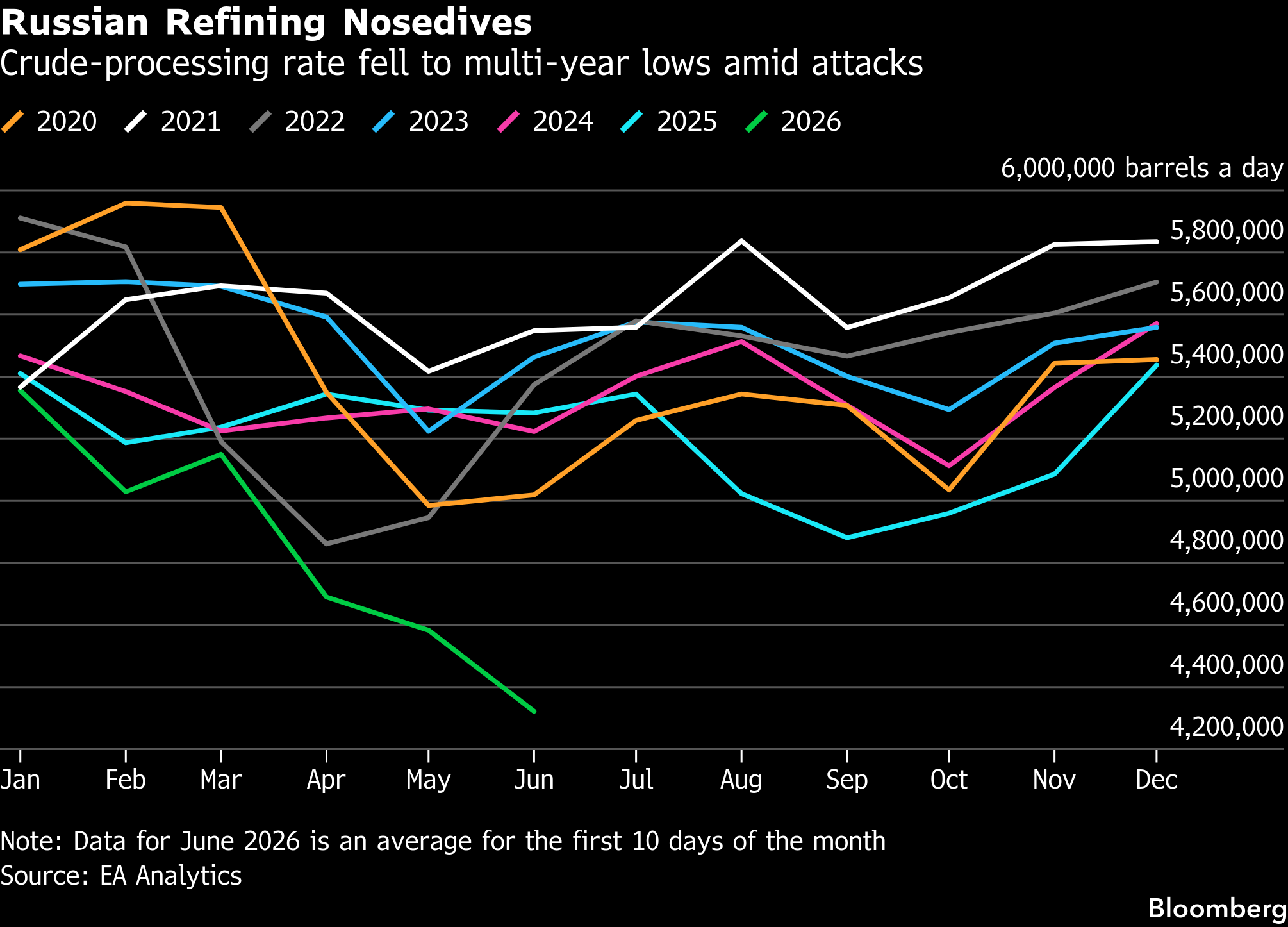
Kyiv has significantly stepped up attacks on oil infrastructure in recent months, with the Moscow refinery alone hit twice this week. Russia’s crude-processing rates have fallen to their lowest level in two decades so far in June, according to estimates by EA Analytics, part of industry consultant Energy Aspects Ltd.
Before Thursday’s attacks, the cost of fuel was already rising in Russia. Average retail gasoline prices increased 1% week-on-week to 69.11 rubles a liter in the June 9-15 period, according to data published by the Federal Statistics Service late Wednesday. That was the biggest jump since early January, weekly data show.
Authorities across Russia have sought to reassure motorists that the situation is under control.
Deputy Prime Minister Alexander Novak held a meeting on the domestic fuel market on Friday and stressed that reliable and timely supplies, as well as continuous monitoring and control of prices, remain the main focus, according to a government statement. After gasoline prices rose at some Moscow-area filling stations, the country’s antitrust service requested pricing and sales figures from two fuel retailers.
According to data compiled by a service that tracks retail gasoline sales, prices at major refueling chains including Gazprom Neft, Rosneft, Lukoil and Tatneft remained near the regional averages seen before the Thursday attacks.
Traffic restrictions imposed in southeastern Moscow after the drone strikes have gradually been lifted, according to the city’s administration.
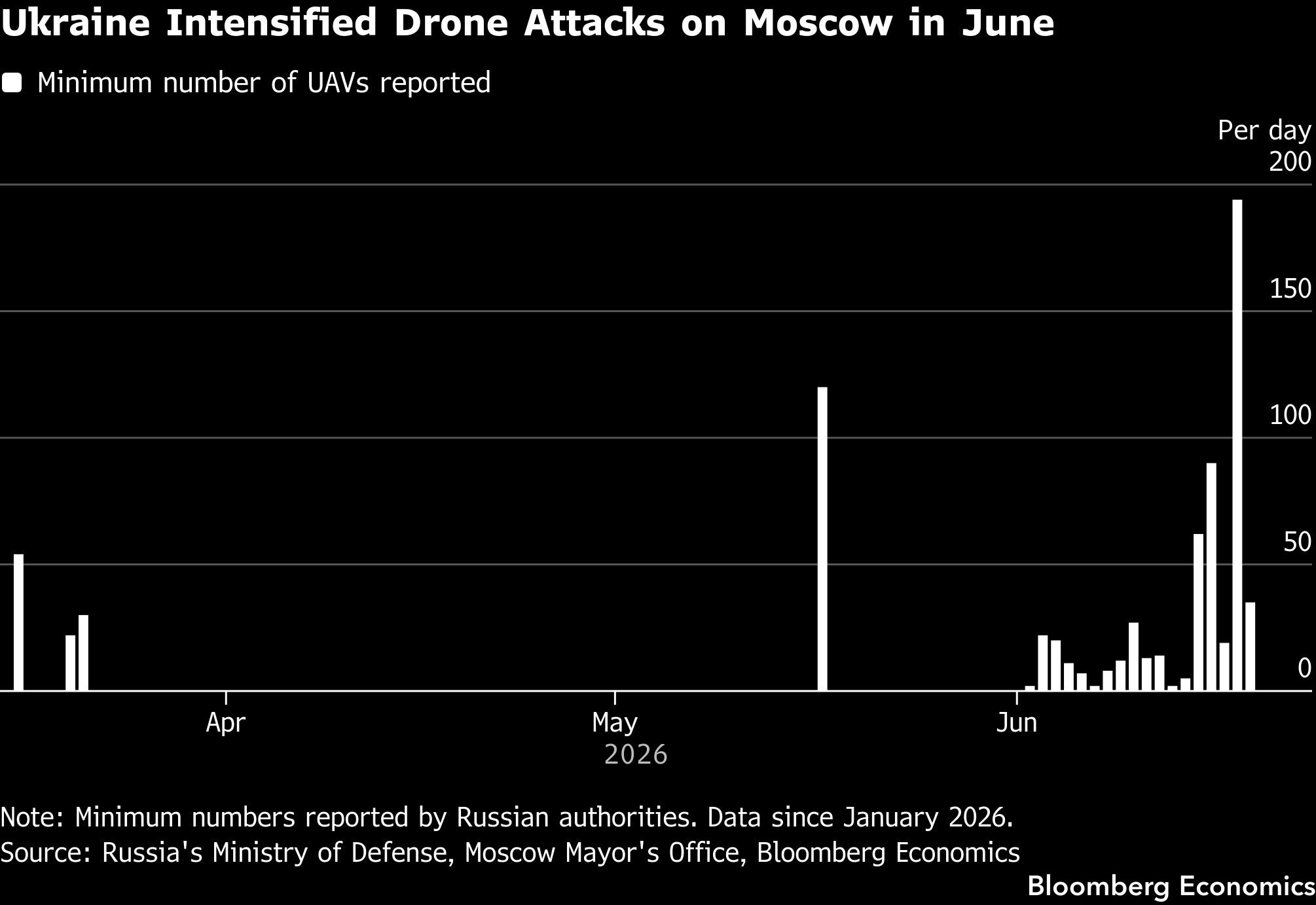
Russia’s biggest airline, Aeroflot, canceled about 170 flights on Thursday, while more than 500 flights in total were canceled or delayed at Moscow airports. Airports experienced further disruption on Friday, as Moscow’s mayor said that the capital’s air defenses repelled more than 70 drones.
Moscow authorities said air quality in the capital remained within normal limits even after the refinery fire, which burned for much of the day. Mayor Sergei Sobyanin said the blaze had been mostly contained by about 3 p.m. local time on Thursday, while firefighters continued working to extinguish remaining hot-spots. He has not provided any updates since then on whether the fire has been fully extinguished.
Following Thursday’s strike on the Moscow refinery, a complex crude-processing unit and four tank reservoirs were damaged, Ukraine’s General Staff said in a Telegram statement on Friday.
Authorities and federal media largely played down the incident, with reports about the Moscow refinery fire receiving only brief coverage on major television channels.
Kremlin spokesman Dmitry Peskov brushed aside questions about the drone attack on Moscow, urging reporters to focus instead on what he described as the “impressive” results of Russian strikes on Ukraine. Peskov also said President Vladimir Putin receives daily reports on developments across the country, indicating he had been informed about the attack.
The disruption to fuel supplies and transportation show how, more than four years after Russia launched its full-scale invasion of Ukraine, the war’s impact is increasingly visible in everyday life, with no let-up in sight.
“This is the new reality, and it’s an unpleasant one,” said Elena, a 47-year-old owner of a small restaurant in Moscow. “But I have a business here, nowhere else to go, and I can’t stop the war.”
(Updates with number of drones repelled below second chart)
©2026 Bloomberg L.P.








