

China Taps Commercial Oil Stockpiles to Help Weather Gulf Shock


(Bloomberg) -- China has started tapping its commercial crude reserves to help offset the supply shock from the Iran war, although the world’s biggest oil importer is continuing to prioritize lower refinery use and fuel export limits to manage the fallout.
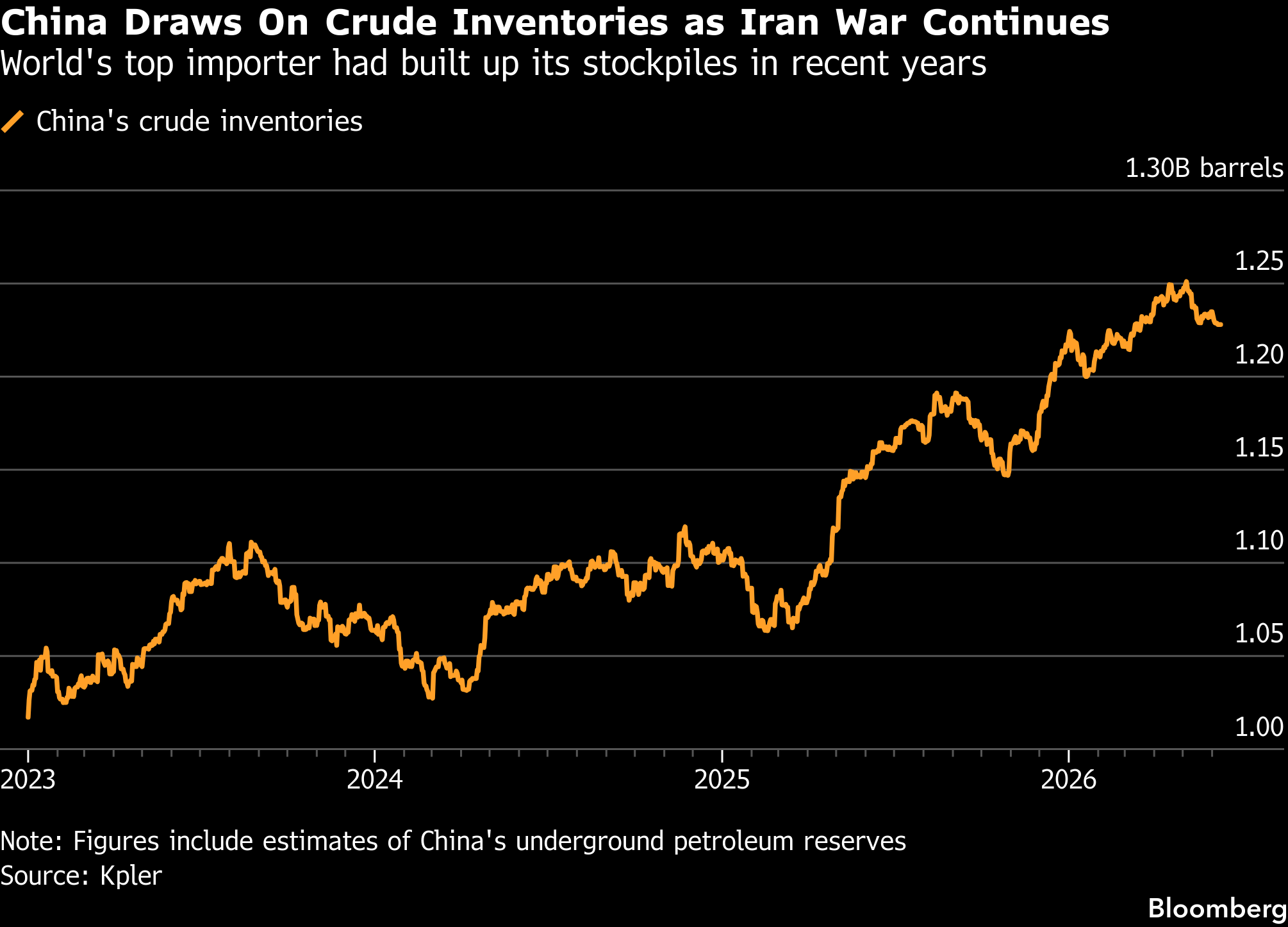
Inventory draws are expected to average about 1 million barrels a day in the coming months, according to estimates from Vortexa Ltd., Kpler and Energy Aspects. That’s about a third of the crude that China is no longer receiving since the conflict led to the near-total closure of the Strait of Hormuz, but still pales in comparison with the roughly 1.2 billion barrels the nation has in its commercial and strategic stockpiles.
The price reaction to what the International Energy Agency has called the biggest oil market shock on record has been relatively muted, as China refrained from tapping international markets to make up for the lost barrels. Global benchmark Brent is up less than a third since the conflict started, with analysts estimating that the nation’s imports could remain subdued for months to come — helping ease pressure on prices.
China has filled up its inventories to unprecedented levels over the past year. It started tapping those reserves in May, and drew down almost 25 million barrels in the month to June 7, Energy Aspects said, citing data from its satellite-tracking Kayrros unit.
While that is sizable — global consumption is just over 100 million barrels a day — weaker downstream demand has made an even bigger difference. State-owned refiners have cut processing rates to record lows, fuel exports have been constrained under wartime measures aimed at preserving domestic supply and the switch to electric vehicles has accelerated.
“China’s transport system has become structurally more flexible than in previous oil shocks,” said Emma Li, lead China market analyst at Vortexa. The rapid adoption of EVs has contributed to a drop of about 1 million barrels a day in fuel demand this quarter, she said.
Some observers have argued that the demand destruction may not be permanent.
“They were building a strategic petroleum reserve, now they’ve stopped building, they’re releasing some from their reserves. They have turned down their refineries, so that’s producing less products,” US Energy Secretary Chris Wright said in Washington on Tuesday. “That’s in response to a crisis, that’s not a permanent change.”
China’s strategic reserves are a tightly held secret, with long-range targets and widespread use of underground storage obscuring the picture. Market participants have been reliant on satellite imagery and third-party estimates to try to fill the gap.
While Beijing has continued adding to its SPR during the war, refiners have increasingly relied on commercial inventories rather than fresh imports, according to analytics firm Kpler. Exactly how much crude has come from state stockpiles remains unclear, given the opacity.
“We cannot completely rule out some SPR utilization,” said Sumit Ritolia, lead analyst for refining supply and modeling at Kpler, adding that less-visible underground reserves may have been used to replenish more observable storage facilities that supplied barrels to the market.
Chinese state refiners are expected to resume purchasing on international markets once they “meaningfully tap reserves,” said Jianan Sun, a London-based analyst at Energy Aspects. “But government authorization, subject to Beijing’s outlook on Hormuz, will be needed before sizable buying returns.”
©2026 Bloomberg L.P.








