

China’s Oil Refiners Slash Output After Crude Imports Plunge


(Bloomberg) Chinese oil refiners sharply reduced output last month to the weakest level in nearly four years, after the country’s crude imports plunged to an eight-year low due to the near-halt to shipments from the Gulf.
Aluminum, another commodity heavily impacted by the war in Iran, saw production hit a record in May, according to the statistics bureau on Tuesday. Meanwhile, China’s worst coal disaster in years forced miners to trim output as the authorities tightened up on safety.
Oil refining volumes extended declines, dropping 9.1% year-on-year to 53.72 million tons, the lowest since August 2022. State-owned refiners ended the month with an average run rate of 66.3%, a low for a dataset that began in late 2021.
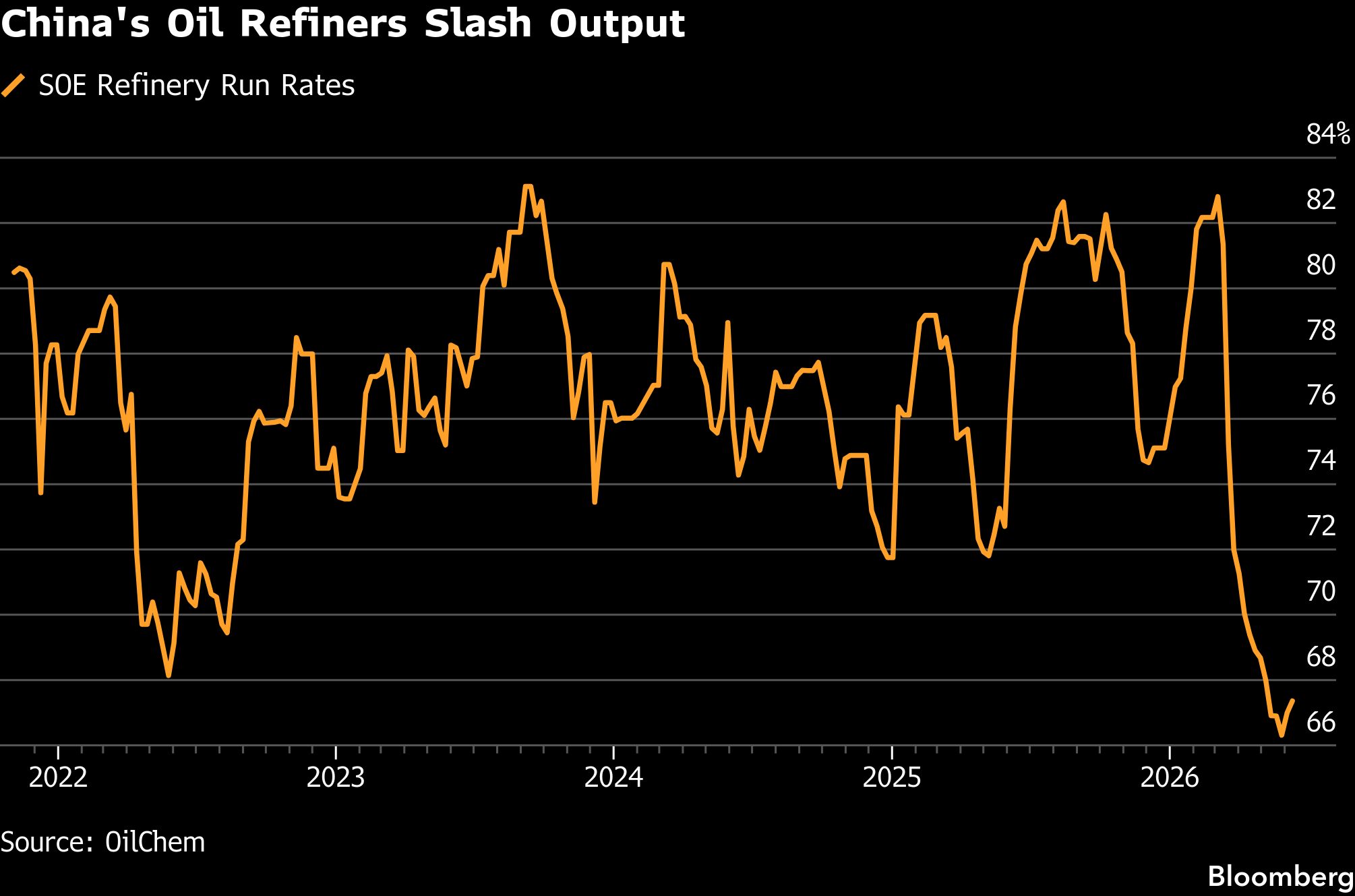
The burning question for the market, now that a deal has been reached to reopen the Strait of Hormuz, is whether Chinese demand for fuels like gasoline and diesel will normalize, or whether the rapid electrification of the country’s transport network has permanently dented consumption. GL Consulting is among those that expect refining activity to remain subdued, forecasting a 5% drop in 2026.
The interim agreement between the US and Iran should help relieve severe tightness in the global market for aluminum. China, the world’s largest producer, has taken advantage of the shortfall from the Middle East to maximize output, which rose again in May by 1.7% to 3.89 million tons.
But the end to hostilities could prove an inflection point if Chinese exports contract in coming months as Middle Eastern supply gradually resumes. Domestic demand remains tepid, while the test of the government’s capacity ceiling could leave smelters at risk of increased regulatory scrutiny.
Nationwide coal output was affected by heightened safety inspections, falling 1.7% to 397.22 million tons. The disruptions are likely to persist for longer in Shanxi, the top producing province where the deadly accident occurred. Other hubs may be quicker to recover as the government seeks to ensure sufficient power over the peak summer period.
Electricity output rose 4.2% in May, with southern regions recording peak loads one month earlier than usual due to El Niño-driven heat.
Steel production fell 2.7% to 84.36 million tons as mills continue to adjust to weaker demand stemming from the ongoing property crisis and lackluster economic activity. Lower steel prices and higher coking coal costs because of the Shanxi accident have also compressed margins.
On the Wire
China’s consumer spending contracted for the first time since the pandemic and investment deteriorated, exposing risks still facing the economy even as it benefits from booming exports and a deescalation in tensions around Iran. Home prices fell at a quicker pace, halting green shoots seen at the start of the year that had raised hopes of a recovery.
If the announced US-Iran deal holds and eventually restores energy flows, it could ease a key constraint on China’s economy, said Bloomberg Economics.
China’s aluminum surplus is set to shrink by 40% to about 634,000 tons this year as a slower 1.8% demand expansion still outpaces a 0.8% supply increase, said Bloomberg Intelligence.
©2026 Bloomberg L.P.








