

HORMUZ TRACKER: Traffic Halts as Trump Weighs Iran’s New Offer


(Bloomberg) -- Traffic through the Strait of Hormuz has come to a virtual standstill while US President Donald Trump weighs Tehran’s latest peace proposal.
Hopes of an early easing of the twin blockades by Tehran and Washington faded after Trump said he’d review the plan, but cast doubts on whether it would satisfy him, saying Iran has “not yet paid a big enough price for what they have done to Humanity, and the World, over the last 47 years.”
A very large crude carrier that appeared to have made an outbound crossing several days ago, one of only a dozen such vessels to leave the Persian Gulf since the beginning of March, appears to be continuing its voyage with its cargo of Iraqi crude.
The Kin A, has left its anchorage at Duqm and is heading for the Suez Canal, according to vessel tracking data compiled by Bloomberg.
The vessel popped up on tracking screens on Saturday off Duqm on the Omani coast, having previously been seen more than three days earlier heading toward Hormuz after loading at Iraq’s Basra terminal. It would likely have crossed the strait on Wednesday.
Observed commercial traffic in Hormuz between Saturday morning and Sunday afternoon was limited to the usual mix of small China-linked or Iran-affiliated ships, vessel-tracking data show.
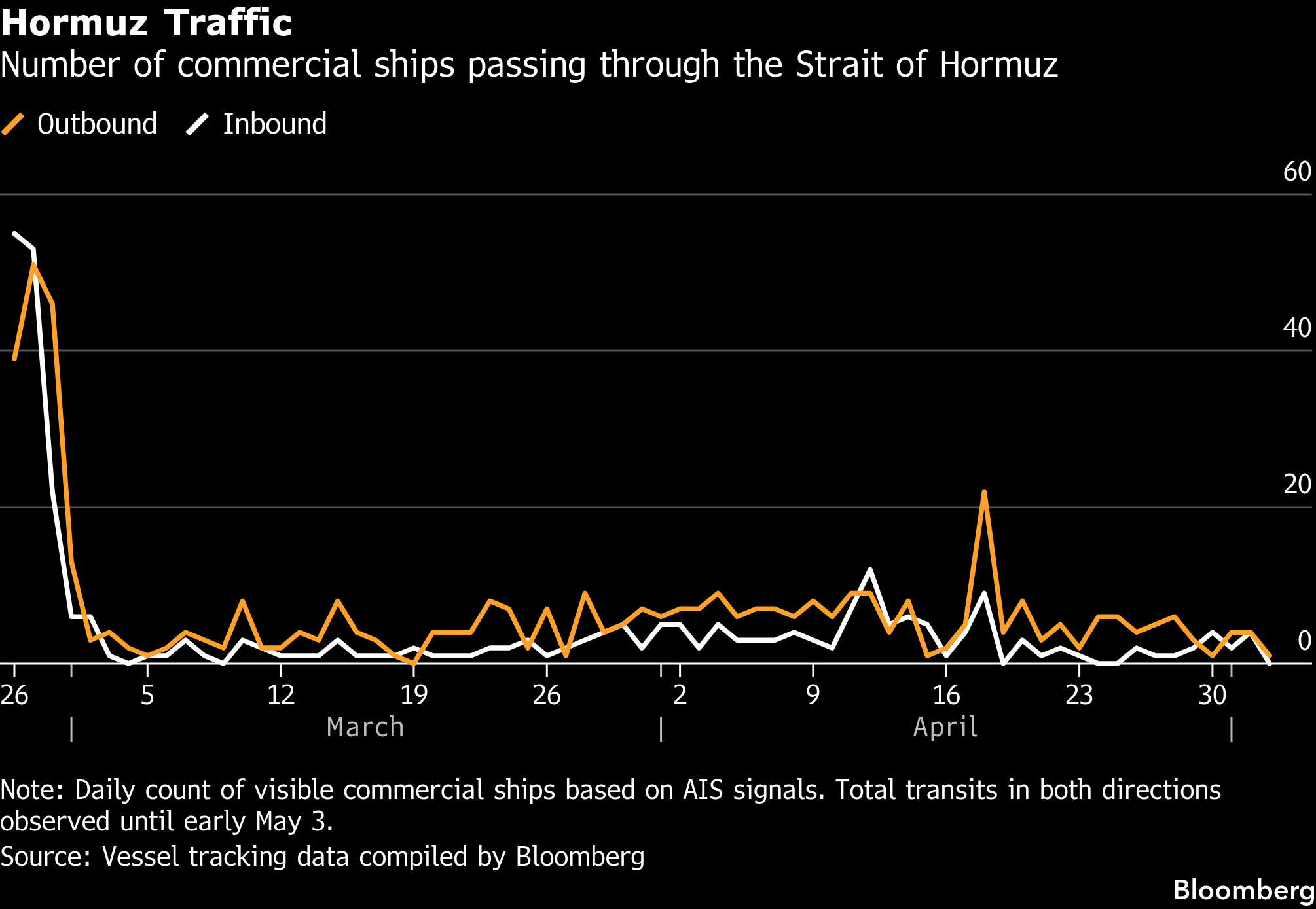
The constrained movement highlights that access to the strait appears to be restricted to select vessels with regional alignment or approval.
Ship Movements
Outbound transits remained limited on Sunday morning. A single Iran-linked bulk carrier was the only ship observed leaving the Persian Gulf. It follows five ships making the outbound transit on Saturday, the most significant of which was the Sarv Shakti, carrying liquefied petroleum gas to India.
Vessels transiting Hormuz with active Automatic Identification System signals during the past day were confined to the narrow northern lane approved by Tehran.
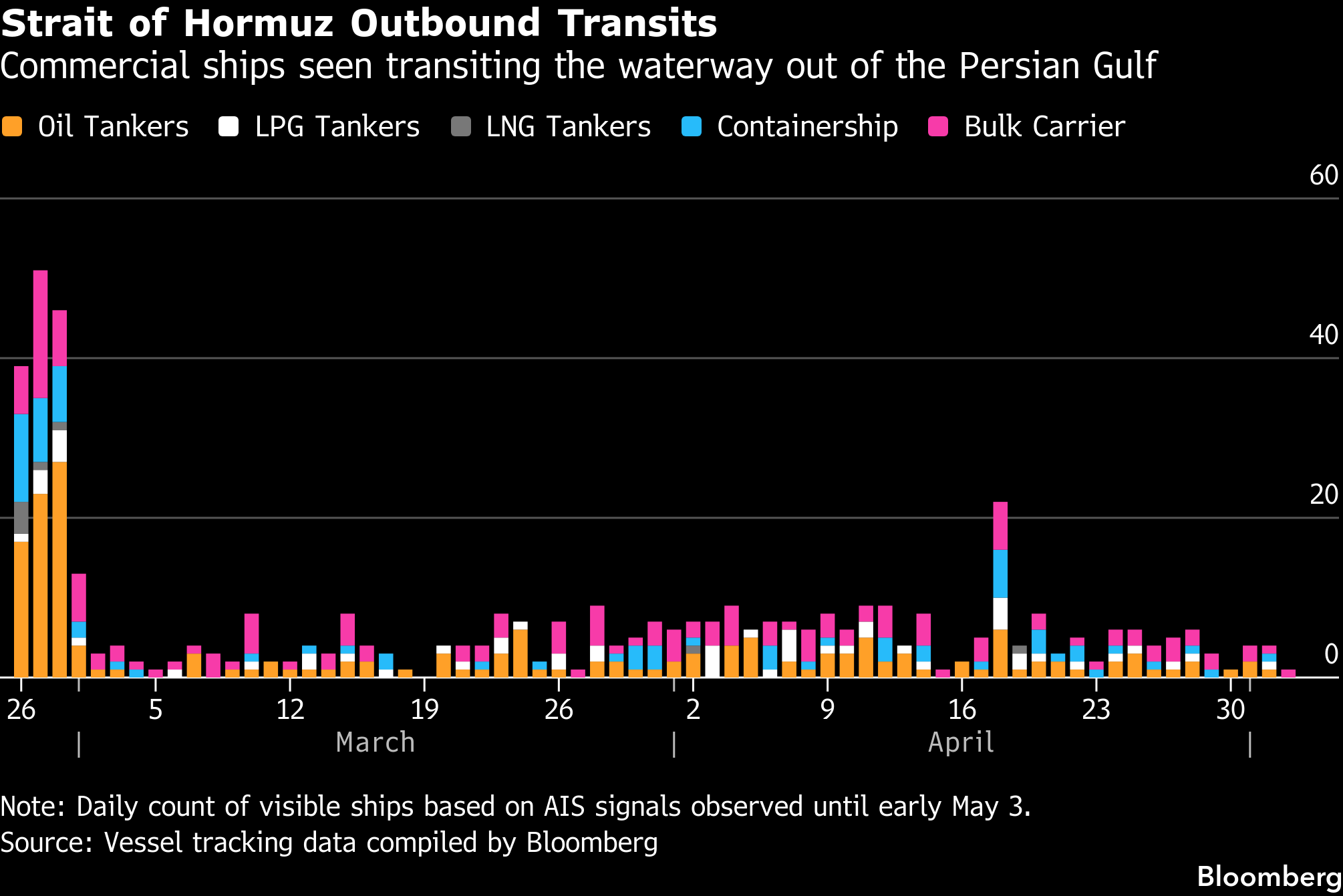
Recent Iran-linked departures have largely stalled in the Gulf of Oman, though it’s unclear whether the ships are following regional itineraries or are being trapped by the US Navy blockade stationed further east outside the gulf.
Observed inbound transits on Sunday morning were limited to a single, small, Iran-linked cargo carrier. That follows two bulk carriers, a fuel tanker and an LPG carrier making the inward transit on Saturday.
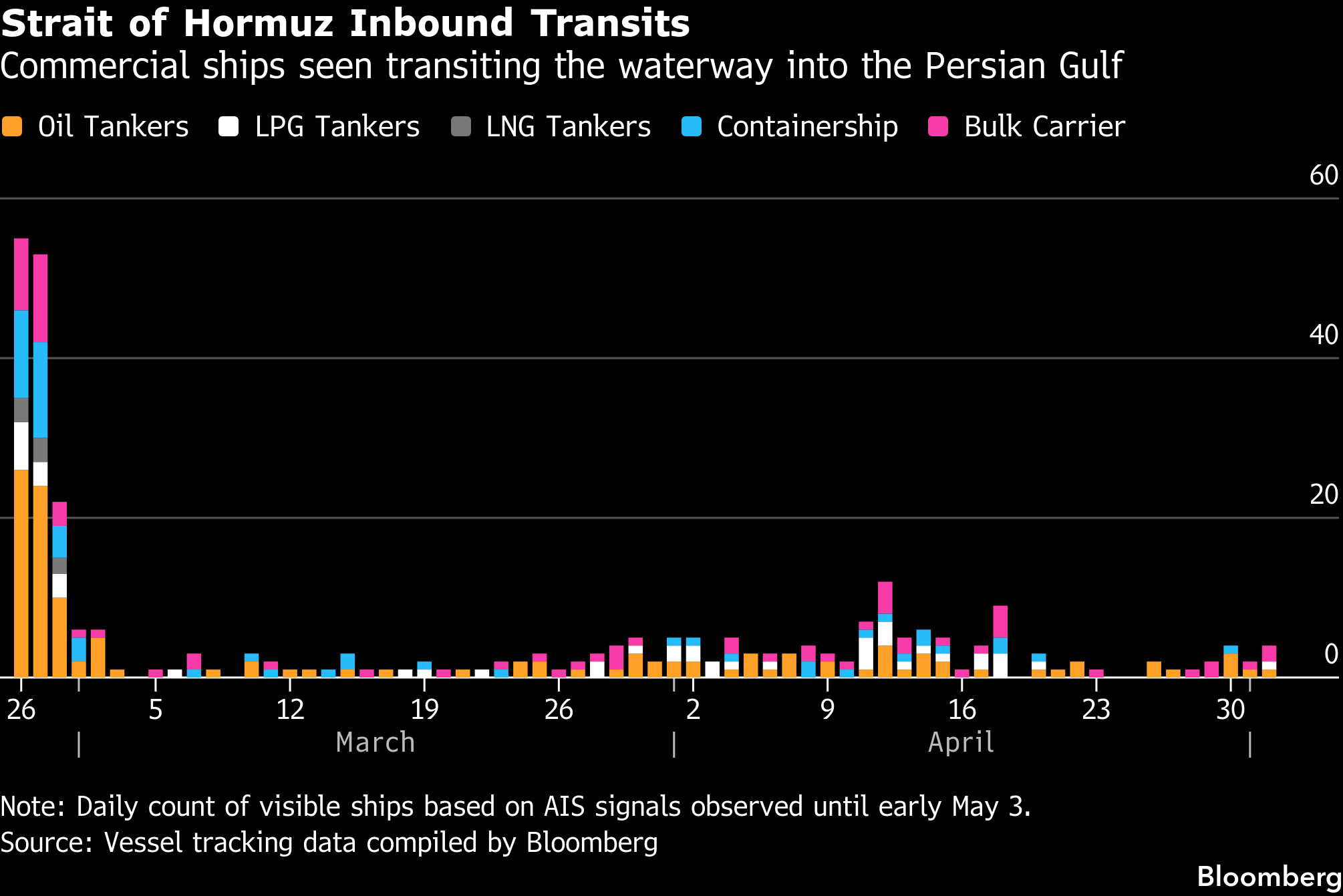
The US blockade may encourage Iran-linked ships entering or leaving the Persian Gulf to switch off their signals to avoid detection, making it harder to get an accurate picture of traffic. That means transit figures may sometimes be revised higher when vessels reappear far away from the riskiest waters.
Even before the US imposed its latest restrictions, it was common for Iran-linked ships to stop sending signals as they headed into Hormuz to exit the Persian Gulf. They generally didn’t enable them again until well into the Strait of Malacca in Southeast Asia, about 13 days’ sailing from Iran’s Kharg Island.
NOTES:
Because vessels can move without transmitting their location until they’re well away from Hormuz, automated positioning signals were compiled over a large area covering the Gulf of Oman, the Arabian Sea and the Red Sea to detect those that may have departed or entered the Persian Gulf.
When potential transits are identified, signal histories are examined to determine whether the movement appears genuine or is the result of spoofing — where electronic interference can falsify the apparent position of a ship.
Some transits may not have been detected if vessels’ transponders haven’t been switched back on. Iran-linked oil tankers often steam from the Persian Gulf without broadcasting signals until they reach the Strait of Malacca about 10 days after passing Fujairah in the UAE. Other ships may be adopting similar tactics and won’t show up on tracking screens for many days.
This tracker will be published during heightened tensions involving Iran, and aims to capture traffic for all classes of commercial shipping.
©2026 Bloomberg L.P.