

Exxon Profit Surprises Analysts Despite Iran War’s Tumult


(Bloomberg) -- Exxon Mobil Corp. outperformed expectations after oil-production increases from Guyana and the Permian Basin helped offset supply losses due to the Middle East war.
Adjusted first-quarter net income of $1.16 a share was 20 cents higher than the average analyst estimate in a Bloomberg survey. Although profit dropped to a five-year low of $4.9 billion, that figure included the impact of temporary accounting charges tied to derivative contracts that the company expects to fully unwind over the coming months.
Even so, Exxon may revise guidance that forecast full-year daily output equivalent to 4.9 million barrels as the Iran war chokes Middle East energy flows and prevents the Texas oil giant from selling crude and liquefied natural gas from the region.
“Part of the challenge with giving guidance is, as you would imagine, we really don’t know how long the Strait of Hormuz will remain closed,” Chief Financial Officer Neil Hansen said in an interview.
Higher energy prices added $1.7 billion to earnings during the quarter, outweighing a $400 million blow from war-related production outages, according to company figures. Roughly 15% of Exxon’s worldwide output remains offline, Hansen said.
Rival supermajors BP Plc and TotalEnergies SE also surpassed expectations when they disclosed results earlier this week.
Exxon “is a fundamentally stronger company than it was just a few years ago, built to perform through disruption and across market cycles,” Chief Executive Officer Darren Woods said in a statement Friday.
The unprecedented global energy shock triggered by the Iran war has pushed international oil prices to more than $125 a barrel. But oil companies in many cases have been hamstrung in reaping the financial windfall as the conflict strands oil and natural gas cargoes, and missile and drone strikes menace critical infrastructure in the region.
Exxon’s bought back $4.9 billion of shares during the quarter and affirmed its intention to repurchase $20 billion worth of stock this year.
Exxon is mitigating production losses with steady ramp-ups in Guyana, the Permian Basin and the US Gulf Coast. It’s also benefiting from higher prices for non-Middle East production.
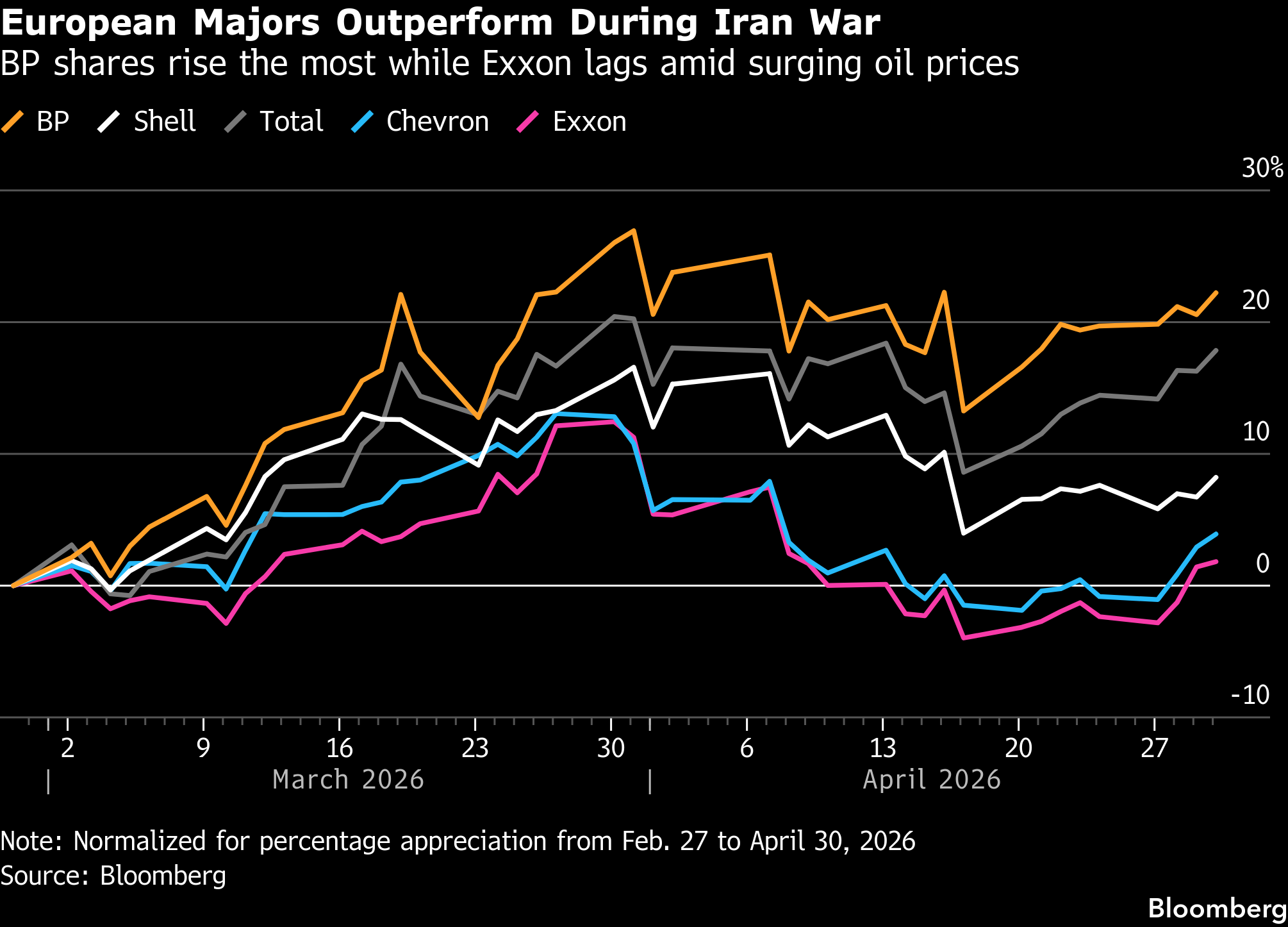
Still, that hasn’t been enough to prevent Exxon stock losing ground to competitors. The shares have advanced about 1% since the war began at the end of February, the worst performance among the five Western supermajors. By contrast, BP is up 20%.
Before the war, Exxon had been the best-performing Big Oil stock since the pandemic due to a successful strategy of growing fossil-fuel production while lowering per-barrel costs.
Exxon’s beat came after Exxon sharply revised down expectations for first-quarter profit due to losses on derivative positions tied to cargoes that had yet to be delivered by the end of the quarter. Those mark-to-market losses amounted to $3.9 billion in the period, which was at the high end of its guidance range.
Exxon expects these losses to unwind over the coming quarters as the shipments conclude journeys and the transactions are completed.
The conflict also poses longer-term problems for Exxon.
The company holds stakes in two liquefied natural gas operations in Qatar that were severely damaged by Iranian missiles in March. A rebuild could take as long as five years and cost billions, according to Qatari officials.
The equivalent of about 800,000 barrels of daily output is currently offline, including 100,000 from Qatari gas-liquefaction operations hobbled by missile fire, Hansen said.
©2026 Bloomberg L.P.