

Dark Hormuz Transits Mount in Sign of Bigger Flows


(Bloomberg) -- Commercial shipping through the Strait of Hormuz remained thin on Tuesday, though growing evidence of so-called dark transits suggest that more vessels are moving through the chokepoint than visible tracking data indicates.
The supertanker Kiara M was tracked off Sohar in the Gulf of Oman on Tuesday after loading about 2 million barrels of Iraqi crude last week. The vessel likely exited the strait over the past day with its positional transponder switched off, a tactic used to avoid being targeted.
Further indications of improving flows emerged as Kuwait offered crude directly to Asian refiners for the first time since the war began. At least 4 million barrels are being marketed to buyers including refiners in China and South Korea, with the cargoes said to have already cleared the strait, though they have yet to register in tracking data.
Diplomatic momentum has also improved. US President Donald Trump said the US is nearing a deal with Iran that could bring the conflict to a close, though Israel has continued to express concerns over the long-term security implications of any agreement.
Visible flows remain muted for now. Apart from the Kiara M, five other commercial crossings were observed on Monday. Activity slowed on Tuesday morning, when only two crossings were visible in the waterway, according to ship-tracking data compiled by Bloomberg.
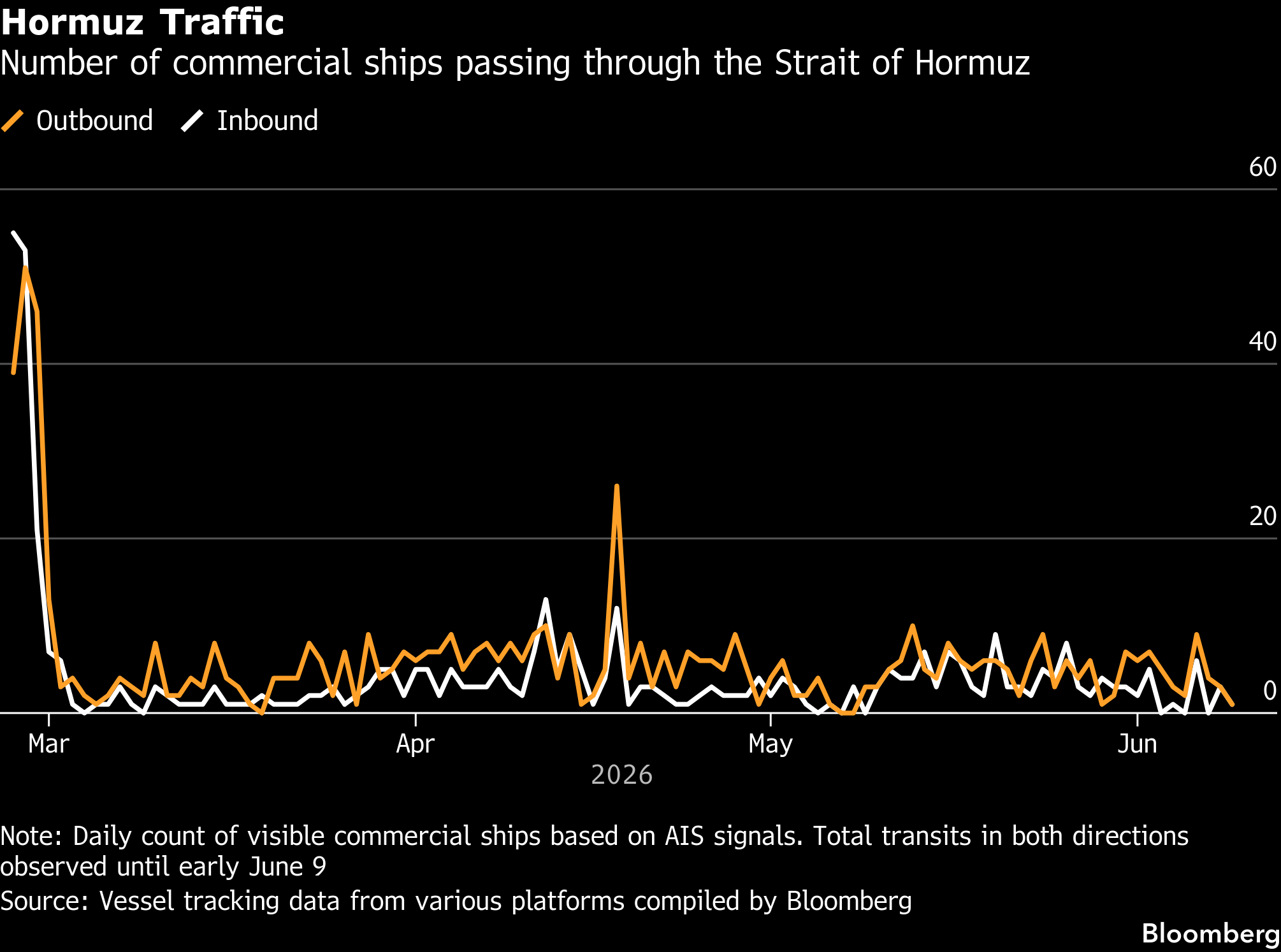
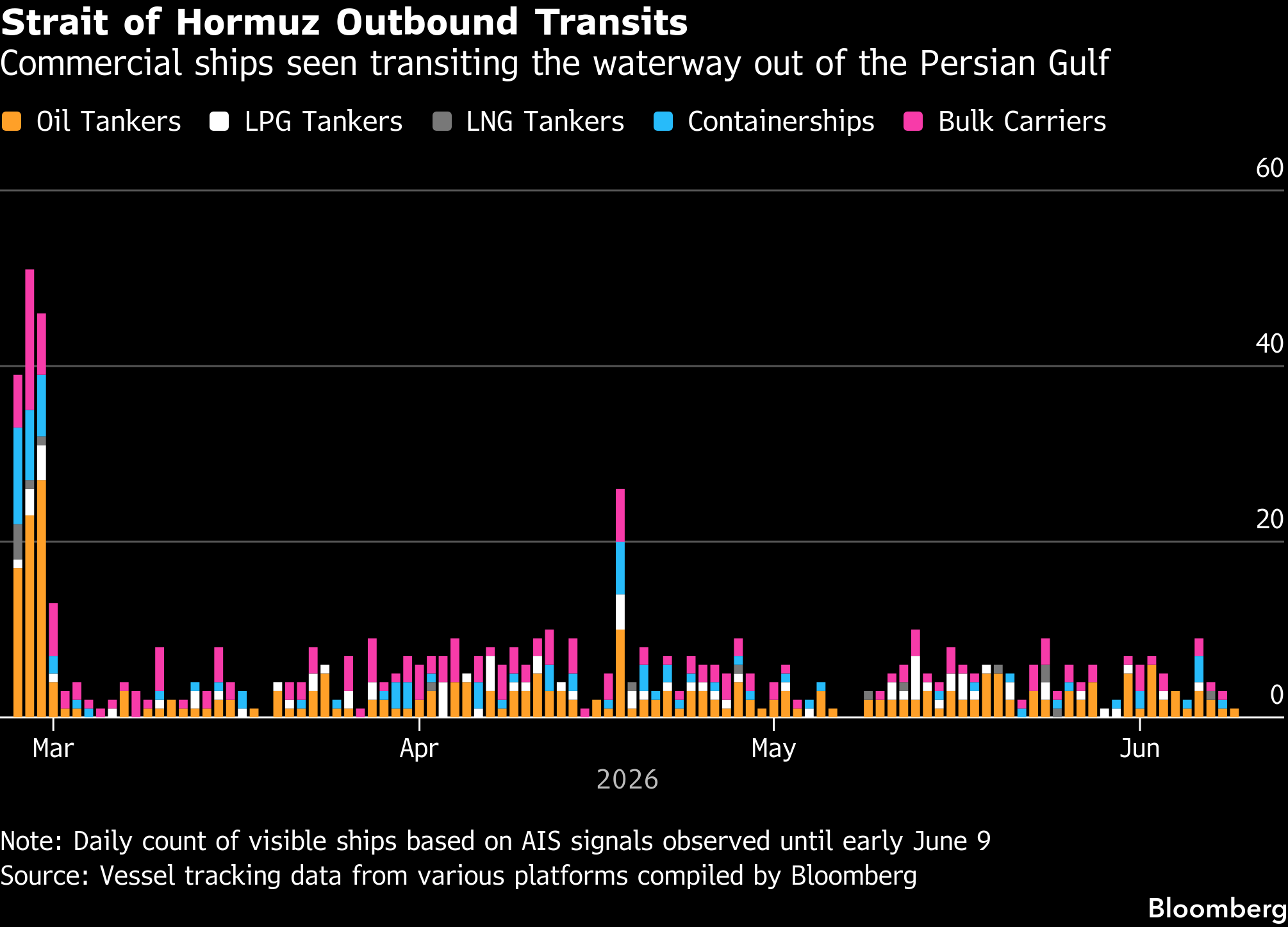
Alongside the supertanker, Monday’s outbound traffic included a bulk carrier and a containership. A China-linked fuel tanker followed on Tuesday, heading out of the strait.
The US blockade of Iranian vessels in the Gulf of Oman is continuing to reshape regional shipping movements. American military officials said Monday that 134 commercial ships had been redirected and complied, while US forces disabled an empty oil tanker on June 8 after it tried to sail to an Iranian port in violation of the blockade.
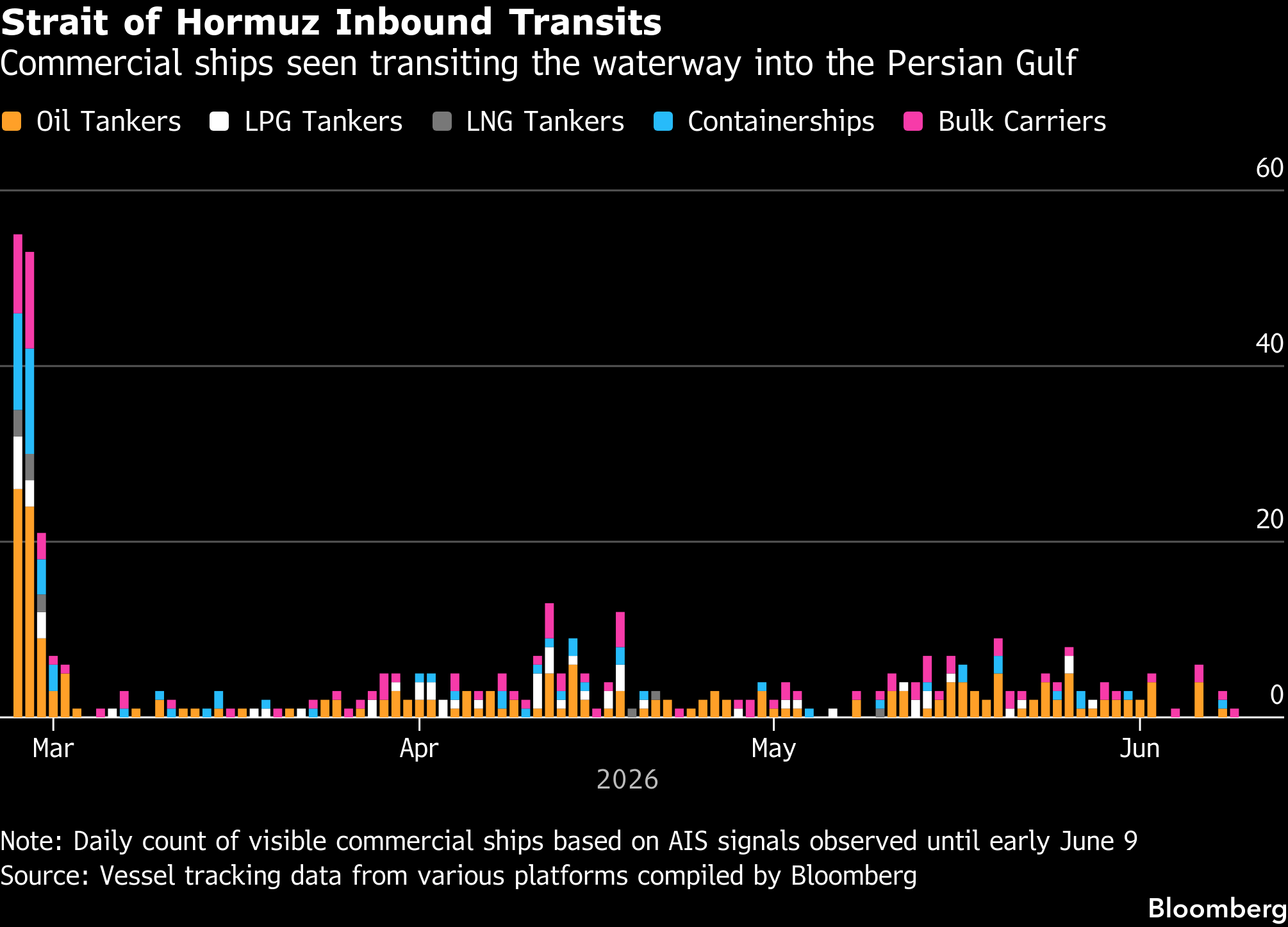
Inbound commercial traffic on Monday was limited to three Iran-linked ships. An India-linked bulker entered on Tuesday.
Ongoing disruptions to AIS transponder signals continue to obscure shipping activity, leading to frequent revisions in transit counts as vessels resurface beyond higher-risk areas and fresh information becomes available.
The US naval presence may also be distorting the observations. Iran-linked vessels entering or leaving the Gulf could be switching off AIS signals to avoid detection, making it harder to track flows in real time.
Even before the US barred movement to and from Iranian ports, it was common for Iran-linked vessels to “go dark” when approaching Hormuz. Signals were often not restored until well into the Strait of Malacca — around 13 days’ sailing from Iran’s Kharg Island.
NOTES:
Because vessels can move without transmitting their location until they’re well away from Hormuz, automated positioning signals were compiled over a large area covering the Gulf of Oman, the Arabian Sea and the Red Sea to detect those that may have departed or entered the Persian Gulf.
When potential transits are identified, signal histories are examined to determine whether the movement appears genuine or is the result of spoofing — where electronic interference can falsify the apparent position of a ship.
Some transits may not have been detected if vessels’ transponders haven’t been switched back on. Iran-linked oil tankers often steam from the Gulf without broadcasting signals until they reach the Strait of Malacca about 10 days after passing Fujairah in the UAE. Other ships may be adopting similar tactics and won’t show up on tracking screens for many days.
This tracker will be published during heightened tensions involving Iran, and aims to capture traffic for all classes of commercial shipping.
Please note that the Hormuz Tracker now includes an NSUB sign-up option. The manual code is NI HORMUZTRAK.
©2026 Bloomberg L.P.








