

Trump-Backed Gas Pipeline to New York Struggles for Customers


(Bloomberg) -- When US President Donald Trump revived a long-stalled pipeline project to bring more natural gas to the Northeast, he vowed to use the force of the federal government to make it happen.
More than a year later, construction has yet to begin. New York State is battling the project in court, but the hurdles extend beyond the legal fight.
More fundamentally, the US energy landscape has changed dramatically since Williams Cos. first proposed the Constitution pipeline more than a decade ago. Not a single utility has announced an agreement to buy gas from the project, and moreover, drillers are no longer pushing to ship their fuel on it.
The result is that the economic case for Constitution has weakened even as the pipeline has taken on outsized political significance. It remains a key test of Trump’s effort to revive stalled fossil-fuel projects, though analysts say the project has become more symbolic than commercially important.
“The project’s strategic rationale has deteriorated,” said Amber McCullagh, a US gas analyst. “Most gas industry executives today would quietly acknowledge that, at this point, when they talk about Constitution, it’s to emphasize the need for a streamlined and straightforward permitting process, rather than as a pipeline that is itself strategically important to build.”
The biggest change for Constitution’s economic case comes from a shift in drilling needs.
When the project was announced in 2012, two gas drillers with operations in Pennsylvania — Southwestern Energy Co. and Cabot Oil & Gas Corp. — soon agreed to ship fuel on the pipeline, providing Williams with long-term partners. Yet both have since merged with other companies and are no longer involved with the project.
At the same time, the region’s shale fields have become less appealing after gas producers tapped much of the lowest-cost production. Now, drillers are balking at signing up to back the pipeline.
So Williams instead turned to utilities in the Northeast to buy gas from the project and help it get established.
Toby Rice, chief executive officer of Pittsburgh-based gas giant EQT Corp., said at this point, support for Constitution needs to come from utilities. If drillers were eager to ship their fuel on the pipeline, they would have signed up already, Rice said.
“The challenge is that the demand is very seasonal, and the market is fragmented,” Rice said.
While northeast power companies are eager for more pipelines, Constitution wouldn’t actually take gas to the population centers where they need it, according to gas-market and pipeline analysts.
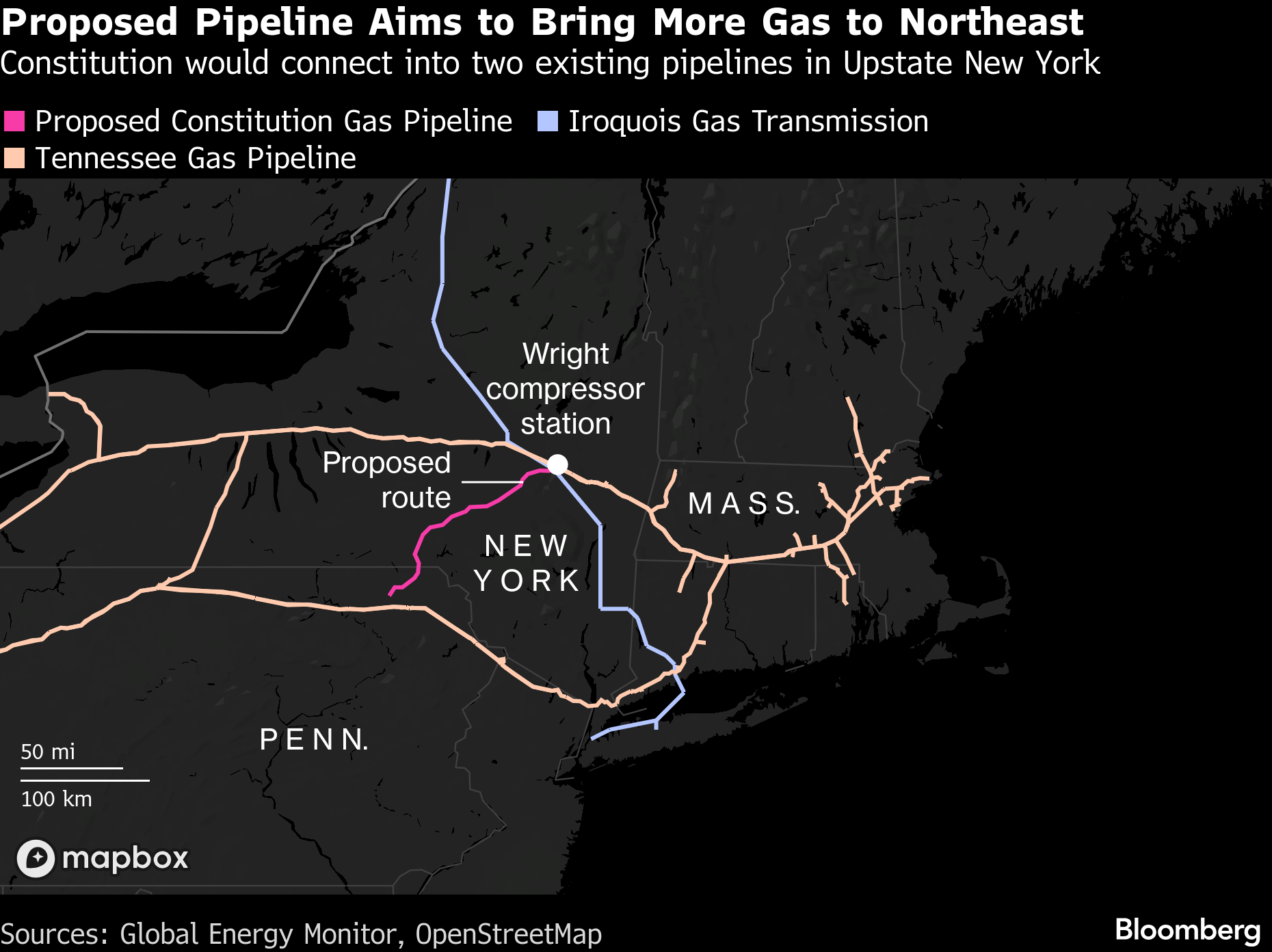
Instead of delivering gas directly to near New York City or in New England, the 125-mile (200 kilometer) pipeline would bring gas from northeast Pennsylvania to a compressor station about 25 miles west of Albany in rural Schoharie County.
To make use of the conduit, utilities would potentially need to expand their own systems. So far, no utility has told New York regulators that there’s a need for Constitution, according to the state Department of Public Service.
Williams, based in Tulsa, Oklahoma, contends the project remains crucial to bring more supply to a densely populated region that suffers from a dearth of pipelines, leading to high energy costs. The company has said Northeast governors support the pipeline, and it remains optimistic utilities will buy gas from it.
“We’re encouraged by constructive conversations with the New England states and are optimistic about securing customer commitments in the near future,” said Cherice Corley, a Williams spokeswoman.
Williams had originally scrapped the project in 2020 after a years-long legal fight over New York’s refusal to grant it a permit under the federal Clean Water Act. Within weeks of starting his second term, Trump promised to bring it back to life. He has repeatedly renewed the pledge and also lobbied New York Governor Kathy Hochul on the project. Legal battles are ongoing over environmental issues in New York.
To be sure, Williams has said it plans to connect the Constitution project to two existing pipelines, the Iroquois Gas Transmission System and Tennessee Gas Pipeline, which would expand its reach.
Yet those pipelines are already nearly full during winter when gas demand peaks, according to Jaxson Fryer, an energy analyst at East Daley Analytics. Unless they are significantly expanded, Constitution won’t provide much relief, he said.
National Grid Plc provides power and gas to large swaths of Upstate New York and neighboring Massachusetts that Constitution could potentially serve. When asked about the project, the company said it would look at ways to expand the supply of gas in the region, but that they need to make sense for its customers.
“We assess any potential project through that lens,” CEO Zoë Yujnovich said in a statement.
Consolidated Edison Inc., which serves much of downstate New York, has no plans to buy gas from Constitution, a spokesperson said. Two other leading Northeast utilities, Eversource Energy and Avangrid Inc., didn’t comment.
“Constitution does not solve the Northeast bottleneck in a meaningful way,” Fryer of East Daley Analytics said.
©2026 Bloomberg L.P.








