

Europe Faces Winter Gas Reckoning as Global Fight for LNG Brews


(Bloomberg) -- A global fight for liquefied natural gas threatens to unravel Europe’s strategy of delaying winter purchases until the Strait of Hormuz reopens.
Governments and energy companies ended last winter believing they could afford to delay rebuilding stockpiles, even as they hit the lowest levels since 2022. The jump in gas prices following the start of the Iran war in late February made it hard to justify purchases, while traders bet diplomacy would eventually prevail and flows through the strait — a conduit for a fifth of LNG supply — would resume.
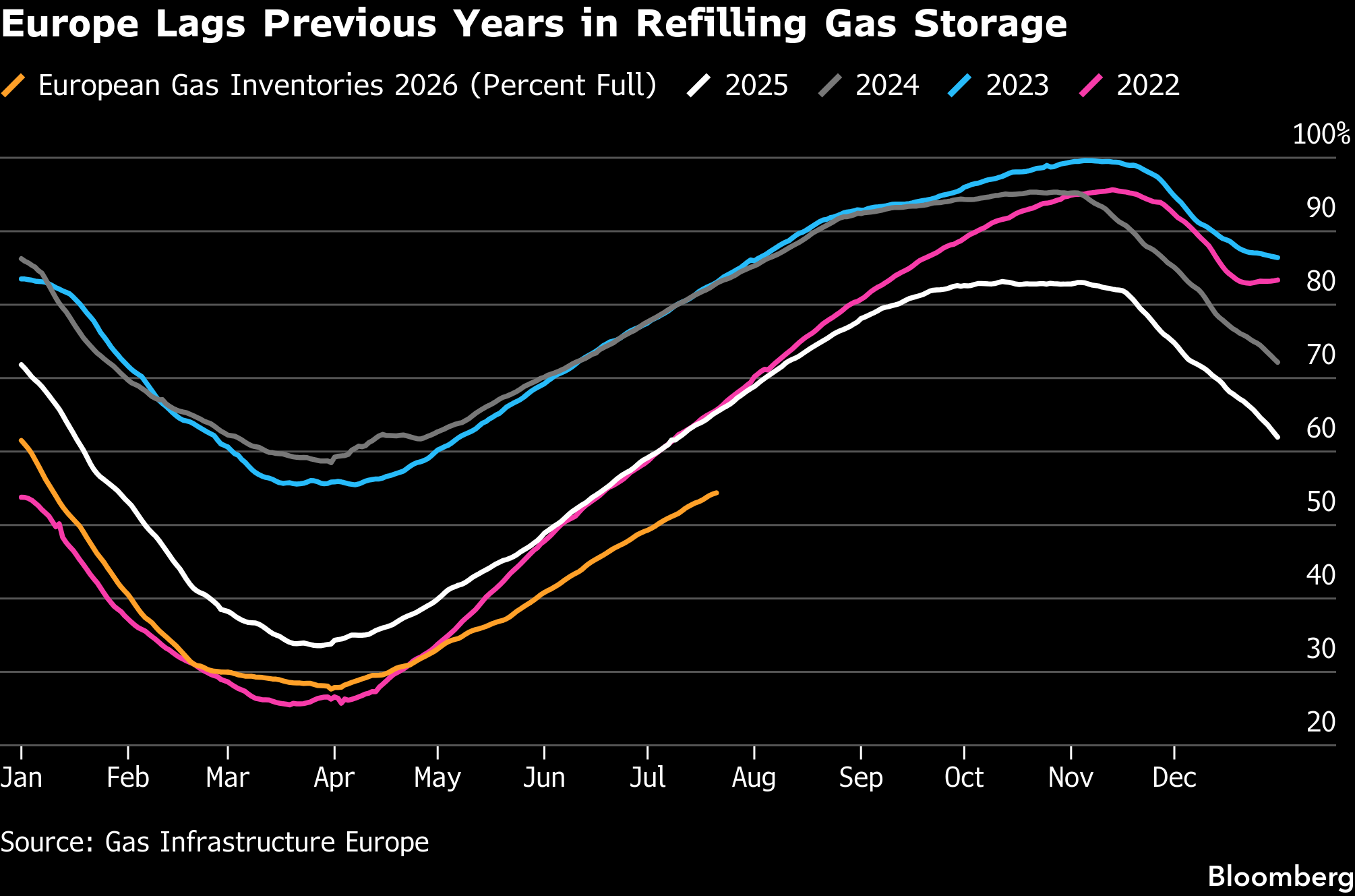
Nearly five months later, that wager is looking risky. Fighting in the Middle East has flared up again, gas prices are near their highest since the conflict began and Europe is well behind its usual stockpiling pace. Asian buyers from China to Pakistan have been snapping up available LNG shipments to replace lost Qatari supply, effectively pulling cargoes away from Europe.
A key question is whether governments — particularly in the largest market Germany — will intervene to support purchases if Hormuz remains shut, potentially fueling a bidding war with other regions in the months ahead. Few doubt Europe will secure enough fuel for winter. The bigger risk is the cost — and whether households and industry can stomach another jump in heating and power bills just a few years after the region’s last energy crisis.
“We have been like the frog in the boiling water,” said Anne-Sophie Corbeau, a researcher at Columbia University’s Center on Global Energy Policy and former head of gas analysis at BP Plc. “The question is whether the frog will jump because now gas prices are increasing — fast.”
A resumption of LNG traffic through Hormuz remains a distant prospect, with exports effectively halted since a Qatari carrier was struck about two weeks ago. Hopes for a diplomatic breakthrough have faded, with Washington and Tehran downplaying the possibility of talks, while President Donald Trump has threatened to bomb bridges and power plants in Iran.
The economic consequences would be significant. Energy consultancy Baringa Partners estimates that if Hormuz remains closed through September, soaring gas and power prices could be enough to tip the UK and Europe into a contraction toward the end of the year.
“European buyers are now having to go to the market and buy gas and pay these prices they weren’t willing to before,” said Caspian Conran, economist at Baringa. “Otherwise we’re going to freeze in the winter.”
Qatar, normally the world’s second-largest LNG exporter, is preparing for a prolonged disruption. It sent several shipments through Hormuz following an ill-fated US-Iran interim peace pact in mid-June, but now plans to extend its force majeure for European customers until the middle of October and for Asia until September, according to people with knowledge of the matter.
That would all but eliminate any chance of Europe drawing on Qatari supply in the run-up to the heating season. European Union gas inventories are just over 54% full, well below a five-year average of 70% and short of the bloc’s Nov. 1 target of 80%.
“No one expected the US-Iran war to escalate again,” said Alex Siow, lead gas analyst for Asia at Independent Commodity Intelligence Services. “Time is getting tight. EU will have to ramp up its purchases now if it were to hit the target.”
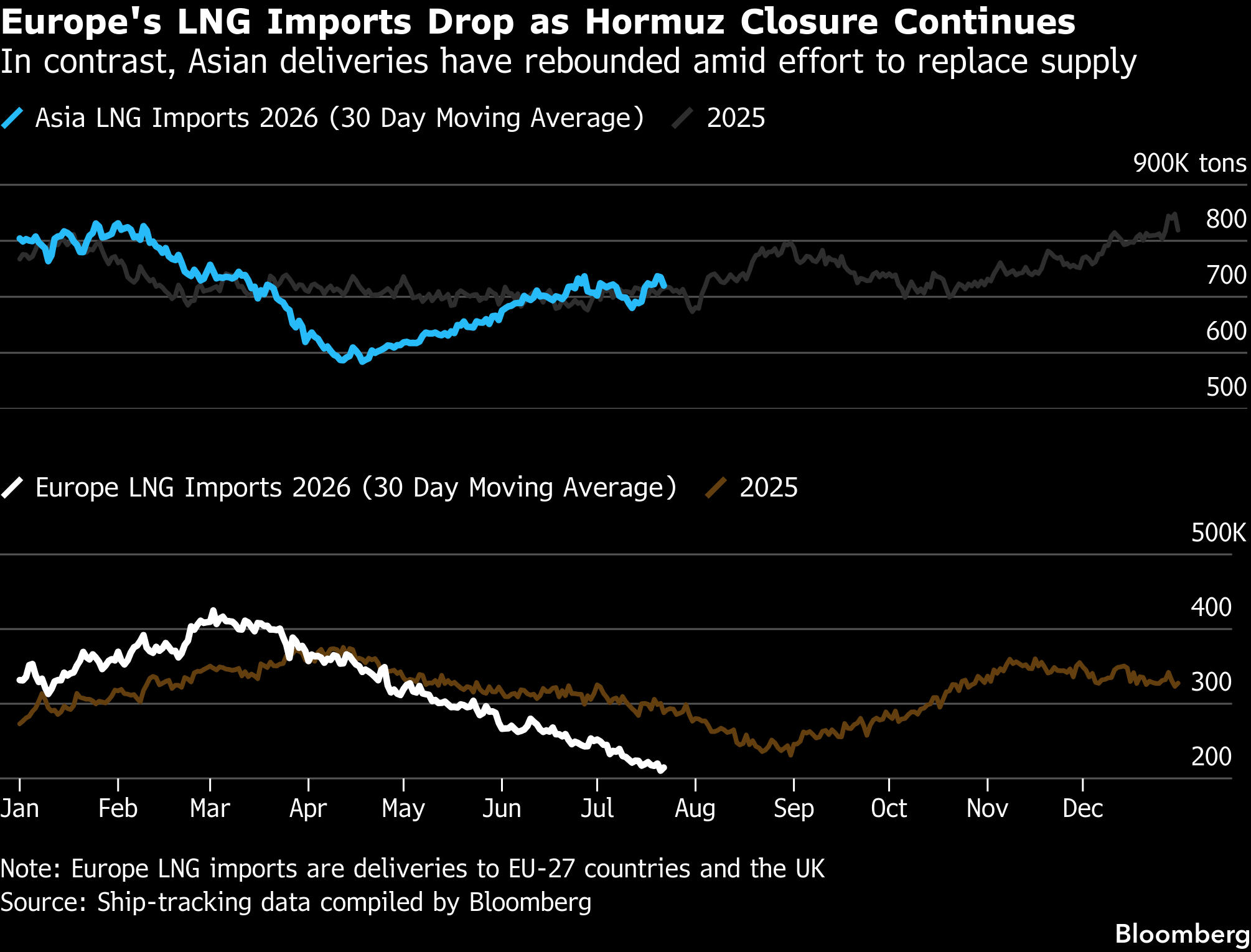
According to Corbeau, Europe would have needed LNG arrivals to match last year’s pace to hit the 80% storage target. Instead, Bloomberg ship-tracking data show deliveries are running about 27% below last year’s levels, based on a 30-day moving average, while imports into Asia have climbed. The shift suggests Asian buyers — which sourced about a quarter of their LNG from the Gulf last year — are seeking supply from other sources, leaving Europe with fewer alternatives.
“Developments in the Gulf are leading market participants to price a prolonged disruption, leaving Europe more vulnerable to a cold shock as we saw in January and parts of February this year,” said Marco Saalfrank, head of continental Europe merchant trading at Swiss-based Axpo Holding AG.
The EU has also committed to ending Russian LNG imports by January 2027, reducing one of its key supply options. Fuel from the exporter made up 17% of Europe’s deliveries between January and June this year, ship-data shows. EU members this week failed to push through a proposal that would restrict firms from transferring Russian LNG to third countries.
Searing temperatures across Asia are keeping LNG demand elevated, with Pakistan, Bangladesh and India buying spot cargoes at some of the highest prices in years. Traders and policymakers see few signs that demand will ease despite the higher costs. Those countries are under pressure to secure fuel or face rolling blackouts or factory shutdowns.
China, the world’s biggest LNG importer, is also returning to the market. The country has ramped up purchases ahead of peak summer demand while rebuilding inventories, with June imports up 8.3% from a year earlier. Chinese buyers have increased procurement from exporters outside the Gulf to offset Qatar.
Even Japan, which leaned more on coal in March and April, is now boosting gas-fired generation as blistering hot weather boosts power prices to the highest level in over three years. That risks draining storage and adding pressure on utilities to buy from the spot market. The same goes for South Korea and Taiwan.
“Asian countries are organizing tenders, Europeans are not,” Corbeau said.
It remains unclear at what point European utilities and governments will be willing to compete for winter supplies. In May, Germany’s gas market manager said it won’t intervene in refilling inventories, citing conviction that private market actors will eventually do so themselves. In other countries, such as Italy and the Netherlands, governments have started to provide some support, raising the risk of fierce competition for supplies within Europe.
The last time Europe faced similar difficulties in rebuilding its inventories was shortly after Russia curbed pipeline supplies in 2022. The region got through that winter largely thanks to exceptionally mild weather, but counting on a repeat is a risky bet.
“If it’s not a warm winter, then there’ll be problems and the problems will be exacerbated by having less gas and storage,” Centrica Plc’s Chief Executive Officer Chris O’Shea said on a call with journalists following earnings on Thursday. “It is not a very good risk management strategy to hope for a warm winter.”
©2026 Bloomberg L.P.








