

Australia Built a Gas Export Empire. Now the Backlash Is Here


(Bloomberg) -- Australia’s liquefied natural gas exporters should be riding high on a A$20 billion ($14 billion) sales windfall from the conflict in the Middle East. Instead, their good fortune has triggered a wave of public backlash.
A war-driven surge in profits has amplified complaints that ordinary Australians are being short-changed by its tax regime on LNG exports, with lawmakers from both ends of the political spectrum questioning why the gas-rich country remains exposed to high prices and potential shortages at home. This has been exacerbated by viral claims the country’s beer drinkers pay more tax than its LNG producers.
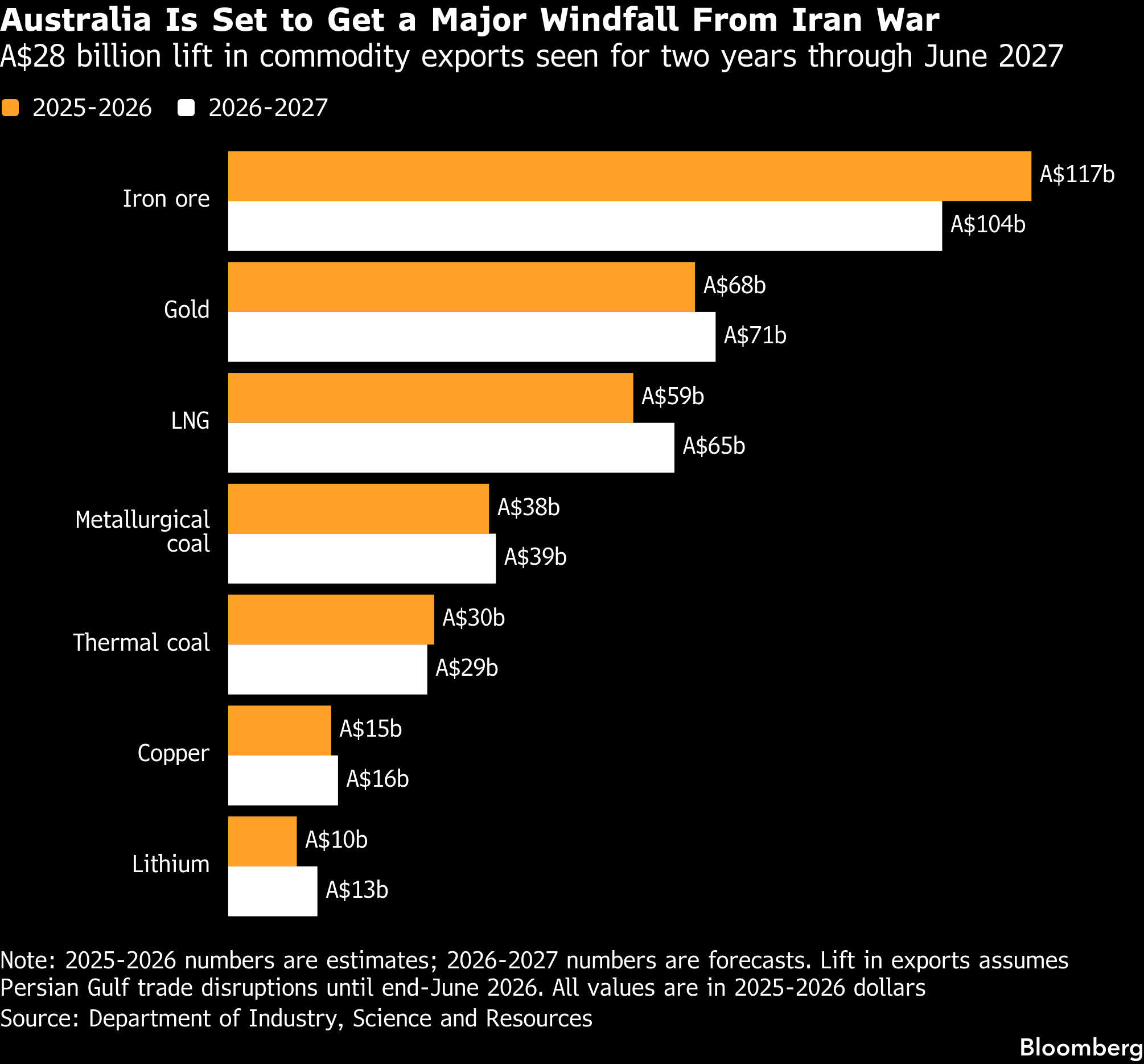
Australia’s LNG export earnings for the fiscal year to June 2027 are forecast to hit A$65 billion ($45 billion), up more than 40% from an outlook made before the near-closure of the Strait of Hormuz choked a fifth of global supply, according to the latest resources and energy quarterly report released Friday.
“It’s harder to make the case for unconstrained fossil fuel exports to the public in a context of record corporate profits, constrained tax returns and repeated price shocks,” said Rohan Bowater, analyst and co-founder of Melbourne-based think tank Accela.
Opinion polls now indicate more than three in five Australians back a 25% tax on gas exports, even as the center-left government decided to leave the levy out of its budget in May. About four-fifths of gas produced in Australia is shipped overseas.
A wave of new LNG projects over the last two decades made Australia one of the world’s top exporters, with the fuel now its third most valuable export after gold and iron ore. As a cornerstone supplier to Asia’s largest gas importers, the industry has become a strategic asset for Canberra — which Prime Minister Anthony Albanese leveraged earlier this year to secure other fuels from its customers in return.
Disruption in the Persian Gulf has heightened both the importance of Australian LNG to the region, as well as its profitability. The country’s two biggest oil and gas producers, Woodside Energy Group Ltd and Santos Ltd, are expected to post a combined net income of nearly $6 billion for the year to December 2026, according to analysts surveyed by Bloomberg. That’s double the estimate a year ago.
However, bumper earnings have sharpened criticism that Australia’s LNG industry is benefiting shareholders more than the broader public. The backlash raises the political risk around future gas export projects, from Woodside’s advanced plans at Browse to new offshore acreage and the ramp-up of Scarborough to Santos’ Barossa, which were already facing mounting opposition from environmental groups.
Critics also point to the Labor government’s favorable treatment. Regulators allowed Woodside’s North West Shelf export project to continue operating until 2070 and approved new exploration permits, framing the additional supply as necessary to ease forecast domestic shortages despite locking in decades of emissions.
LNG exporters have been backed by powerful lobbying efforts by groups such as the Australian Energy Producers — an association that represents oil and gas producers. The AEP is among the world’s most “engaged” and “oppositional” associations, according to London-based think tank InfluenceMap, which tracks lobbying groups.
That influence has also been reinforced through decades of high-profile civic sponsorships, particularly in Western Australia. Woodside’s bright yellow sponsorship vests for junior lifesavers have long been an iconic feature on the state’s beaches.

To boost supply and curb rising energy costs, the government was able to push forward a scheme to reserve gas for local use — 20% of annual LNG exports — sparking strong opposition from parts of the industry and its lobbyists. Santos Chief Executive Officer Kevin Gallagher warned in May that this will drive prices down for a short period, but kill investment and supply.
The country’s long-simmering issue over how to tax LNG exports without dissuading investment exploded into a cost-of-living debate during a Senate inquiry in June. Independent Senator David Pocock’s question to a Treasury official elicited agreement that the country’s beer drinkers paid more tax than its LNG exporters.
Their exchange has been viewed millions of times on social media.
“For too long there has been an assumption in Canberra that the gas industry is politically untouchable,” Pocock, who represented Australia at rugby union and was a key instigator of the inquiry, told Bloomberg. “That assumption is beginning to change because Australians can see the gap between record gas exports, huge industry profits and what is flowing back to the public.”
The Senator said he was unperturbed the inquiry failed to secure support for a 25% levy on LNG export revenue. “I don’t think it’s a question of whether there will be a tax on gas exports; it’s a question of when,” he said.
It’s now not just progressive politicians like Pocock calling for gas tax reform — far-right politician Pauline Hanson last month argued for a new royalty and Commonwealth equity model for future gas projects, saying taxpayers should get a better return.
The Australia Institute maintains the country’s multinational gas exporters pay “no royalties and minimal tax.” The progressive think tank alleges Japan’s Inpex Corp., which has stakes in the country’s Ichthys LNG, Prelude FLNG and Darwin LNG projects, paid no royalties or corporate tax on A$21 billion of gas exports between 2015 and 2025.
The gas industry strongly disputes these claims, and has warned that higher levies or reservation rules threatens supply and risks damaging Australia’s reputation with trading partners. The oil and gas industry contributed almost A$22 billion in taxes and royalties in 2024-25, according to the AEP.
At the core of the debate is the Petroleum Resource Rent Tax, which lets LNG producers deduct capital and exploration spending — and carry unused deductions forward — before project profits are taxed. A 2023 attempt to tighten the regime stopped short of a broader overhaul, but limited the proportion of assessable income that could be offset by deductions to 90%.
At least for now, voters appear unconvinced. Members of the ruling Labor party are breaking rank, with former minister Ed Husic warning in April that the country opened the door to others to “plunder our resources” without Australians getting the best outcome.
“Australians overwhelmingly support a tax on gas exports,” said Fumi Hayashi, an analyst at InfluenceMap. “And momentum is growing.”
©2026 Bloomberg L.P.