Landmark Energy Projects of the Year

From megawatts to smart watts, looking deep and up: The projects rewiring energy in 2025 and powering the next wave in 2026

2025 laid the groundwork; 2026 will feel the consequences. Last year's convergence of molecules, electrons and digital code set in motion forces now reshaping energy markets and grid architecture in real time. The shift from transition to addition, and from renewable capacity to firm clean power (utility-scale storage, advanced nuclear, industrial electrification) means grids entering 2026 can increasingly dispatch clean energy on demand, whatever the weather. Resilient hydrocarbons locked in security of supply even where carbon constraints tightened, giving policymakers room to push harder this year.
What happens next matters most: record clean-energy capex committed in 2025 is breaking ground now; CCS hubs are scaling from pilots into networks moving millions of tonnes; hydrogen corridors are linking exporters and offtakers in contracts that rewrite trade relationships; LNG megaprojects coming online will reset global gas flows for the next decade. Above all, the AI boom has fused power, grids and data infrastructure into a single system challenge, and 2026 is the year utilities, hyperscalers and regulators either solve it together or watch bottlenecks choke growth.
The fifteen projects below, spread across five continents and spanning onshore, offshore, deep subsurf ace and even outer space, cover a broad mix of sectors, subsectors, sizes and scopes. Some announced or just agreed upon, others partially or fully implemented - they are the live wires that will determine whether the energy industry can sustain both momentum and reliability through the rest of the decade.
ADNOC GAS - SEFE LNG DEAL
LOCATIONS: UAE & Germany
LEAD DEVELOPER: ADNOC Gas/SEFE
WHAT
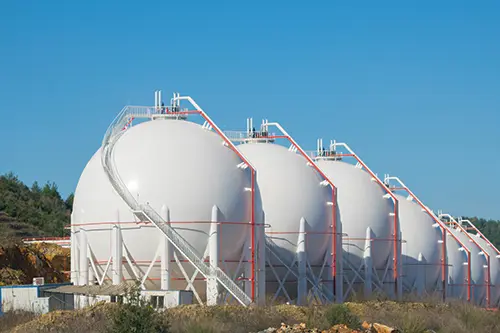
This multi-year LNG supply agreement between ADNOC Gas and Germany’s SEFE showcases the UAE’s growing role in European energy security.
WHY IT MATTERS
The three-year LNG supply agreement announced in July 2025 between ADNOC Gas and Germany’s Securing Energy for Europe (SEFE), covering around 0.7 MTPA starting in the summer of 2025, became a flagship example of the UAE’s emerging role in European gas security. By locking in multi-year volumes during a period of heightened European import needs, the deal underscores Abu Dhabi’s strategy of using targeted, partnership- based LNG contracts to deepen ties with key OECD markets, while supporting its broader gas monetisation and transition agenda.
BASF INDUSTRIAL ELECTRIFICATION
LOCATIONS: Germany
LEAD DEVELOPER: BASF
WHAT
BASF moved into large-scale industrial electrification with major new projects aimed at cutting emissions at its Ludwigshafen facility.
WHY IT MATTERS
BASF broke ground in early Autumn on one of the world’s most powerful industrial heat pumps at Ludwigshafen, Europe’s largest chemical complex.
100k
tonnes
About 50MW of thermal output and 500,000 tonnes of steam per year, using renewables plus cracker waste heat, are expected to cut emissions by around 100,000 tonnes of CO2 annually from mid-2027. With the cracker demonstration and a 54MW PEM electrolyser moving from planning into implementation during 2025, BASF shifts from roadmaps to full-scale electrification, offering a global blueprint for deep decarbonisation of process heat and feedstocks. These combined initiatives position Ludwigshafen as a flagship site for electrified chemistry.
PROVENCE GRAND LARGE
LOCATIONS: France
LEAD DEVELOPER: EDF Renouvelables
WHAT
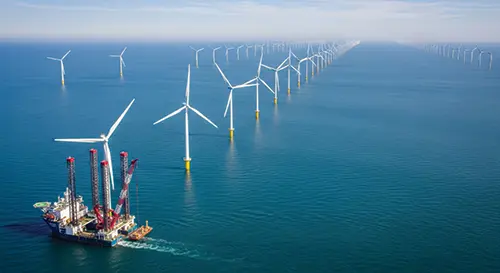
Provence Grand Large became one of the first fully-financed commercial scale floating offshore wind projects.
WHY IT MATTERS
Provence Grand Large moved through financial close and into execution in 2025, as one of the first commercial scale floating offshore wind farms to secure full project financing.
350
million
By proving bankability for tension leg platform technology in deep Mediterranean waters, the project opens the door for floating wind in steep coast markets such as Japan, South Korea and the US West Coast, where fixed bottom foundations are not viable.
NORTHERN LIGHTS CCS PROJECT, PHASE 2
LOCATIONS: Norway
LEAD DEVELOPER: Equinor, Shell, TotalEnergies
WHAT
Norway’s Northern Lights CCS Project received its first CO2 injection, establishing CCS infrastructure for industrial emitters.
WHY IT MATTERS
The Northern Lights CCS Project in the North Sea received its first CO2 injection on August 25, 2025, marking the start of operations for Europe’s first complete cross border CO2 transport and storage system and paving the way for a second phase expansion to “at least” 5MT per year of capacity.
$700
million
By operating as an open access carbon bank for industrial emitters across Europe, the project turns CCS from isolated pilots into shared infrastructure tied directly into the EU’s decarbonisation framework.

EU’S GRIDS PACKAGE & ENERGY HIGHWAYS
LOCATIONS: European Union
LEAD DEVELOPER: European Commission
WHAT
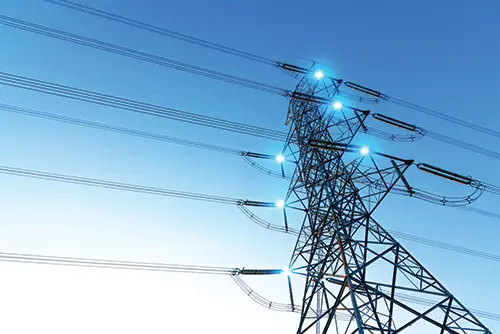
The European Union advanced initiatives aimed at modernising and expanding its power grid.
WHY IT MATTERS
The European Grids Package and associated “Energy Highways” initiative, presented in December 2025, function as a legislative megaproject for Europe’s power system. By speeding up cross border interconnectors, modernising planning rules and promoting digitalisation and flexibility, the package aims to ensure that abundant wind and solar from the North Sea, Iberia and beyond can reach industrial demand centres, underpinning EU targets for renewables and electrification. These measures signal a decisive shift towards a more integrated continental grid, strengthening resilience, accelerating market coupling, and enabling the large-scale electrification required for Europe’s long-term climate goals.
THREE MILE ISLAND: THE NEXT CHAPTER
LOCATIONS: USA
LEAD DEVELOPER: Constellation Energy/Microsoft
WHAT
The federally-backed Three Mile Island Unit 1 nuclear in Pennsylvania was restarted to supply round-the-clock power to Microsoft ’s data centres.
WHY IT MATTERS
The Three Mile Island accident in the 1970s effectively terminated the US nuclear power industry for many a decade. Last year’s announcement by Constellation Energy to restart the Unit 1 reactor on an island in the Susquehanna River under a long-term power agreement with Microsoft turns one of nuclear energy’s most famous sites into a test case for pairing legacy baseload with AI era demand. The arrangement, supported by federal loan backing,
aims to deliver 835 MW of 24/7 carbon-free electricity to power energy intensive data centres, demonstrating that nuclear restarts can be part of the solution to grid strain driven by digitalisation and AI workloads.


IN NUMBERS

835 MW
amount of carbon-free power that can be supplied to data centres

5 million tonnes
amount of CO2 that can be avoided annually
700k
Number of homes that can be powered by the project

$1 billion
Financial backing provided by DoE to restart project
ALASKA LNG’S ARCTIC COMEBACK
LOCATIONS: USA
LEAD DEVELOPER: Glenfarne Energy Transition / AGDC
WHAT
Alaska LNG’s project gaining renewed momentum with Glenfarne, securing business in Asia and Europe.
WHY IT MATTERS
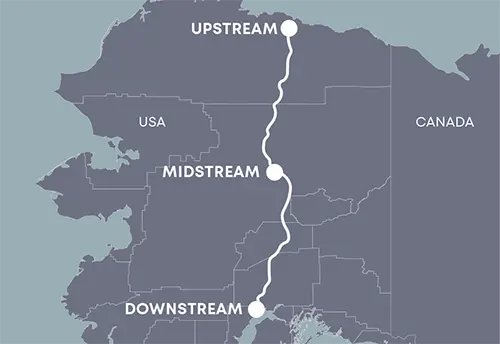
In 2025, Glenfarne became the lead developer for the Alaska LNG project and, on October 23, signed key commercial agreements with Asian buyers such as Tokyo Gas and POSCO, signalling renewed momentum for the only federally authorised LNG export project on the US Pacific Coast.
350
million tonnes
With a planned capacity of around 20 MTPA and a phased development strategy, Alaska LNG offers a new route for North Slope gas and a potential future supplier to both Asian and European markets seeking long-term, diversified LNG. The renewed progress also strengthens confidence in long delayed Arctic gas monetisation e_ orts, positioning the project as a strategic bridge between North American resources and global buyers navigating tightening supply dynamics through the 2030s.
INDIA’S NATIONAL GREEN HYDROGEN MISSION
LOCATIONS: India
LEAD DEVELOPER: Government of India/PSUs
WHAT
India’s green hydrogen initiatives surged with a long-term vision of becoming a major user and exporter of green hydrogen.
WHY IT MATTERS
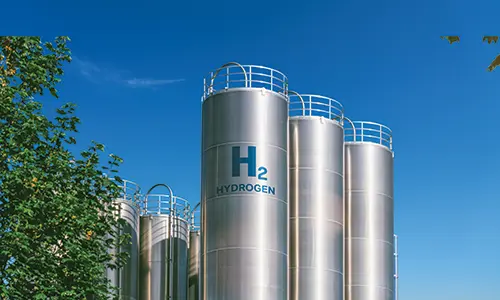
India’s first indigenous hydrogen fuel cell inland vessel, launched on the Ganges at Varanasi in December 2025, provides a tangible flagship for the National Green Hydrogen Mission. Beyond symbolism, it showcases domestic technology and public sector coordination in a sector targeting up to 5 million tonnes per year of green hydrogen production. The goal is to build local electrolyser manufacturing capacity and to position India as both a major user and exporter of green hydrogen.
MOZAMBIQUE LNG PROJECT RESTART
LOCATIONS: Mozambique
LEAD DEVELOPER: TotalEnergies
WHAT
Mozambique re-entered the global LNG push as construction resumed on its US$20 billion Cabo Delgado LNG project - signalling renewed momentum for one of Africa’s most watched gas developments.
WHY IT MATTERS
TotalEnergies’ decision in late 2025 to lift the force majeure and move towards restarting
construction on the roughly $20 billion Mozambique LNG project revives one of the world’s largest greenfield gas developments, after years of security related suspension. With a planned capacity of around 13.1 MTPA (million tonnes per annum) by the end of the decade, Mozambique re-enters the stage as a critical new supply option versus the US-Qatar LNG duopoly, strengthening supply diversity for European and Asian buyers into the 2030s.
IN NUMBERS
$20 billion
CapEx for the project

65 trillion cubic feet
Rovuma Basin’s recoverable gas

13.1 million tonnes
forecasted annual capacity by 2030

43 million tonnes
potential annual expandable capacity of facility
MASDAR’S ‘ROUND THE CLOCK’ 24/7 CLEAN ENERGY PROJECT
LOCATIONS: UAE
LEAD DEVELOPER: Masdar/EWEC
WHAT
Abu Dhabi-based Masdar took major strides towards exporting dependable clean power
WHY IT MATTERS
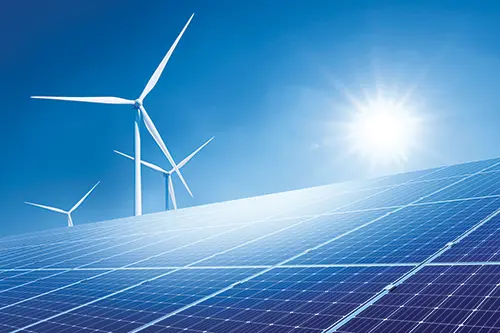
In 2025, Masdar and EWEC launched a 5.2GW solar PV plus 19 GWh battery energy storage project in Abu Dhabi, billed as one of the world’s largest integrated solar storage plants and designed to deliver round-the -clock, grid scale clean power. By addressing intermittency and providing firm “solar as baseload” for the era of AI and digital infrastructure, the project signals a strategic pivot for the UAE and wider Gulf from exporting hydrocarbons to exporting reliable clean electrons.
WESTERN GREEN ENERGY HUB (WGEH)
LOCATIONS: Australia
LEAD DEVELOPER: InterContinental Energy
WHAT
One of the world’s largest green hydrogen export concepts, in Western Australia, moving into early development in 2026.
WHY IT MATTERS
The Western Green Energy Hub advanced in 2025 as one of the most ambitious green hydrogen export concepts globally, targeting up to 50 GW of combined wind and solar capacity over 15,000 squarekilometres in southeast Western Australia.
60
million
Once built, the hub could produce millions of tonnes of green hydrogen and derivatives for export to Japan, South Korea and other markets, anchoring an Asia-Pacific hydrogen corridor and positioning Australia as a premier supplier of green molecules. Its continued progress underscores growing investor confidence in large-scale hydrogen ecosystems, signalling that Australia is preparing to compete aggressively in emerging clean molecule trade flows shaping regional energy security and industrial decarbonisation.
JAFURAH SAUDI GAS PIVOT
LOCATIONS: Saudi Arabia
LEAD DEVELOPER: Saudi Aramco
WHAT
The Jafurah project in Saudi Arabia ramped up the country’s standing as a major player in the LNG sphere.
WHY IT MATTERS
Saudi Aramco’s Jafurah shale gas project reached a key milestone in 2025, with the first phase completed and output beginning at around 450 million cubic feet per day. This step underpins Saudi Arabia’s pivot from an oil only champion to a major gas and Natural Gas Liquids (NGLs) player, reinforcing regional power and petrochemical feedstock supply. Jafurah’s scale and ramp up potential also create room for future LNG exports, adding another heavyweight to a market long dominated by Qatar and the US, and reshaping expectations for Middle East gas flows into Asia.
SYDA, D ORBIT SPACE CLOUD
LOCATIONS: Global, Low Earth Orbit
LEAD DEVELOPER: Valuematic (SYDA); D Orbit
WHAT
Both SYDA and Italy’s D Orbit’s SpaceCloud prototype worked to explore solutions to AI’s exploding power demand - through the use of autoscalers.
WHY IT MATTERS
Valuematic’s SYDA (Synaptic Data Autoscaler) and D Orbit’s Space Cloud Services prototype capture 2025’s defining energy questions: how to cope with AI’s exploding power demand and to what extent the energy industry has to rely on autoscalers that not only use AI, but also leverage it to create models for digital services and infrastructure.
D Orbit’s in-orbit data processing demonstrations show how some workloads can be offloaded to centres located in the space, reducing downlink and easing pressure on terrestrial grids, land and water.
SYDA, on the other hand, uses a revolutionary synapse-inspired model to predict computational loads and autoscale cloud resources across regions, cutting idle capacity and decoupling data centre energy use from raw compute growth.

LOUISIANA LNG’S “US GULF SUPER TRAIN”
LOCATIONS: USA
LEAD DEVELOPER: Woodside Energy
WHAT
Woodside solidified its global LNG position with the approval of the 16.5 MTPA Louisiana LNG project.
WHY IT MATTERS
Woodside’s final investment decision on April 29, 2025 for the Louisiana LNG development, a three-train facility totaling about 16.5 MTPA, cements the company’s status as a top tier global LNG player and extends US Gulf Coast export dominance into the 2030s.
$17.5
billion
Backed by long-term offtake agreements and midstream partnerships, the project reinforces the US Gulf as a flexible, large-scale supply hub for Atlantic and Pacific basin buyers navigating a volatile gas market.