

Japan to Allow More Coal-Fired Power to Cope With Energy Shock


(Bloomberg) -- Japan will allow more use of coal-fired power plants in an effort to boost security of supply to cope with the energy shock from the war in the Middle East.
The country will let less-efficient coal facilities take part in capacity market auctions in the fiscal year starting in April, according to documents from a panel meeting at the trade ministry on Friday. Such plants had been restricted from the auctions — where generators sell supply — to tackle climate change.
Japan is joining other nations that have shifted course to use the dirtiest fossil fuel more in the wake of of the war. The effective closure of the Strait of Hormuz and the shutdown at the world’s largest liquefied natural gas plant in Qatar have left Asian nations that are heavily reliant on Middle Eastern energy vulnerable.
South Korea is also considering more flexible use of coal power if deliveries of LNG are disrupted. Soaring gas prices are also pushing European countries to rely more on the fossil fuel for electricity generation.
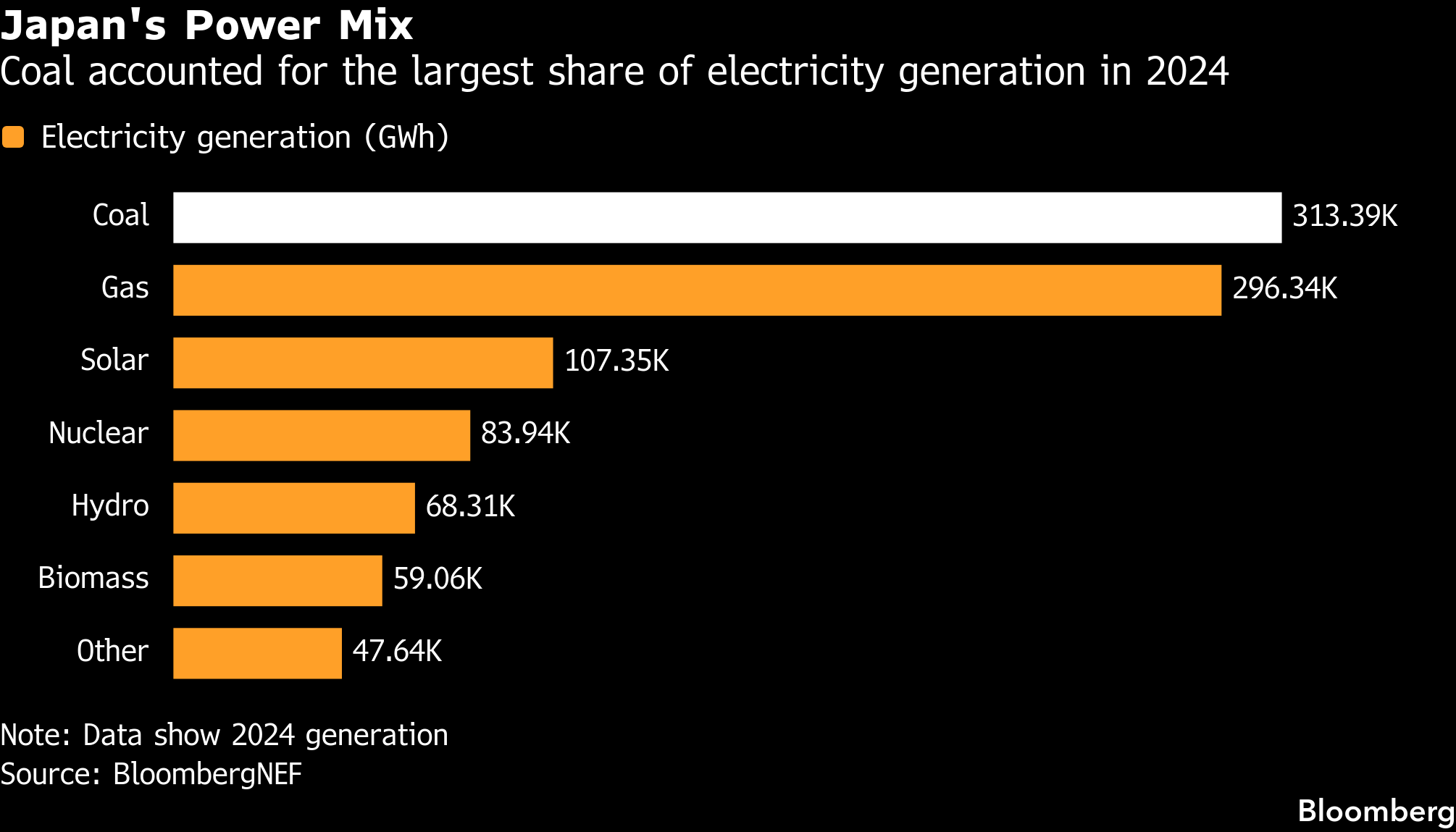
Coal accounted for the largest share of Japan’s power generation in 2024 and in the previous two years, according to data compiled by BloombergNEF. The proposal presented on Friday will offset about 500,000 tons of LNG use, the trade ministry said in the document.
Increasing coal-fired power will also help insulate Japan from uncertainty over oil imports, which is occasionally used for backup generation. Japan relies on the Middle East for more than 90% of its oil, with most going to the transport and industrial sectors. Around 64% of coal imported into Japan came from Australia in 2023, according to data from the trade ministry.
While Japan has limited exposure to the Middle East when it comes to LNG, the government will work with the private sector to monitor its inventories of the fuel regularly, the trade ministry said. The government may step in to help coordinate LNG sharing between utilities if needed, it added.
The proposal is a shift, even if temporary, away from original policies that tried to limit the use of inefficient and polluting coal power plants. Japan outlined in its latest national energy strategy last year that it will continue to gradually cut use of such power generation assets.
Japan was one of only five major polluting nations or regions to curb total greenhouse gas emissions in 2024 with a 2.8% reduction, the most recent global annual data compiled by the European Commission shows. The nation’s power industry lowered emissions by 8% between 2005 and 2024, the figures show, as installations of clean energy expanded.
Even so, the nation’s target to cut emissions 60% by 2035 from 2013 levels is regarded as too weak and currently insufficient to enable Japan to hit net zero by 2050, according to BloombergNEF.
©2026 Bloomberg L.P.