

Heat Wave Pushed UK Power Grid to Record Operating Strain


(Bloomberg) -- On a sweltering day in late June, the UK’s power grid came under exceptional strain. As temperatures rose, wind generation slumped and electricity prices spiked, forcing Britain’s grid operator to take emergency measures to keep the lights on.
The system ultimately held. But fresh analysis shows the grid’s frequency remained below its normal operating level for almost 26 minutes — the longest such stretch on record, according to energy data provider Montel — leaving the system with less margin for error if another problem had occurred.
The findings come as Britain’s grid faces political scrutiny. Shadow Energy Secretary Claire Coutinho has accused the National Energy System Operator of withholding information and risking blackouts, citing whistleblowers who contacted her about actions taken on June 23. While Coutinho hasn’t provided evidence for the claims, and NESO denies wrongdoing, the dispute has drawn renewed attention to the resilience of the UK’s grid.
The episode underscores a broader challenge facing Europe. As heat waves grow hotter, longer and more frequent, electricity demand is becoming less predictable just as power systems rely increasingly on weather-dependent renewable generation. That’s leaving grid operators with limited flexibility when conditions don’t cooperate.
In recent weeks, NESO has issued three warnings asking for additional electricity supplies to maintain a sufficient operating reserve. While all of the warnings were ultimately resolved without incident, including one this week, they’re emblematic of the extra measures needed to keep society functioning as normal when extraordinary heat becomes routine.
Such measures are typically associated with winter, when heating demand peaks. But as extreme temperatures drive up electricity use across Europe, summer is emerging as an increasingly risky season for the region’s power system.
“When I was a trader, we were always saying summer is boring,” said Noemie Baud, an analyst at Montel and former senior intraday power trader at Convex Energy. “This is not the case anymore. Summers are as interesting, if not more, than the winters.”
Emergency Measures
Weather conditions were particularly difficult on June 23. The UK, like much of Western Europe, was in the midst of a scorching heat wave. Schools were forced to shut, and the authorities issued a red alert for much of the country, warning that the heat could disrupt energy and travel — and might even turn deadly.
Around midday, the UK generated over 13 gigawatts of solar power, with the renewable source supplying more than a third of electricity to Britain’s transmission network, according to grid data. But by evening, that generation faded. With little wind, the UK was forced to ramp up gas-fired power plants to their highest level since March to fill the gap.
Signs of trouble soon surfaced. Around 6 p.m., the grid’s system frequency started to fall sharply. The metric, which must remain close to 50 hertz to keep the power system stable, is legally required to stay between 49.5 and 50.5 hertz. In practice, however, it rarely strays outside a much narrower range of 49.8 to 50.2 hertz, according to NESO.
Around 8 p.m., the frequency fell to as low as 49.656 hertz.
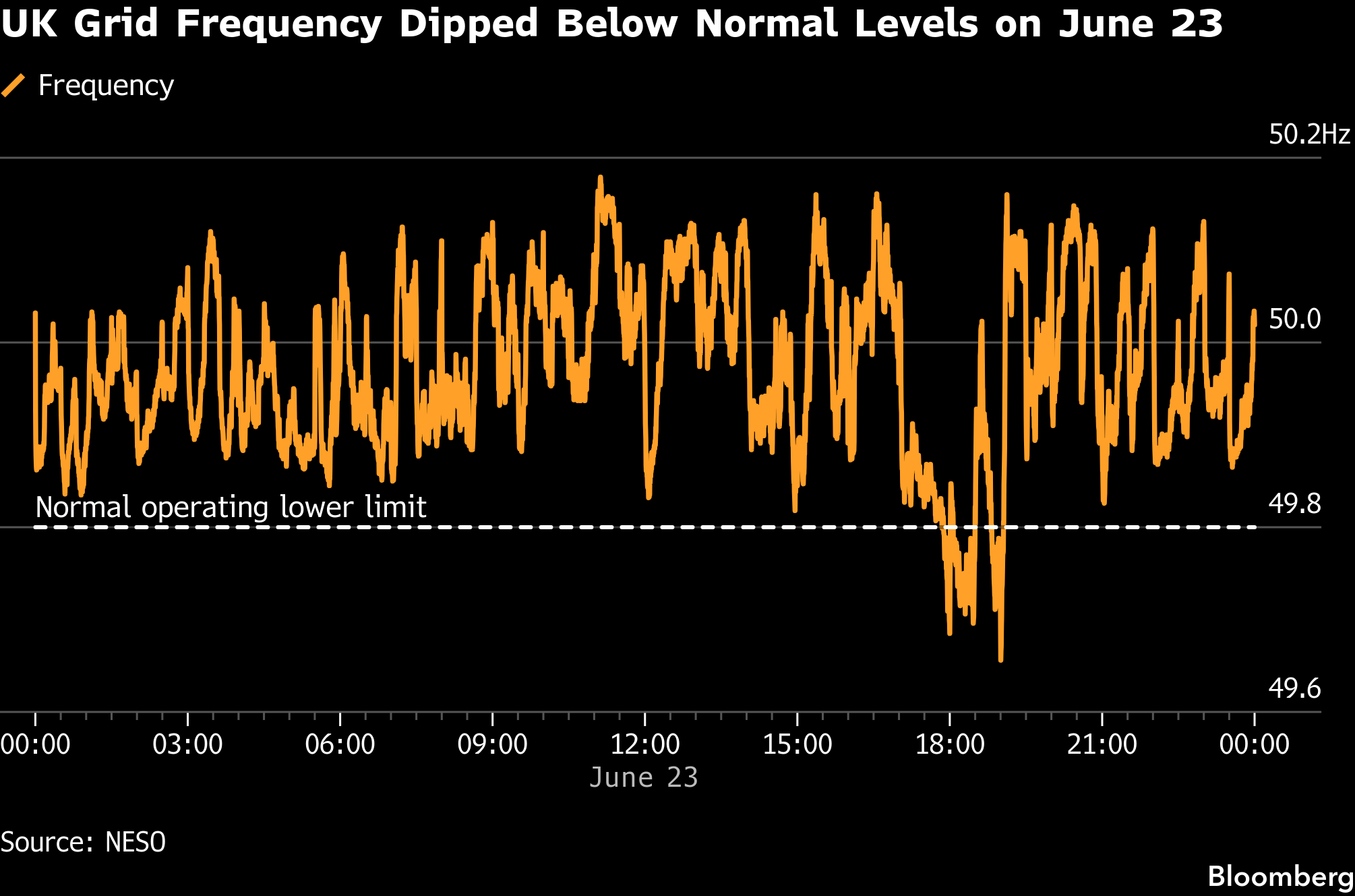
The following day, power traders dissected what had happened at a weekly industry forum. NESO representatives pointed to a confluence of unfavorable conditions: Electricity demand had been exceptionally high, transmission constraints forced the grid to curtail some wind generation, and wind output was weaker than forecast, further tightening supplies.
At that point, the UK grid operator took emergency action. It halted exports over the BritNed power cable linking Britain and the Netherlands, according to NESO’s responses to questions from traders. NESO also asked the French grid operator for assistance. While it didn’t specify the action it took, grid data show exports stopped around the same time.
These measures stabilized the system, and ultimately, the UK had other options at its disposal if needed: Britain was still able to export electricity to Denmark and Belgium during the heat wave, flows it could have curtailed if conditions had deteriorated further.
Even so, the grid was “looking riskier than usual,” said Montel’s Baud. “They were not in a comfortable situation,” she said. “I can’t say how close it was to a blackout.”
In the days since June 23, NESO has emphasized that no customers lost power and that the electricity system “remained secure.” But the episode was serious enough for the grid operator to launch a detailed review to prepare for the next inevitable moment of stress.
“We will continue our analysis of operational data and implement any lessons learned,” a spokesperson for NESO said in an emailed statement.
(Updates fifth paragraph with resolution of NESO warnings.)
©2026 Bloomberg L.P.