

Arctic Blast Triggers Alerts and Disruptions Across Europe

(Bloomberg) -- A blast of Arctic air is spreading bitterly cold weather across much of Europe, boosting power demand and disrupting transport in some areas. Hundreds of flights were canceled at the Schiphol airport in Amsterdam due to snow on runways.
The high-pressure systems over the Atlantic and Arctic caused temperatures to hit -1C (30F) in London on Monday, with lows expected to be around zero on Tuesday, according to the UK’s Met Office. The cold snap is also affecting other parts of northern Europe, as well as central areas and the Nordic region.
The sub-zero temperatures are set to drive waves of snow and ice in many places, including Scotland, Spain, Germany and the Netherlands. France has issued orange weather alerts across 26 departments.
The conditions have raised heating demand across the continent, with France ramping up gas generators to meet electricity consumption that hit a five-year high on Monday.
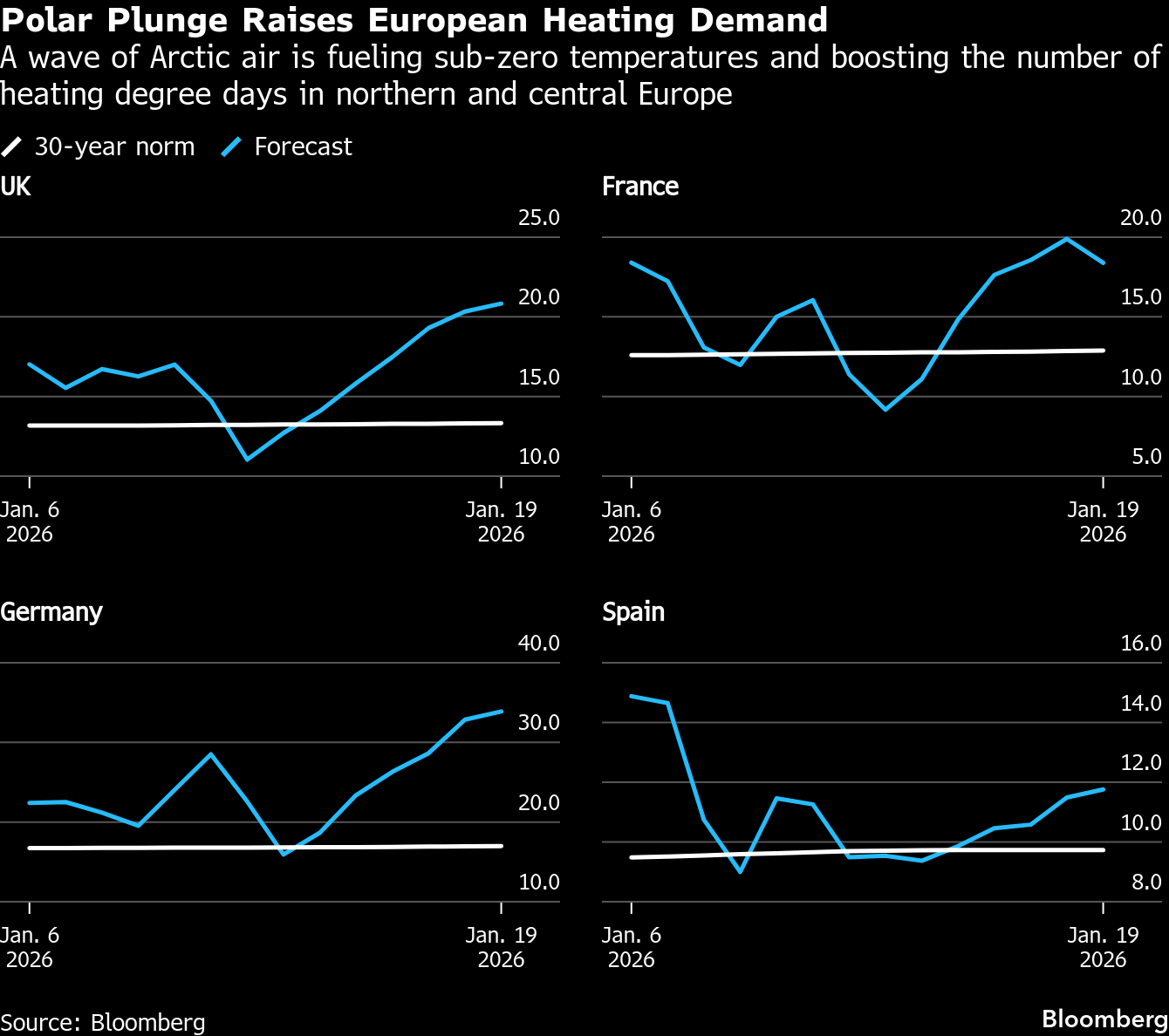
Lows of -4C are expected in Paris on Monday and Tuesday, 7C below the long-term norm. Elsewhere, minimum temperatures in Munich should range from -10C to -12C for much of the week, according to government forecasters.
In France, up to 15 centimeters (about 6 inches) of snow is expected in some areas, according to Meteo France. By Monday, heavy snowfall was causing widespread travel disruptions.
Flights were limited at Paris Charles de Gaulle and Paris Orly airports, and transport operator RATP suspended bus service throughout the capital, according to Transport Minister Philippe Tabarot. Deteriorating conditions also fueled a record 910 kilometers (565 miles) of traffic jams on roads across the Paris region, according to France Info.
Ahead of the snowstorm, authorities prohibited heavy goods traffic on several major highways in Brittany, and rail operator SNCF warned of train disruptions in Normandy. School transportation was suspended for the entire day in Brittany and Normandy, broadcaster TF1 said.
By next week, the high pressure is forecast to give way to warmer, wetter air from the Atlantic Ocean, which is expected to bring a shift toward milder conditions across the western half of Europe, according to analysis from Vaisala and MetDesk.
Some weather models see cold weather returning again quickly. Still, European natural gas prices dropped Monday amid projections for milder weather and ample supply later this month and in early February.
(Updates with additional details in paragraphs six through eight.)
©2026 Bloomberg L.P.