

England’s Water Network Buckles Under Sudden Summer Drought


(Bloomberg) -- The severe “flash drought” that has gripped England is pushing an already struggling water network toward breaking point — and it’s showing no sign of easing.
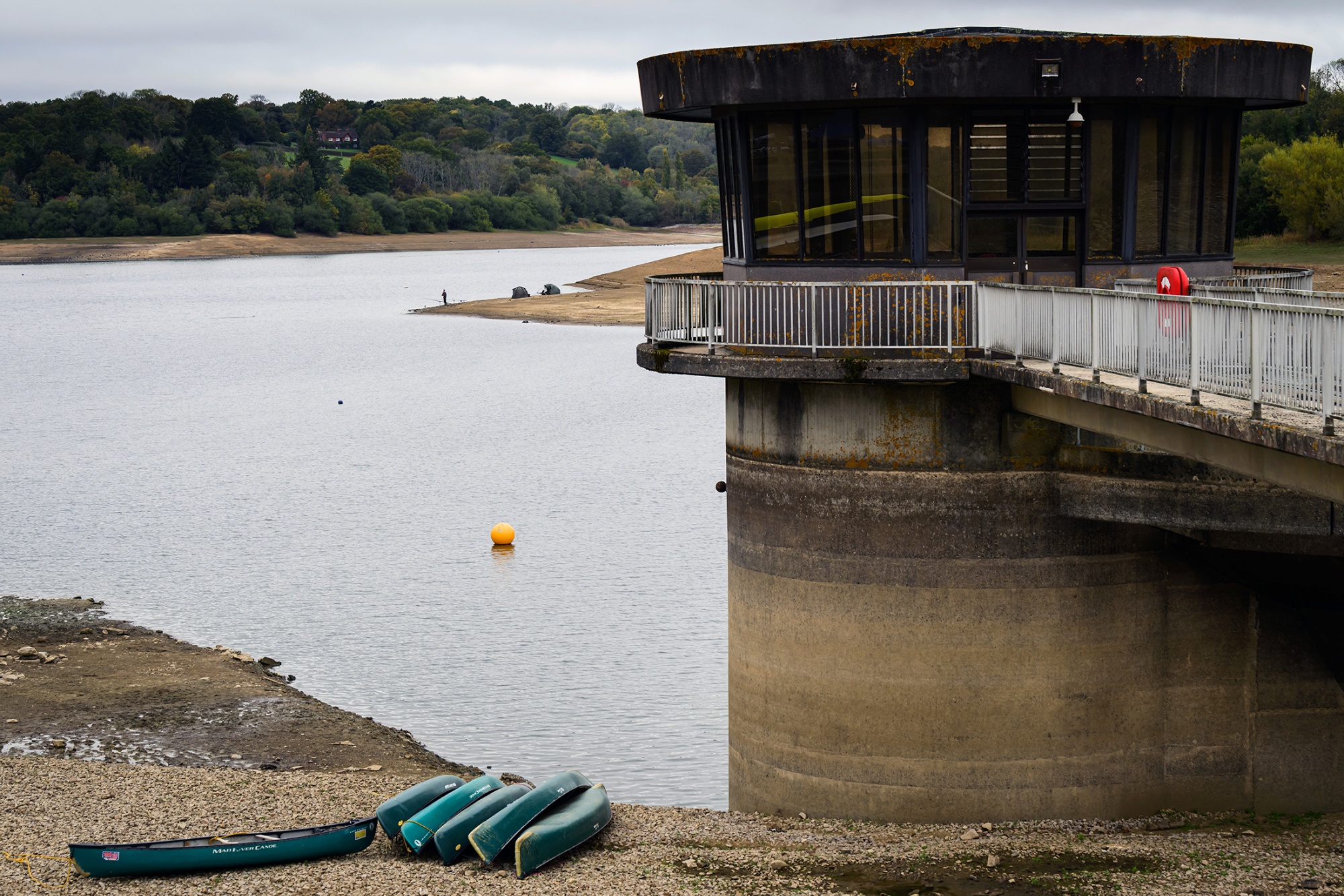
The situation is particularly dire in the southeast, where one of the wettest ever winters had replenished reservoirs and boreholes so much that they should have had enough water to get through summer. But now, water companies are trucking supplies around, seeking emergency restrictions and asking to keep drawing from environmentally protected rivers to keep the taps on.
Some 30 million people face hosepipe bans and supplies have been disrupted by heat waves and drought, which drained rivers, sparked wildfires, hurt crops and turned grass yellow across swaths of the country. London has been so bad that dry clay led to record insurance claims tied to home subsidence. Utilities have scrambled to avoid a repeat of 1976 crisis, when water was rationed in some areas and people filled buckets from standpipes in the street.
“The summer of 2026 has produced the most intense flash drought we’ve seen,” said Jamie Hannaford, head of water resources and drought at the UK Centre for Ecology & Hydrology.
Water companies are now preparing for the possibility that conditions deteriorate even further.
A hearing was held Tuesday as Southern Water seeks to impose tougher restrictions on customers while continuing to take water from the River Test even as its flows fall below a set threshold. The Test is a protected chalk stream, and taking more when flows are already low can further damage its habitats, including those used by endangered salmon.
The firm has also applied for powers to ban some non-essential uses of water, potentially England’s first such restrictions in two decades, affecting businesses including car washes and non-domestic swimming pools. At the hearing, the Environment Agency backed the proposed restrictions on commercial water use, but raised significant concerns about Southern’s request to keep drawing water from the Test as flows fall.
The extreme weather is further exposing a water system plagued by leaks and outages, as demand ramps up and drier ground damages aging pipes. Cash-strapped Thames Water, whose infrastructure can date to Victorian times, is contending with even more pipe bursts while considering whether to revive a beleaguered desalination plant. Climate change is making water investment, a major political issue in the UK in recent years, ever more important.
The UK’s water crunch comes as Europe faced successive heat waves and drought this year that also stressed power systems and public health services.
“There is a risk that we could experience our own Cape Town Day Zero event,” said Rob Lawson, director at Artesia Consulting, referencing the 2018 threat of having to turn off taps there.
England had its driest July ever, and while some rain returned in August, it was far below normal. Though certain regions — including in the north — are faring better than others and autumn is approaching, much more rain is needed to reverse the drought.
Showers in recent days have brought some relief, but the Met Office said there’s currently no strong indication for a sustained period of above-average rainfall in the short term.
London Squeeze
To maintain supplies, Thames Water has reduced exports to neighboring utilities, redistributed water to where it’s needed most and brought more groundwater sites online as demand soared in the heat. Lower Thames reservoirs fell to 62% of capacity by Aug. 24, 13 percentage points below the normal range, government data show. That’s down from 72.4% at the end of July.
Heat and dryness cause soil to shrink, leading to pipe cracks. Thames Water’s visible leaks totaled 2,871 in July alone, up about 66% from two years earlier.
In August, burst pipes left around 10,000 customers in east London and Essex without water or with low pressure for almost a week. Chigwell resident Sue Bell spent an entire day securing bottled water while caring for her housebound husband. She considered staying in a hotel, but nearby ones were also affected, and she’s now keeping emergency supplies.
“I just don’t trust them,” she said of Thames’ supplies.
The company wants to revive its desalination plant in east London, an energy intensive facility that cost £270 million ($367 million) to build and was designed to provide as much as 150 million liters (39.6 million gallons) a day during drought. Thames expected it to be offline until 2028 amid membrane issues, but said it could potentially resume production this year.
Longer term, Thames needs billions of pounds for new pipes and water supplies as it fights for financial survival. Its proposed £6.6 billion Oxfordshire reservoir won’t be ready until 2040.
Wheelers Oyster Bar in the popular southeastern seaside town of Whitstable was at the sharp end of weather-related disruptions in May, when supply issues affected thousands of Kent properties. South East Water said demand during hot weather pushed local storage reservoirs to critical levels, even as it treated and pumped more than usual.
Wheelers chef Mark Stubbs arrived at work to find no water just as around 30 boxes of fresh produce were delivered. Staff couldn’t process seafood or clean equipment. Stubbs estimates he threw away as much as £2,000 of food and the business lost several thousand pounds more after canceling reservations.
“You can’t wash your hands, you can’t sanitize, you can’t do anything,” he said. “It literally stops everything.”
The restaurant is now considering taking the unusual step of having its own emergency backup water storage.
As service issues continued, South East Water has used a fleet of tankers to move water and inject it into the system where there are constraints, shifting at least 23 million liters since the start of July.
Drought last year also exposed challenges with the utility’s emergency backups. When it tried to tap the River Ouse to refill the Ardingly Reservoir, protective fish screens restricted flows to abstraction pumps, meaning the extra supplies were unavailable.
Before this year’s drought, leakage problems were already worse than expected. Thames Water, South East Water and Southern Water leaked more in the 2024-25 year than forecast in water-resource plans.
Regulators have repeatedly warned firms are failing to deliver against their own plans, and has told Southern that six consecutive years of underperformance put customers and the environment at “unacceptable risk.”
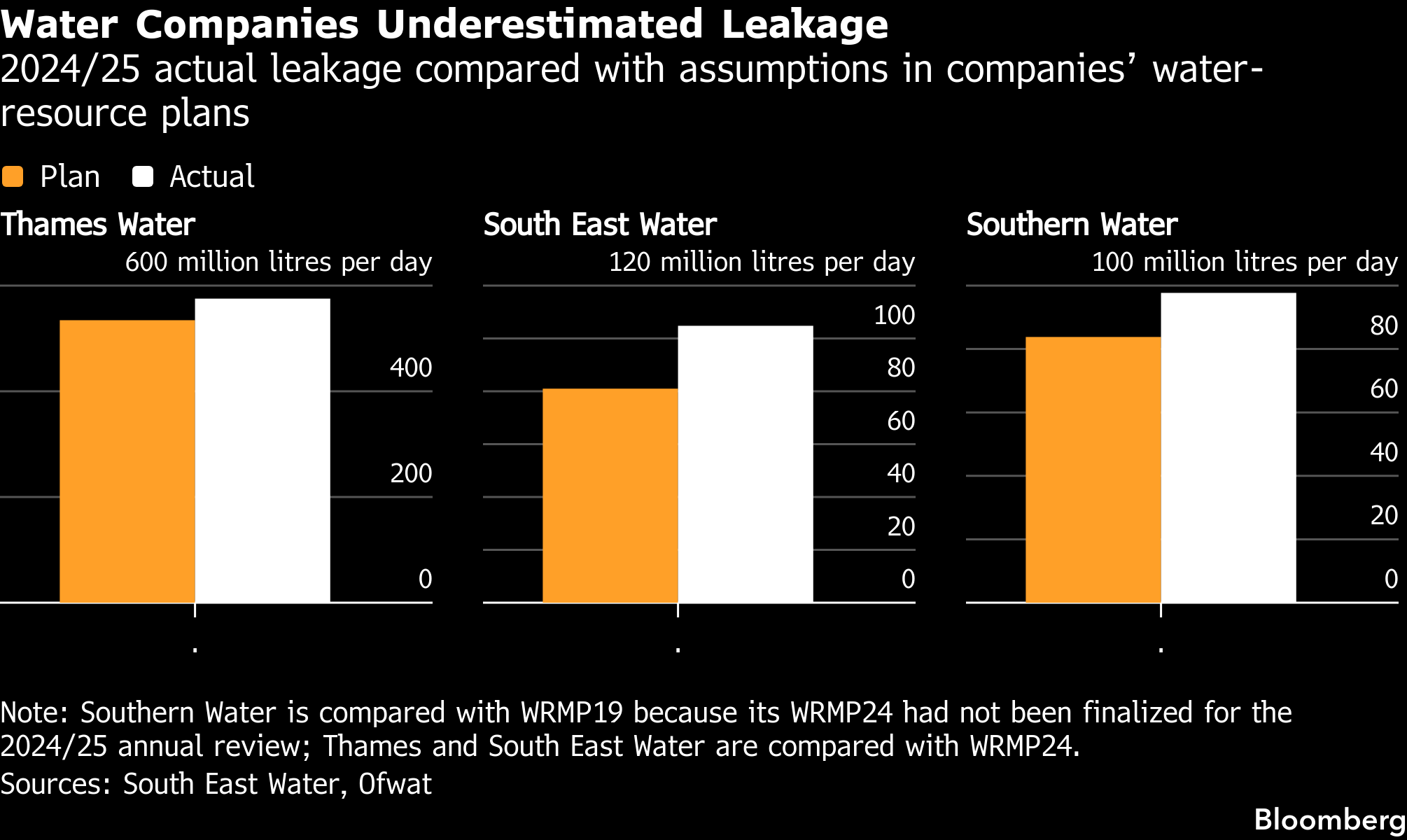
South East Water said it fixed more than 21,000 leaks in the past year, about 10% more than the previous year, and has brought in additional repair teams to tackle bursts and leaks. Southern said it has beaten its regulatory leakage targets this year, and that its drought order application is precautionary.
Environmental Threat
With reservoirs under pressure, water companies often turn to rivers to tap supplies. The problem is that their levels have also fallen.
On the River Test, one of England’s rare chalk streams, riverkeeper Donny Donovan has never seen flows so low in six decades of knowing the waterway. Six miles (9.7 kilometers) from its source, he was alarmed when he measured the water at 16.4C one morning in August, around 2C warmer than he had previously recorded there.
The heat and dwindling river flows are making blanket weed spread across parts of the Test, smothering other plants and drawing oxygen from the water.
Southern Water wants permission to continue abstracting from the Test, if necessary, even when daily river flows fall beyond the normal 355 million-liter threshold designed to protect it. Flows were around 433 million liters on Aug. 24.
But doing so could have serious consequences.
Salmon in the area’s chalk streams are genetically distinct and already below conservation thresholds, said Ali Morse, water policy manager at The Wildlife Trusts. Low river flows can leave fish stranded in warmer, oxygen-depleted water and make it harder for them to migrate upstream to breed.
“If we lose them from these chalk streams, they’re permanently gone,” she said.
Curbing Southern’s reliance on rivers isn’t easy, with the Havant Thicket Reservoir, which will be the first new reservoir in England and Wales in decades, not expected to supply water until around 2031. Morse said that leaves the region vulnerable until then, with demand reduction one of the few options to safeguard supplies without further damaging the environment.
For riverkeeper Donovan, it’s about what water is worth.
“Water for this river comes bubbling out the ground, just like oil comes bubbling out the ground,” he said. “But it is infinitely more valuable than oil.”
©2026 Bloomberg L.P.








