

Iran Shock Boosts South Korea’s Push to Cut Fossil Fuel Imports


(Bloomberg) -- The Iran-driven energy shock is adding urgency to South Korea’s push to cut its reliance on imported fossil fuels, giving President Lee Jae Myung momentum to push his clean-energy agenda.
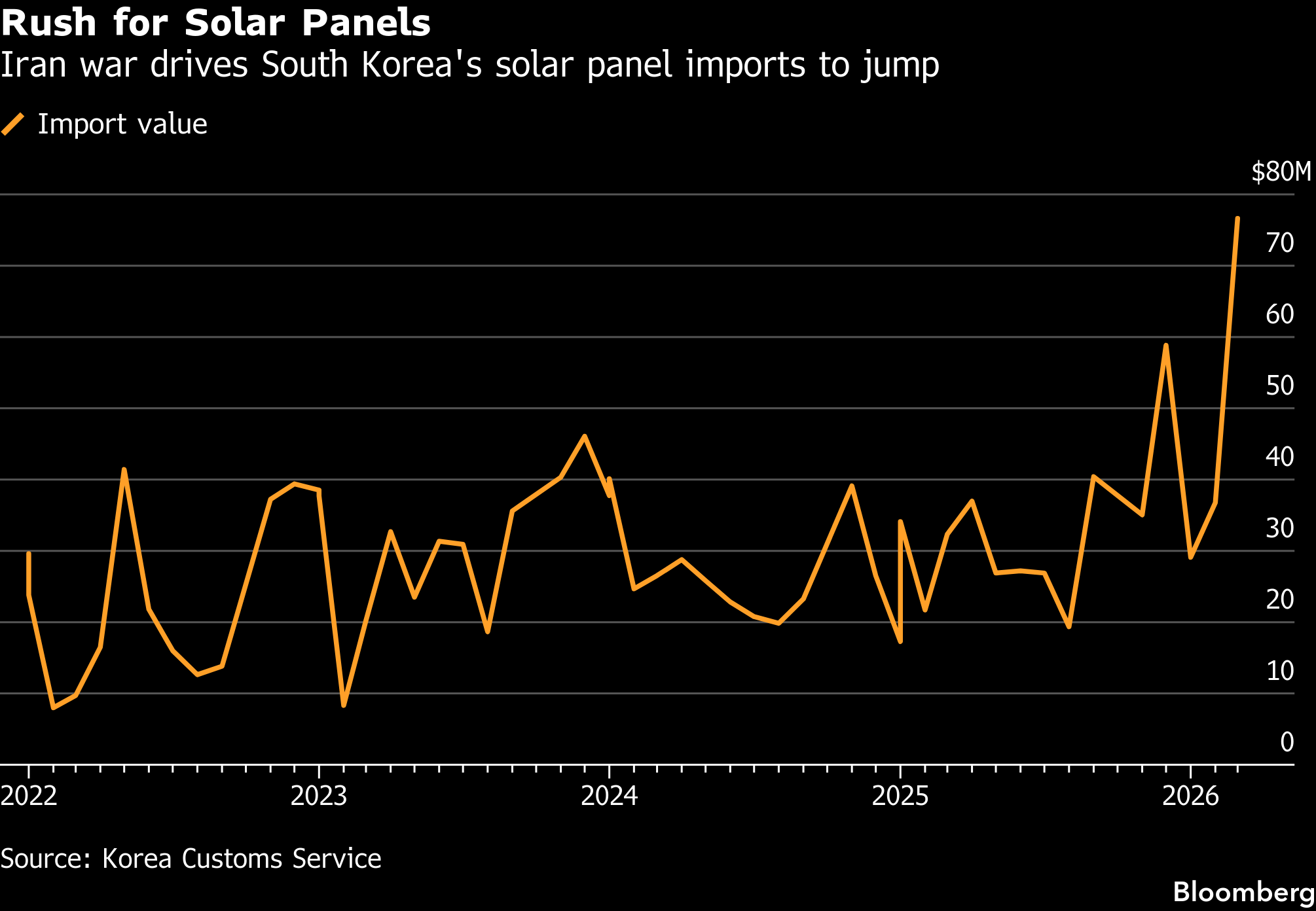
Electric vehicle sales and solar panel imports have surged since the conflict in the Middle East began in late February, early signs that higher fuel costs and supply risks are reshaping behavior.
Seoul — which imports the majority of its energy, including 70% of its crude oil via the Strait of Hormuz — has rolled out a supplementary budget with 540 billion won ($365 million) for solar and wind projects, energy storage systems and EV subsidies.
The shifting consumer demand and increased fiscal support suggests the crisis is influencing both markets and policy. But core targets — expanding clean power, phasing out coal and reducing gas dependence — predate the conflict, raising questions over the depth of the structural change.
“The government has set the right direction and framing, but it’s not yet doing enough to turn this into a real opportunity to accelerate the transition,” said BloombergNEF analyst David Kang. “The biggest missed opportunity is Korea’s long-delayed power market reform, especially on the retail side.”
Liberalizing retail electricity markets, which are still dominated by Korea Electric Power Corp., would allow the state-backed utility to focus on grid upgrades needed to integrate renewables and EVs, said Kang.
The climate ministry said reforms are underway and pledged to deliver tangible results from the transition.
President Lee has repeatedly framed the Iran War as a catalyst for faster change.
“The Republic of Korea as a whole must move very swiftly toward renewable energy,” he said last month. “Our future will be at a serious risk if were continue to rely on fossil fuels.”
South Korea gets about 80% of its energy from fossil fuels, of which 93% is imported, highlighting the nation’s high external dependence. Meanwhile, demand is rising from AI data centers, electrification and advanced industries.
Lee’s strategy, laid out before the crisis, centers on a state-led transition. He has pledged to phase out coal by 2040, cut gas use and expand renewables, while his government also set tougher emissions targets.
An April roadmap targets a 20% share of renewables in power generation and 100 gigawatts of capacity by 2030, as well as grid upgrades.
Consumers are already responding. Domestic EV sales more than doubled in March from a year earlier, while solar panel imports rose 137% to a record $76.6 million.
The trend mirrors global shifts toward EVs, rooftop solar and other low-carbon technologies as energy security concerns grow.
Still, gaps remain. South Korea was among the few countries to see a significant increase in coal-fired generation following disruptions to oil flows through the Strait of Hormuz, according to the Centre for Research on Energy and Clean Air. The group said the rise was mainly because of weaker nuclear output.
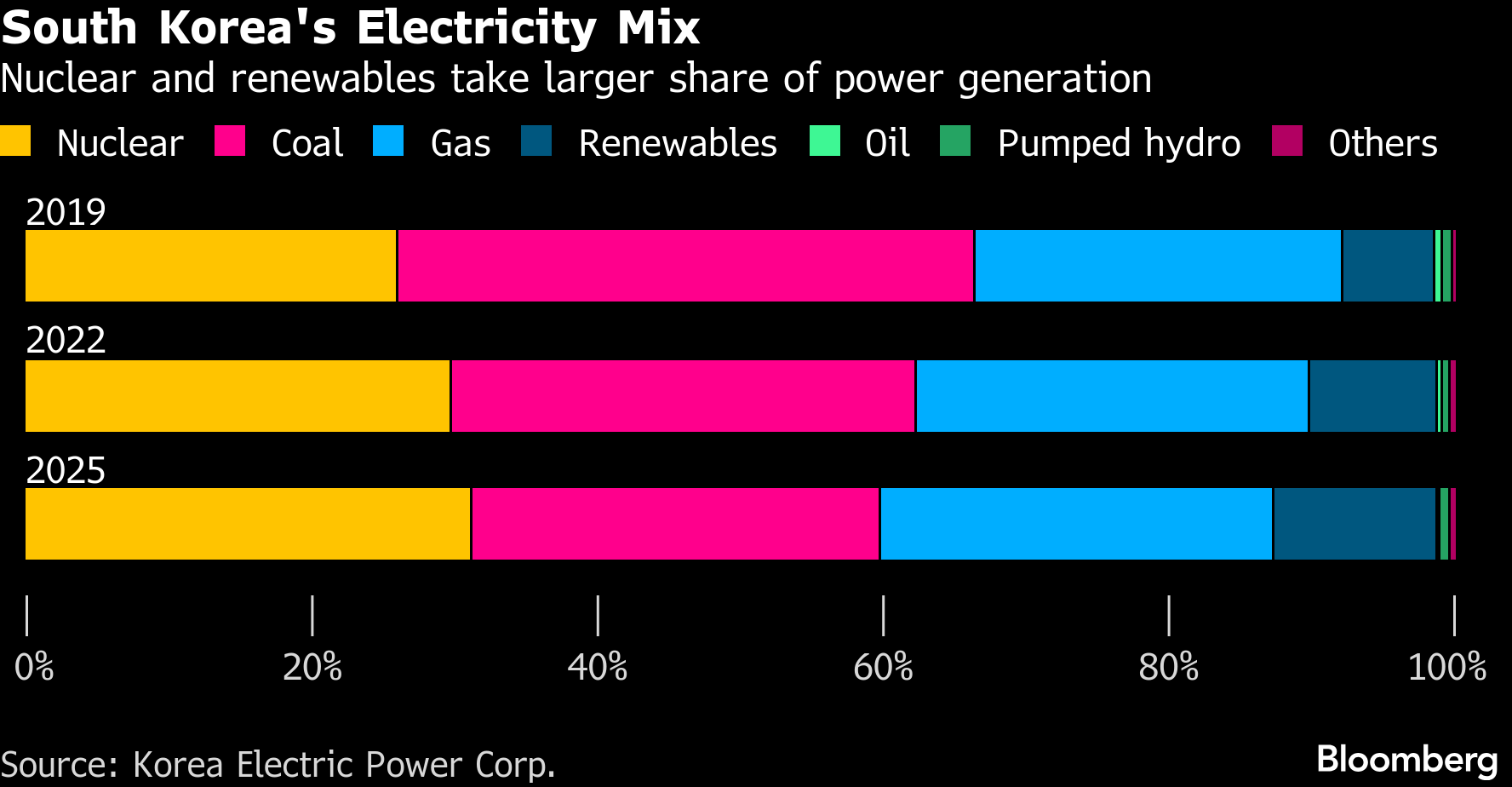
Nevertheless, it illustrates how the nation still falls back on fossil fuels under stress. Coal and gas continue to account for the bulk of power generation, while renewables make up only about a 10th, with projects slowed by permitting and grid constraints.
South Korea’s transition lags industrial peers by about 15 years, but recent policy signals point to a stronger push to accelerate the shift, according to Paige Nguyen, Asia Director at the Institute for Energy Economics and Financial Analysis.
“Although South Korea’s renewable installation costs remain relatively high by global standards, they are becoming increasingly competitive and, in many cases, are already on par with or below the marginal costs of LNG-fired power generation,” Nguyen said.
Nuclear remains a key variable. Lee has backed continued reliance “for the time being,” maintaining plans to build two reactors and one small modular reactor, while saying any further expansion will be reviewed in line with the energy mix and public consensus.
Whether momentum leads to faster permitting, grid investment and new capacity will determine if the shift goes beyond plans.
“The current crisis has created a powerful momentum,” said Katherine Hasan, an analyst at the Centre for Research on Energy and Clean Air. “But to ensure this isn’t just a temporary shield, the government needs to take a leap.”
©2026 Bloomberg L.P.