

India’s Delayed Climate Plan Sets Weak New Emissions Goal


(Bloomberg) -- India set a modest target to cut a key emissions metric 47% by 2035, as the world’s third-largest polluter attempts to balance growing energy demand and action on global warming.
A new goal to reduce emissions intensity — the amount of pollution generated per unit of gross domestic product — is calculated against a baseline year of 2005, and makes only an incremental advance on the nation’s prior commitments. India set an earlier pledge in 2022 to cut the metric 45% below the same level by 2030.
The long-delayed strategy, which had originally been due by February last year under the terms of the Paris Agreement, was outlined at a cabinet briefing Wednesday. New plans also include a target to raise the share of electricity generation capacity from non-fossil fuel sources to 60% by 2035 from a prior goal of 50% by 2030, which India said it has achieved years ahead of schedule.
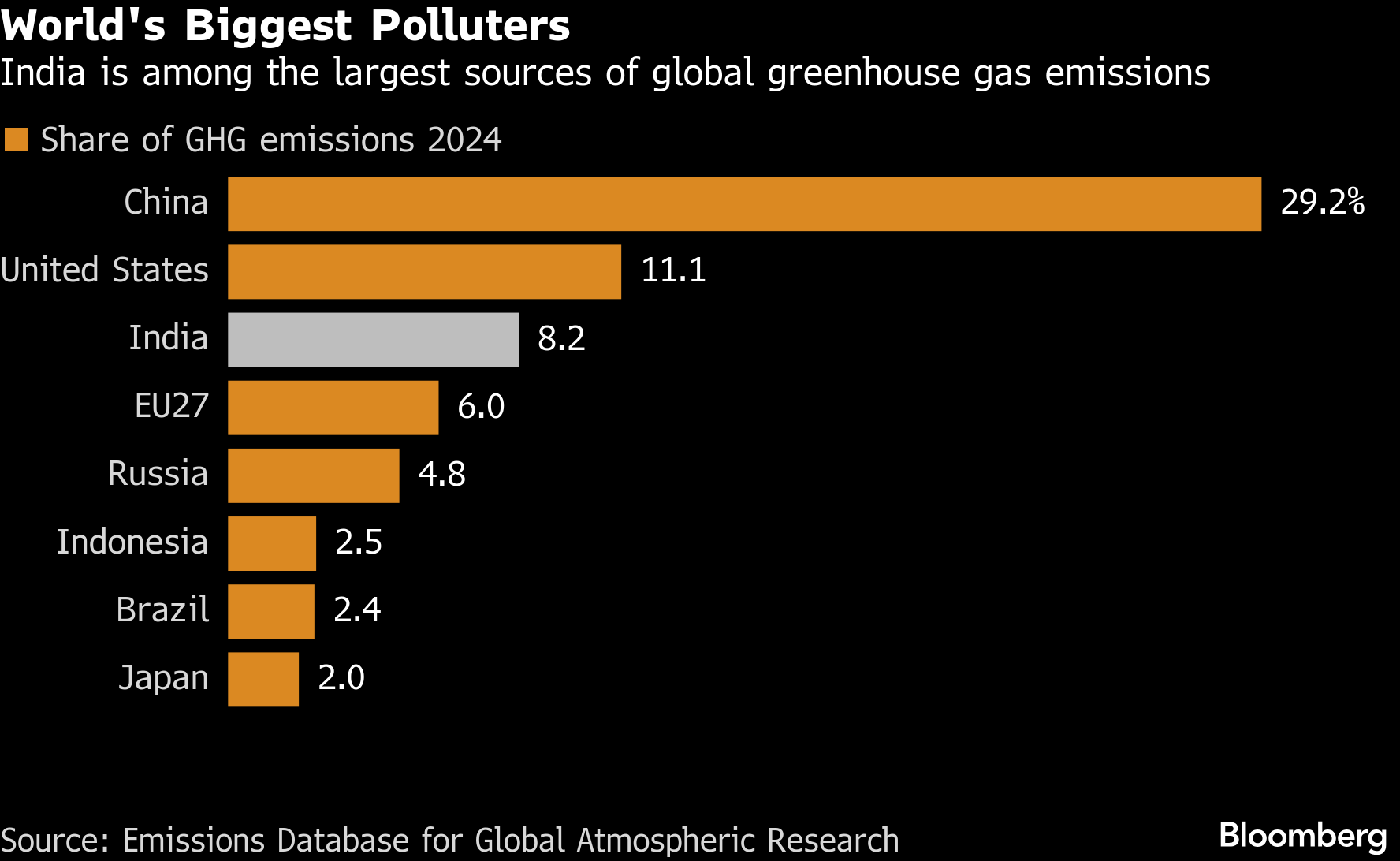
India’s fresh targets follow a series of underwhelming climate strategies from dozens of other countries that the United Nations has warned will leave the world far off track to limit global warming this century to 1.5C.
The nation’s new emissions-cutting strategy to 2035 is an attempt to “harmonize national realities, developmental priorities, energy security and the need for greater ambition in climate action,” Prime Minister Narendra Modi’s office said in a statement.
India goals underestimate the “potential for transformative clean energy growth,” said Lauri Myllyvirta, lead analyst at the Centre for Research on Energy and Clean Air. “India’s booming clean energy industry is highly likely to deliver much faster progress than policymakers were prepared to commit to today.”
The nation’s climate role is seen as particularly crucial. India is an expanding economy where emissions are continuing to rise, population growth won’t peak until the 2060s, and demand for air conditioning and data centers is pushing electricity consumption higher. Coal currently accounts for nearly three-quarters of power generation.
A new 60% target for non-fossil electricity generation compares to a forecast this month by the country’s power ministry that already projects clean energy capacity will rise to 70% by March 2036.
“This is actually much less ambitious,” said Alexander Hogeveen Rutter, a Bengaluru-based power analyst. “It is substantially less than the government’s own generation plan” and implies a lower-than-expected rate of solar and wind additions which risks raising power costs for consumers and reducing energy security, he said.
Indian officials have frequently urged richer countries to take on more of the immediate burden of reducing emissions, and complained about the level of financial aid offered to developing nations. India also argues that its situation is unique as it needs to fully develop its economy while also limiting pollution, unlike Western nations where industrialization was propelled by fossil fuels and unchecked emissions.
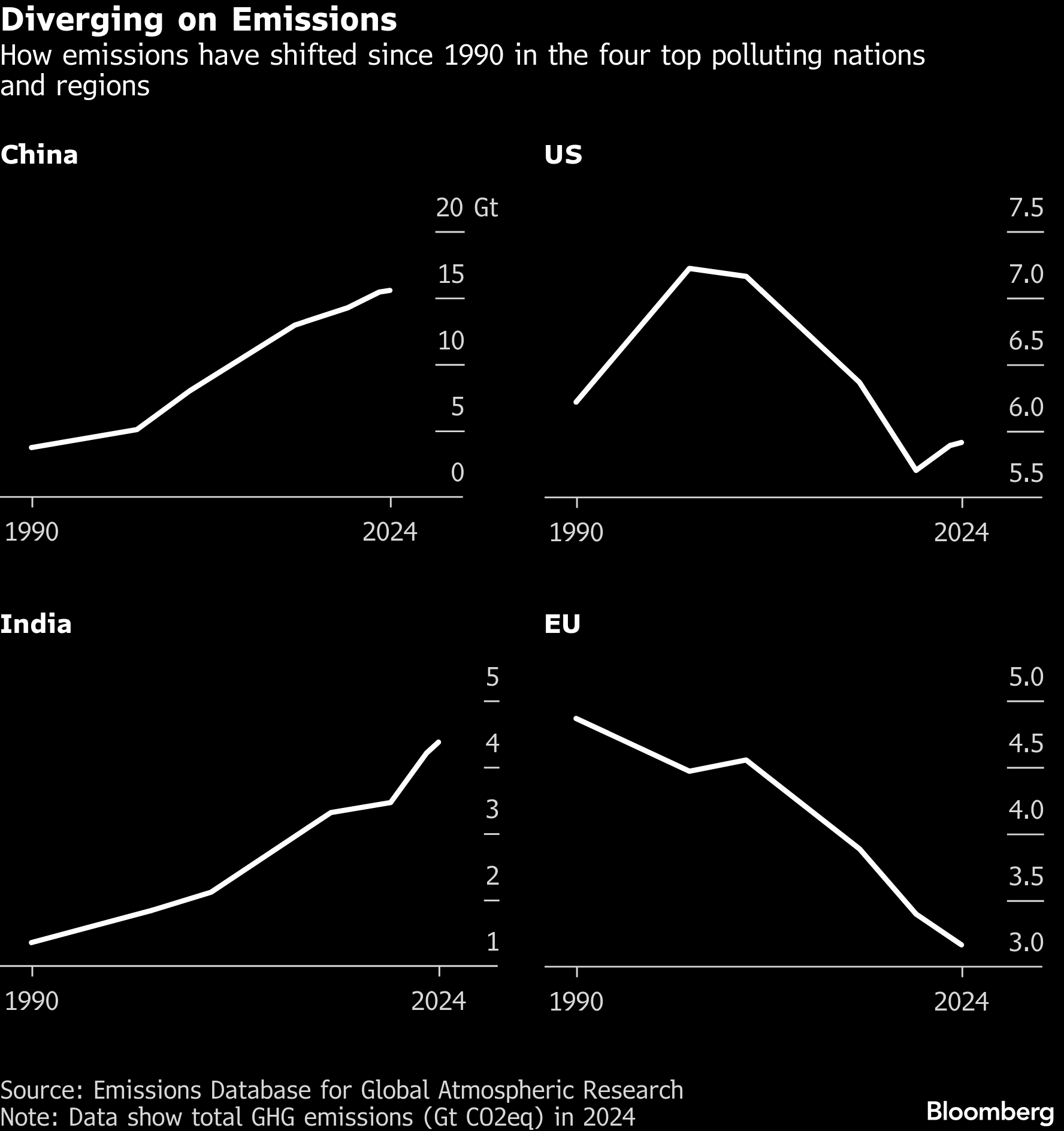
Details presented at Wednesday’s cabinet meeting also outlined a plan for India to extend forest and tree cover to create a carbon sink capable of sequestering between 3.5 billion and 4 billion tons of carbon dioxide equivalent.
The new plans put India on track toward achieving net zero by 2070, Modi’s office said in its statement. That goal is two decades after many other national targets, and a decade later than China. A draft blueprint on how to achieve the ambition previously called for about $21 trillion in investments.
India’s revised targets “are a step in the right direction, but they fall short of the ambition required at this stage of the energy transition,” said Vibhuti Garg, director, South Asia, at the Institute for Energy Economics and Financial Analysis, a think tank.
©2026 Bloomberg L.P.








