

Texas Declares Disaster as Season’s Biggest Storm Approaches


(Bloomberg) -- Texas Governor Greg Abbott issued disaster declarations for more than half the counties in the state ahead of a powerful winter storm that will be one of the toughest tests of the electric grid since a deadly 2021 collapse.
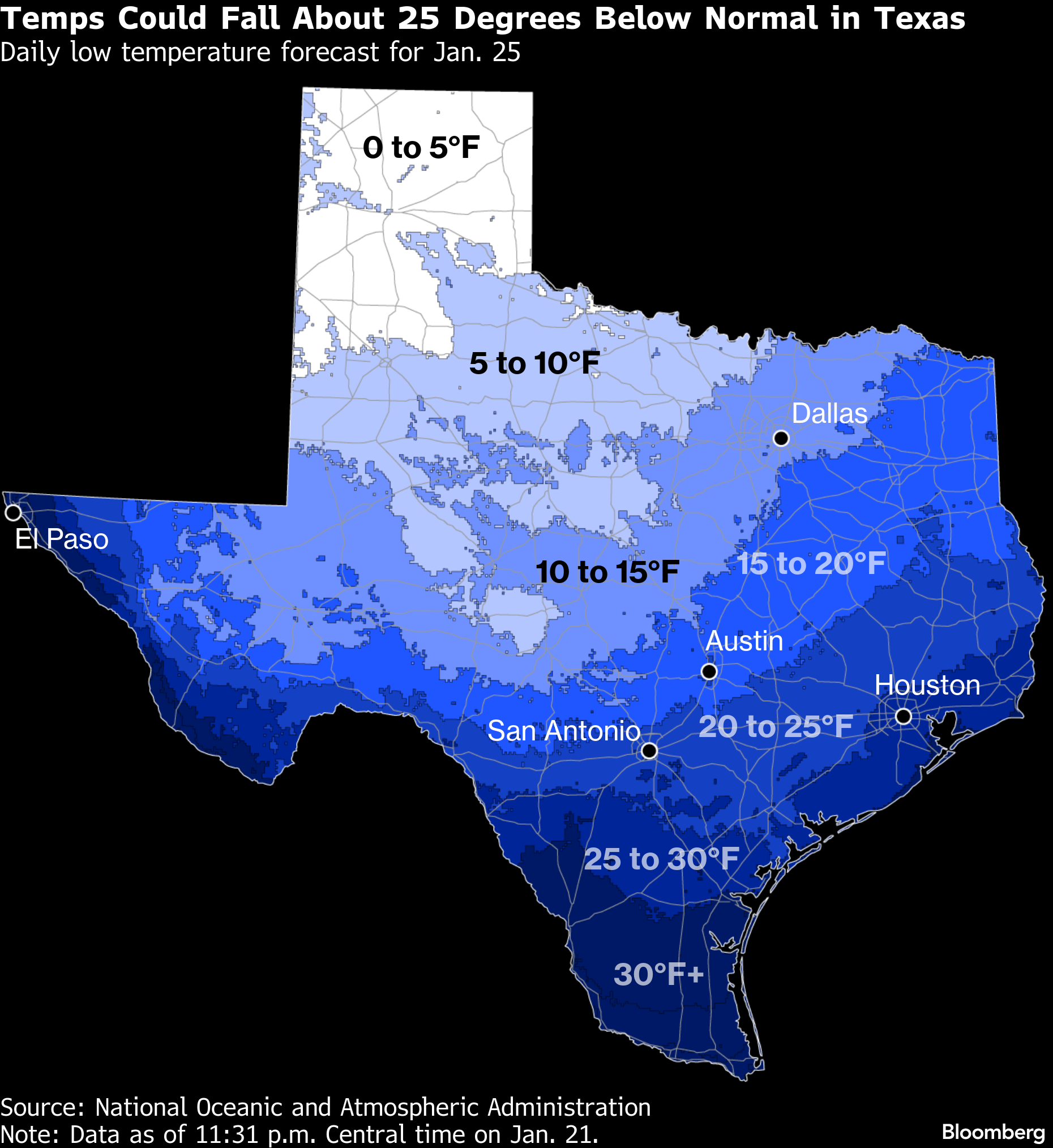
Ice is predicted for the Dallas area, the Panhandle is bracing for snow, and the capital city Austin is forecast to dip to 16F (-9C) — roughly 25F chiller than normal. The cold is set to persist through the weekend before readings start to moderate early next week, said Brian Hurley, a senior branch forecaster with the US Weather Prediction Center.
Abbott issued disaster declarations for 134 counties on Thursday and warned that ice may threaten power lines in coming days. The Electric Reliability Council of Texas, the state’s main grid operator, issued a weather watch from Saturday through Tuesday with the possibility of higher electrical demand and the potential for lower reserves.
Even so, Ercot expects power supplies to be ample and Abbott expressed confidence that the grid won’t have any major issues.
While some of the forecast conditions resemble the historic February 2021 freeze that killed more than 240 people and paralyzed the entire state, Texas has one thing going for it: this storm will be shorter and less intense than what the National Weather Service calls the “Great Texas Freeze,” which lasted the better part of nine days.
During that disaster, outages knocked out power to nearly 10 million people across the US South, leaving them without heat, lights, the ability to cook, while bursting water pipes in homes and businesses. It was the first $1 billion disaster of that year.
And even as population growth, crypto mining, data centers and corporate relocations have contributed to surging electric demand, Texas has invested in fortifying its grid over the past five years.
Ercot is projecting peak demand of about 83 gigawatts on Monday, which would surpass last year’s all-time winter high of 80.2 gigawatts. But it expects to have sufficient supply — about 93 gigawatts of capacity. (One gigawatt is equivalent to a traditional nuclear reactor.)
“Texas has seen substantial growth in solar and battery storage capacity — with nearly 40 gigawatts of new solar and storage capacity added between end of 2021 to 2025,” said Helen Kou, an analyst at BloombergNEF. “Ongoing expansion of these resources, plus continued winter weatherization grid investment, will help keep the grid prepared.”
The main threats to most of Texas will be ice on power lines and trees as temperatures plunge. Dallas is expected to dip to 8F Sunday night, with Houston falling to 22F, the weather service said. Snow will be mainly across far northern Texas and the Panhandle, but many areas in the central part of the state will get between 0.25 to 0.5 of an inch of ice, which can snap tree branches and drop power lines, Hurley said.
In preparation for the storm, CenterPoint Energy Inc. said it’s establishing staging sites in the Houston area and marshaling more than 3,000 utility linemen to help restore any power outages.
Almost the entire eastern US from the Great Plains to the Atlantic Coast area covered by winter storm warnings, advisories, watches and cold alerts, according to the National Weather Service. The only part of the county not affected is the West and parts of the Southeast. A wide area from Washington DC to New York into New England may get as much as 10 inches of snow Sunday, Hurley said. Air travelers will likely face cancellations and long delays.
The storm’s worst is expected to sweep the South, from eastern Texas and Louisiana to Arkansas and North Carolina, Georgia and Virginia, where as much of an inch of ice will encrust trees and power lines, leading to widespread outages.
“Ice is going to be a bigger deal because it has more impacts,” Hurley said.
As forecast, storm and ice damages and losses may reach $25 billion if disruptions last into next week, said Chuck Watson, a disaster modeler with Enki Research. Estimates may change depending on the exact track of the worst damages.
In the wake of the 2021 storm, Texas required generators and powerline operators to make sure facilities can operate during freezing temperatures. Texas also adopted market reforms designed to secure extra power reserves during times of grid stress.
Officials also say they improved emergency planning and coordination among utilities, the state grid operator and state agencies. Still, the Texas grid remains relatively isolated from the rest of the country’s bulk power network, leaving the state largely dependent on supplies within its own territory.
For Texas, the forecast remains locked in, but the saving grace is that “it doesn’t seem to be as long” as 2021, Hurley said.
©2026 Bloomberg L.P.








