

Solar’s Boom in Europe Is Reaching Places Once Deemed Too Dark


(Bloomberg) -- For decades, Europe’s renewable energy map looked straightforward: solar was mostly used in the sunny south, while the north relied on wind. But plunging equipment costs and higher electricity prices have made solar projects viable in places once considered too dark, cold or remote to pay off.
Large solar farms are being built around the Arctic Circle in the Nordics, rooftop panels are spreading across northern Scotland and the technology has even found a role in the notoriously cloudy Faroe Islands in the Atlantic Ocean. Its rise is giving governments another way to electrify their economies while producing more energy at home.
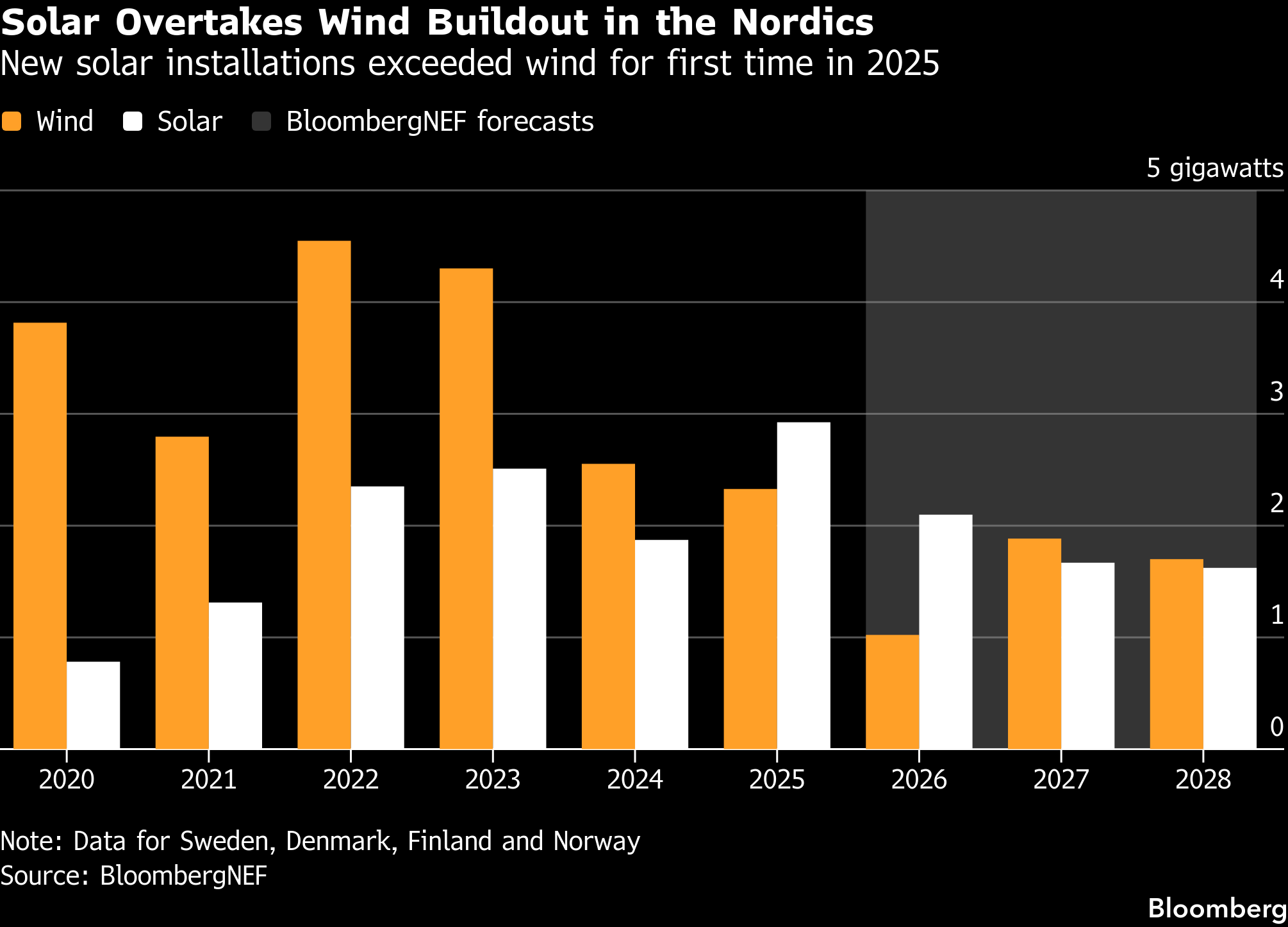
Across the Nordic region, for the first time, investors and utilities added more new solar capacity than wind in 2025, a lead expected to continue this year, according to BloombergNEF. Governments have upgraded their own forecasts as installations exceed expectations. Sweden reached its original 2030 solar target in 2023 and is already close to meeting a newer, more ambitious goal. Finland hit its end-of-decade target six years early.
“The question isn’t whether solar works this far north anymore,” said Warren Campbell, chief executive officer of Swedish solar developer Alight AB. “It’s how much we’re going to build.”
Developers are already planning the next wave of projects. Companies have proposed at least another 300 megawatts of solar in Finland’s northern Lapland region. Projects of around 600 megawatts are seeking grid connections in the north of Sweden.
The industry’s momentum in Europe’s northern flank is in sharp contrast to its struggles further south. So much solar has been installed in Spain that power prices are plunging and investors get very little or no return at all for their buck.
But in the Nordics, the shift has been driven by a sharp improvement in economics. Panels and related equipment costs in Europe have fallen 30% since 2021 according to Aurora Energy Research, while higher electricity prices have made projects far more attractive. Nordic wholesale rates averaged about €11 per megawatt-hour in 2020 before surging to more than ten times that level during the energy crisis that followed Russia’s invasion of Ukraine in 2022. They averaged €79 during the first six months of this year.
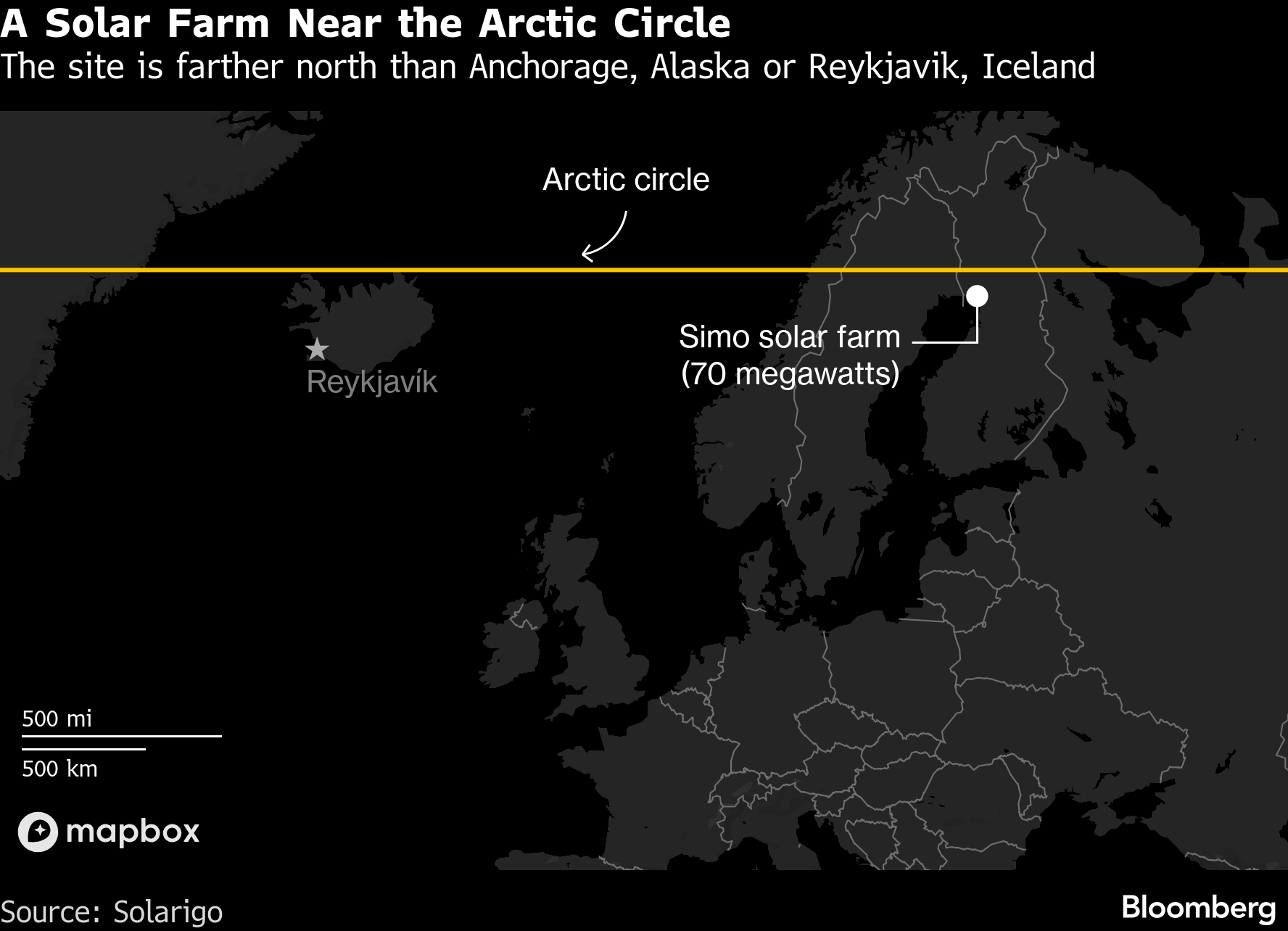
Few projects illustrate that transformation better than Exilion’s Simo solar park, just south of the Arctic Circle. Tommi Riski, the company’s director of business development and electricity markets, says that in the early days of the project, the typical response was “Who the hell builds a solar plant in Lapland?”
Less than three years later, the €40 million ($46 million) project is generating electricity for almost 22 hours a day at the height of summer.
The park earns most of its revenue during the summer months. The European Commission’s solar calculator show that a project in northern Finland would generate around 82% of its annual output between April and September. For a similar project in Madrid, it would be 58%.
Exilion’s business case assumes virtually no generation between November and January, treating any winter output as a bonus. The site also hosts a wind farm, which generates most of its electricity during the dark winter months, illustrating how the two technologies increasingly complement one another in northern climates in so-called hybrid projects. Batteries are also increasingly included.
Operating that far north also comes with some advantages over those building on the continent. Cooler temperatures help solar panels operate more efficiently, while snow reflects additional light onto the site’s double-sided panels, boosting production.
Finland and northern Scandinavia may offer the clearest example of how far north large-scale solar can now work. But the shift isn’t confined to the Nordics. Across northern Scotland, households and businesses are adding panels at a record pace. Installation company AES Renewables has added solar systems as far north as Thurso, almost on the same latitude as Oslo.
Nearly 2,000 homes across the Scottish Highlands and islands installed solar panels in the six months through April, despite the region receiving barely half the sunshine of southern Spain. The demand has prompted AES to increase its workforce by more than 50% since the start of last year.
Installations are also picking up in the Faroe Islands, a windswept archipelago northwest of Scotland and regarded as one of the world’s cloudiest places. The islands had only a handful of solar farms a few years ago but lower costs and growing interest from households and businesses are changing that.
Local utility SEV estimates there are now more than 60 installations, with another 25 to 30 awaiting approval. Although the Faroes receive relatively little sunshine overall, the new solar installations dovetail nicely with wind and hydropower, which generate less electricity during the summer.
That allows solar to fill a seasonal gap in the system, just as fossil-fuel use is increasing. “Since we rely on expensive diesel in the summer, that is a benefit for solar,” said Helma Maria Trondheim, an SEV research engineer.
©2026 Bloomberg L.P.








