

War Hastens an Indonesian Biofuels Push That Has Global Stakes


(Bloomberg) -- Four trucks and a passenger bus have just completed a 40,000-kilometer (25,000-mile) road trip around Java. The epic journey — a distance equivalent to a circumnavigation of the globe — will help to determine whether Indonesia can deliver one of the world’s most ambitious biofuel-blending mandates in the next few months.
With energy bills rising due to the Iran war, the Southeast Asian nation is fast-tracking the rollout of a diesel blend comprised 50% of biofuels from its vast palm plantations. The aggressive timetable will push the industry’s limits and serve as a test case for other crop-rich economies – from Malaysia to Brazil – that are seeking to cut reliance on fossil fuels.
“If Indonesia succeeds, it shows that very high biofuel blends are possible when demand is engineered” rather than left to market forces, said Khor Yu Leng, an economist at Segi Enam Advisors in Singapore, who has tracked the palm oil industry for nearly two decades. “This could push other countries to strengthen mandates for energy security.”
By some distance, Indonesia is the global leader in terms of the proportion of biofuels in its diesel mix. The country produces a blend that is 40% derived from palm oil, and its ambition to introduce the next grade – B50 – aligns with President Prabowo Subianto’s push toward self-sufficiency in food and fuel.
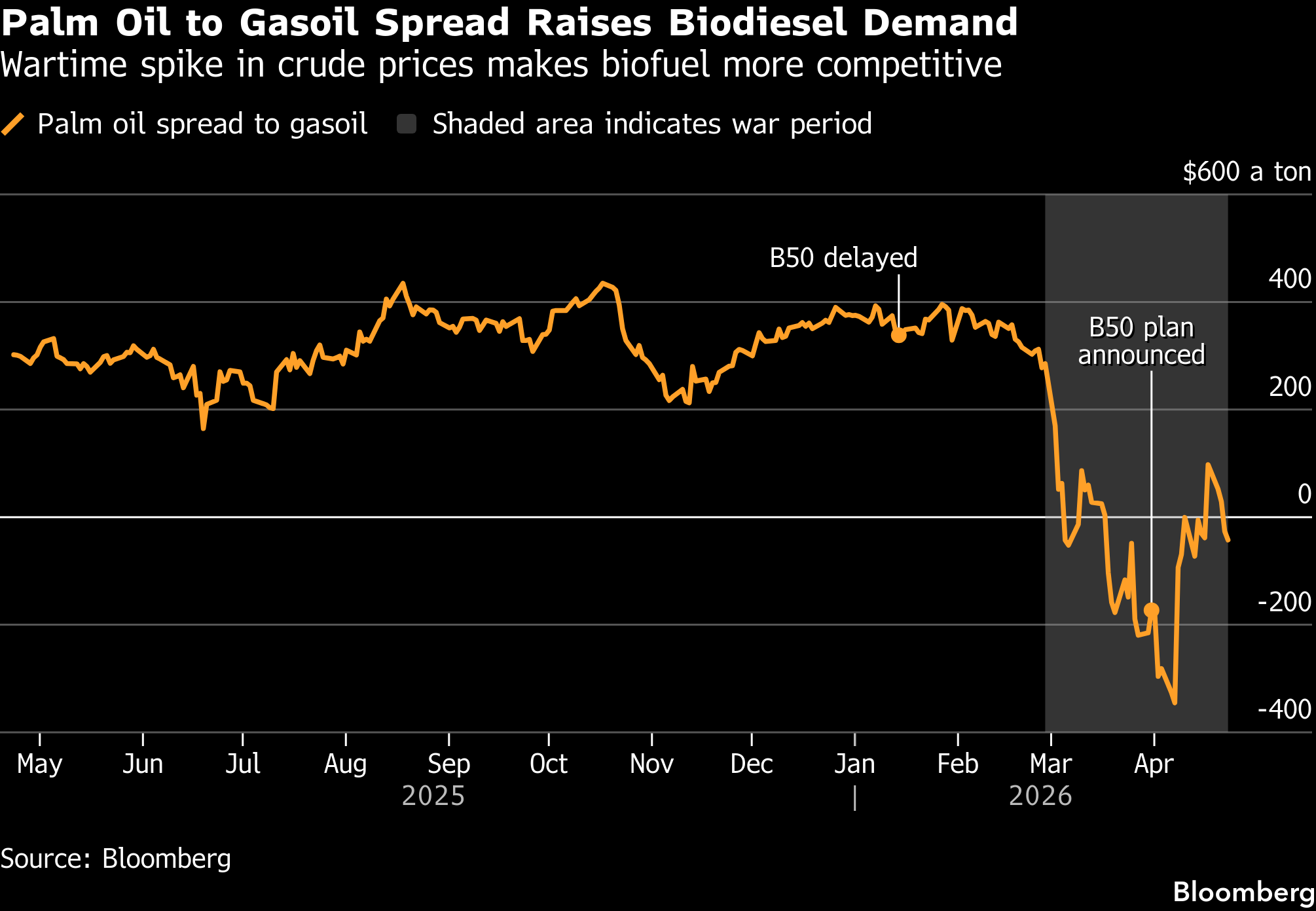
The world’s biggest palm oil producer has the resources to succeed. The spike in crude prices arising from the war has also given the country a window to advance its goal — on the rare occasions, such as now, when conventional diesel costs more than biofuel, the government avoids paying a subsidy that’s usually needed to incentivize producers and keep biodiesel competitive at the pump.
But the race to roll out B50 by July – at least a year ahead of a previous schedule – faces challenges. Another key input for biodiesel, methanol, is in short supply due to the war. Storage tanks, meanwhile, are filled with unsold byproducts, according to people familiar with the matter, who asked not to be named discussing private matters.
Added to that, a reduction in exports as the country retains more palm oil for domestic use would likely push global prices for the tropical commodity higher. That risks adding to food inflation wrought by the war, with palm oil used in scores of products across grocery-store shelves.
“On paper, Indonesia has sufficient capacity to produce the volumes of biodiesel required for B50,” said Julian McGill, an agricultural economist and managing director of advisory firm Glenauk Economics in Kuala Lumpur. “In practice, this requires running at extremely high capacity utilization.”
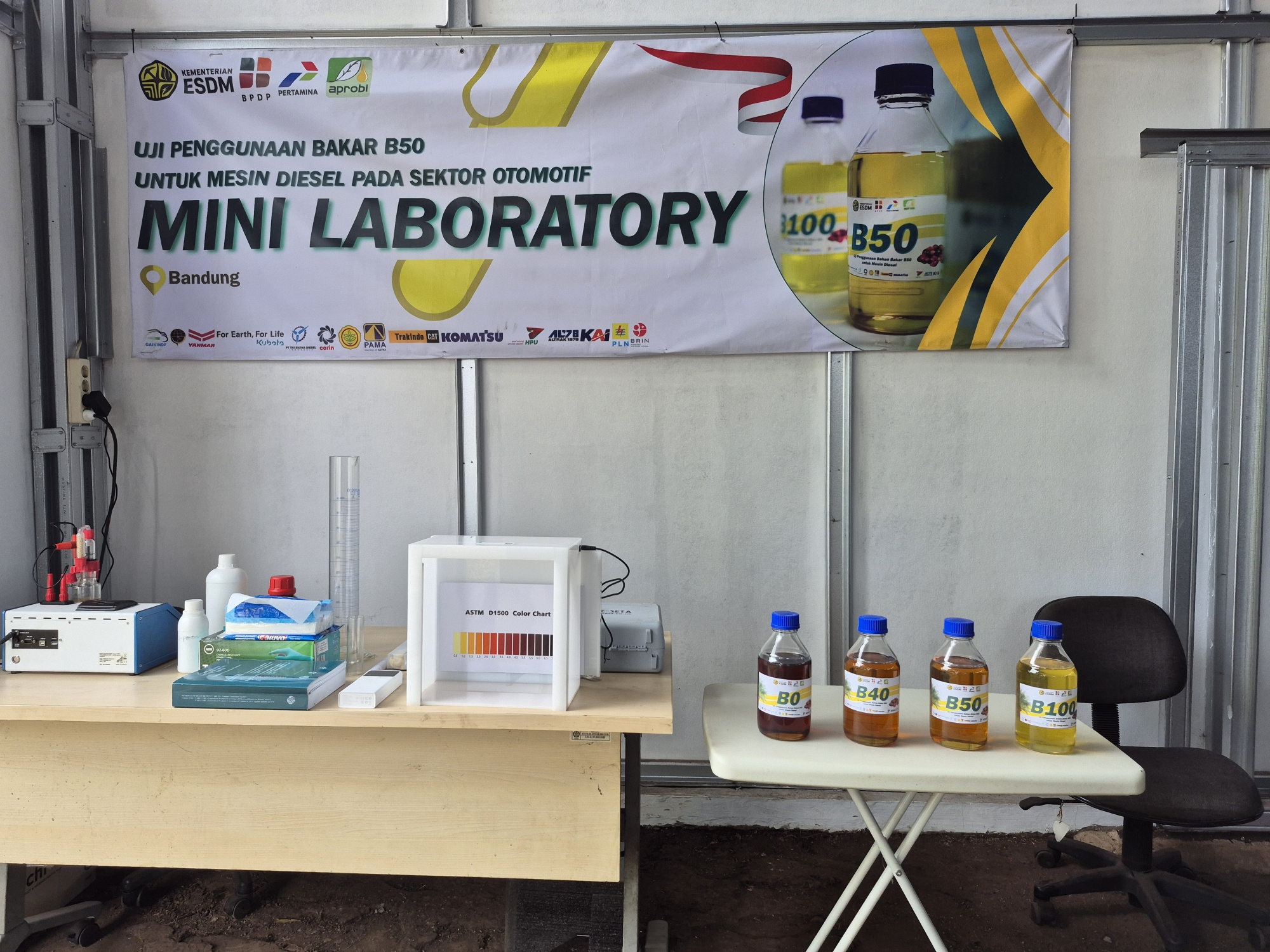
Before any of this is possible, the new fuel must be road-tested. These trials were what took the Japanese-branded trucks and Mercedes-Benz Group AG bus to the highlands of Java last week. Four SUVs are still on the road, headed for the mountainous east of Indonesia’s most populous island to check the blend’s performance at high altitudes.
“Indonesia is a tropical country with varying humidity levels, which affects fuel conditions,” Cahyo Setyo Wibowo, head of the B50 trials, said at the journey’s end-point. Due to its high saturated-fat content, palm-based biodiesel is prone to cloud and solidify in cooler conditions, making fuel systems more vulnerable to clogging at higher elevations.
So far, though, preliminary results have shown B50 to have performed reliably, said Eniya Listiani Dewi, director general of new and renewable energy at the Ministry of Energy and Mineral Resources. Engine components, lubricants and fuel systems have stayed in line with manufacturers’ recommendations throughout the trials, which are due to end next month.
“What Indonesia has achieved is remarkable,” McGill said. “There were doubts that even B30 was possible, and today they are on the cusp of pushing through B50 as other Northern Hemisphere countries continue to treat single digits as the blend wall.”
Malaysia, a distant second in terms of palm oil production, plans to transition in stages from B10 to B20. Brazil – with a B15 diesel mandate – is awaiting results of tests on a higher blend, and is also seeking to lift its mandatory blend of ethanol into gasoline to 32%. The US, meanwhile, just finalized long-awaited blending standards that will boost levels mixed into both conventional diesel and gasoline.
Few countries, if any, can replicate Indonesia’s blending levels in biodiesel, said Khor, the economist. The system is “state-structured, industry-funded and scale-driven,” she said, while other models are market-driven and fiscally linked, “making them more flexible but less certain in scale.”
According to McGill, a full rollout of B50 in the second half of the year would need an additional 1.7 million tons of biodiesel. That would amount to a roughly 12% increase on the amount required for the existing annual quota for the B40 mandate.
And with the July deadline in mind, Indonesia’s government has already sent letters to biofuel producers asking for their commitment to supply additional volumes for the program, said Dewi from the ministry.
Some of these producers, however, are hesitant to commit to the new targets, one of the people familiar with the industry said. While palm oil is abundant, the producers’ main concern is a shortage of methanol, the ingredient needed to break apart the oil molecules and convert them into biodiesel.
Much of Indonesia’s methanol traditionally comes from the Middle East via a sea route that’s been choked by the war. Prices have more than doubled since the conflict began at the end of February, according to data from analytics firm Polymer Update.
The implications of B50 for palm oil markets are also significant. Even a gradual increase in blending rates would increase domestic consumption and reduce exports, with production growth unlikely to keep pace. That’s likely to boost palm prices over the medium term, said Artem Hammerschmidt, head of vegoils and biofuel research at Netherlands-based Ceras Analytics.
These input considerations, as well as the strains on capacity, cast some doubt over whether the switch to B50 will be possible within just a few months. After all, as recently as January — before the war began — the government said policymakers would need more time to build infrastructure and calculate the costs of transition.
“A more realistic trajectory would imply an effective national blend rate of around B42-B43 in 2026, rising to B45 in 2027 and only reaching full B50 implementation from January 2028,” Hammerschmidt said.
Regardless, Indonesia is committed to B50. For the government, it’s a matter of energy sovereignty. Asked recently whether Indonesia might slow the program should fossil fuel prices retreat, making biodiesel more expensive than gasoil again, Energy and Mineral Resources Minister Bahlil Lahadalia said: “The B50 must continue.”
“This is about survival,” he added. “We should not – just because prices are falling – go back to relying on imports.”
©2026 Bloomberg L.P.








