

Fund Sees ‘Significant’ Opportunity in India’s New Climate Plan


(Bloomberg) -- India’s new emissions-reduction plans offer significant investment opportunities in sectors related to grid upgrades and storage batteries, according to one of the country’s largest climate-focused funds.
By 2035, the world’s third-largest polluting nation aims to increase the share of electricity generation from cleaner sources to 60%, and plans to cut emissions intensity — the amount per unit of economic output — by 47% from a baseline year of 2005.
“That means very significant investment opportunities,” said Jayant Sinha, president of Eversource Capital, a private equity firm with more than $700 million in assets that invests in infrastructure. “Billions and billions of dollars have to flow into grid upgradation, battery storage, and so on.”
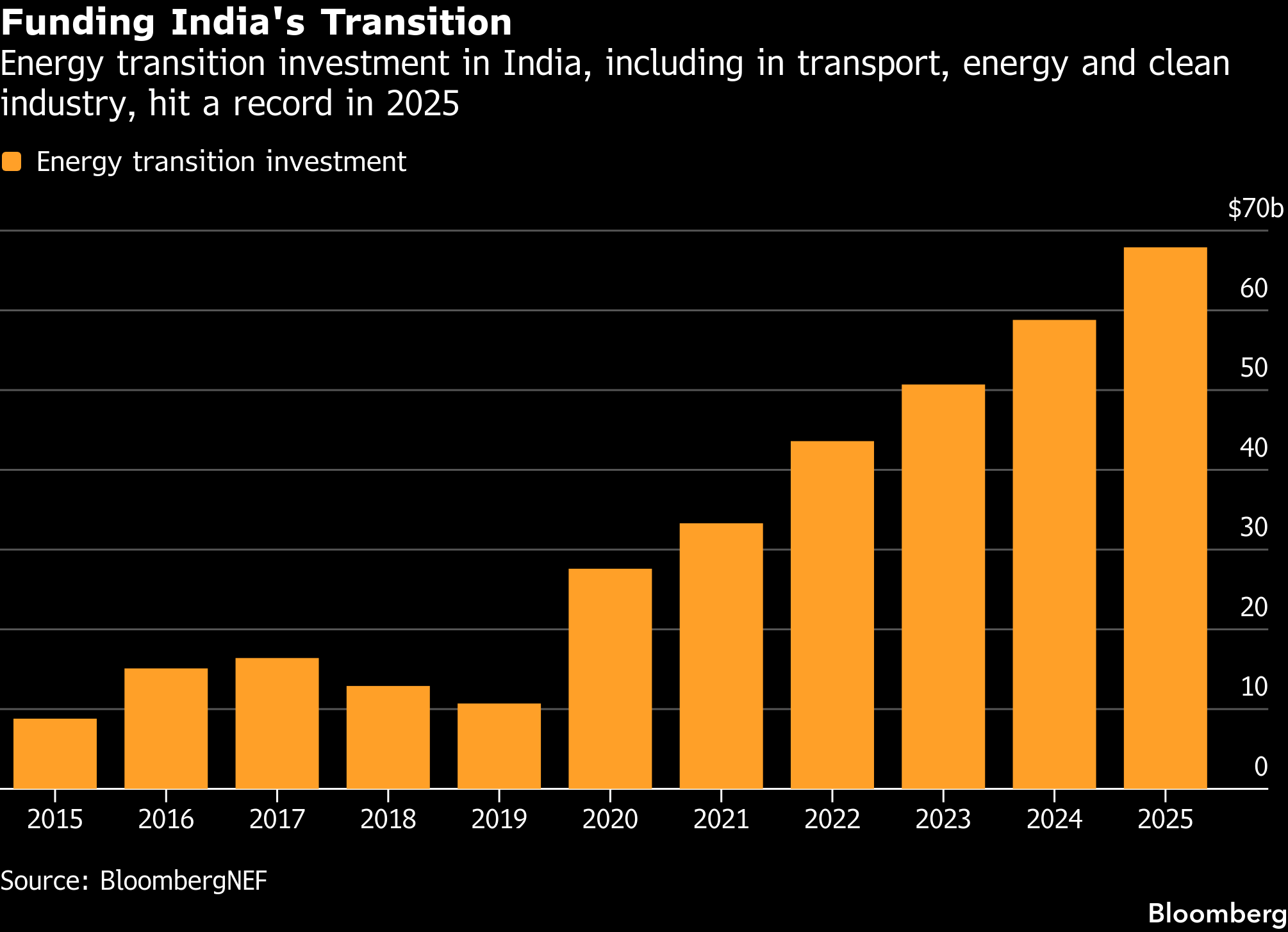
Energy transition investment in India jumped about 15% in 2025 to a record $67.9 billion, according to data compiled by BloombergNEF tracking sectors including electrified transport, clean industry and renewables. To hit net zero by 2070, India may need to deploy as much as $21 trillion on decarbonization, according to a draft document developed last year by Niti Aayog, the government’s top think tank.
Opportunities associated with India’s 2035 emissions goals also include electric vehicles and charging networks, Sinha said in an interview. Eversource has invested in companies focus on deploying smart meters and electric bus management systems in India.
India’s latest climate plan, required under terms of the Paris Agreement, has been criticized by advocates of faster action as lacking in ambition. The strategy didn’t set a goal for reductions in absolute greenhouse gas emissions, while a clean energy target is regarded as offering only an incremental advance.
Any shift by Prime Minister Narendra Modi‘s government toward more aggressive plans would need far greater investment, Sinha said. “Not just hundreds of billions of dollars, but trillions of dollars are going to be required,” he said.
©2026 Bloomberg L.P.