

Data Centers Are Finding a Surprising Way to Deploy Batteries


(Bloomberg) -- The scramble to find enough power for artificial intelligence has data center operators looking for any solution. An unexpected one taking root pairs batteries — long seen as a key to adding more renewables — with fossil fuels.
BloombergNEF has tracked 4.9 gigawatts of energy storage announcements that are co-located with on-site fossil fuel generation at data centers. That’s about 32% of announced global on-site data center battery capacity. The sites include some of the largest AI data center complexes under development, such as Elon Musk’s Colossus supercomputer in Memphis, Tennessee, and the combo has become so popular that companies such as Caterpillar Inc. and GE Vernova Inc. have announced products or partnerships pairing energy storage with gas generation.
Batteries are a linchpin for unlocking solar and wind energy’s full potential by soaking up excess green energy and then discharging it when the wind isn’t blowing or the sun isn’t shining. However, the steep drop in battery costs is now allowing energy-storage technology to be deployed in conjunction with natural gas to provide more reliable power for data centers.
While gas can provide round-the-clock power, not all plants work 24/7. For many behind-the-meter facilities, data centers are choosing gas turbines that run for shorter periods and don’t ramp up quickly enough to meet computing needs. That has hyperscalers turning to batteries, which can rapidly discharge power, to fill these gaps. The batteries also help prevent damage to gas turbines that aren’t designed to be used for frequent ramping cycles.
“I assumed batteries would be a tool for decarbonization,” said Michael Thomas, founder of clean energy research firm Cleanview who has also been tracking the rise of energy storage paired with gas. “What we are learning in this new AI era is that they can also be used as a tool for fossil fuel power because their technological advantages make it possible to build and operate an off-grid power plant.”
While data centers now face an average of four years to get power from the grid, they are turning to gas generators paired with energy storage as a bridge source of energy, said Allison Weis, Wood Mackenzie’s global head of energy storage. As long interconnection queues delay requests for utility-connected power, data center developers are finding it faster to bring their own generation.
Data centers also have sharp demand spikes driven by computing-intensive tasks, such as training models. Batteries paired with gas can help provide power rapidly enough to ensure smooth operations. Energy storage is projected to support 9.8 gigawatt-hours of gas generation at data centers through 2030, according to BNEF.
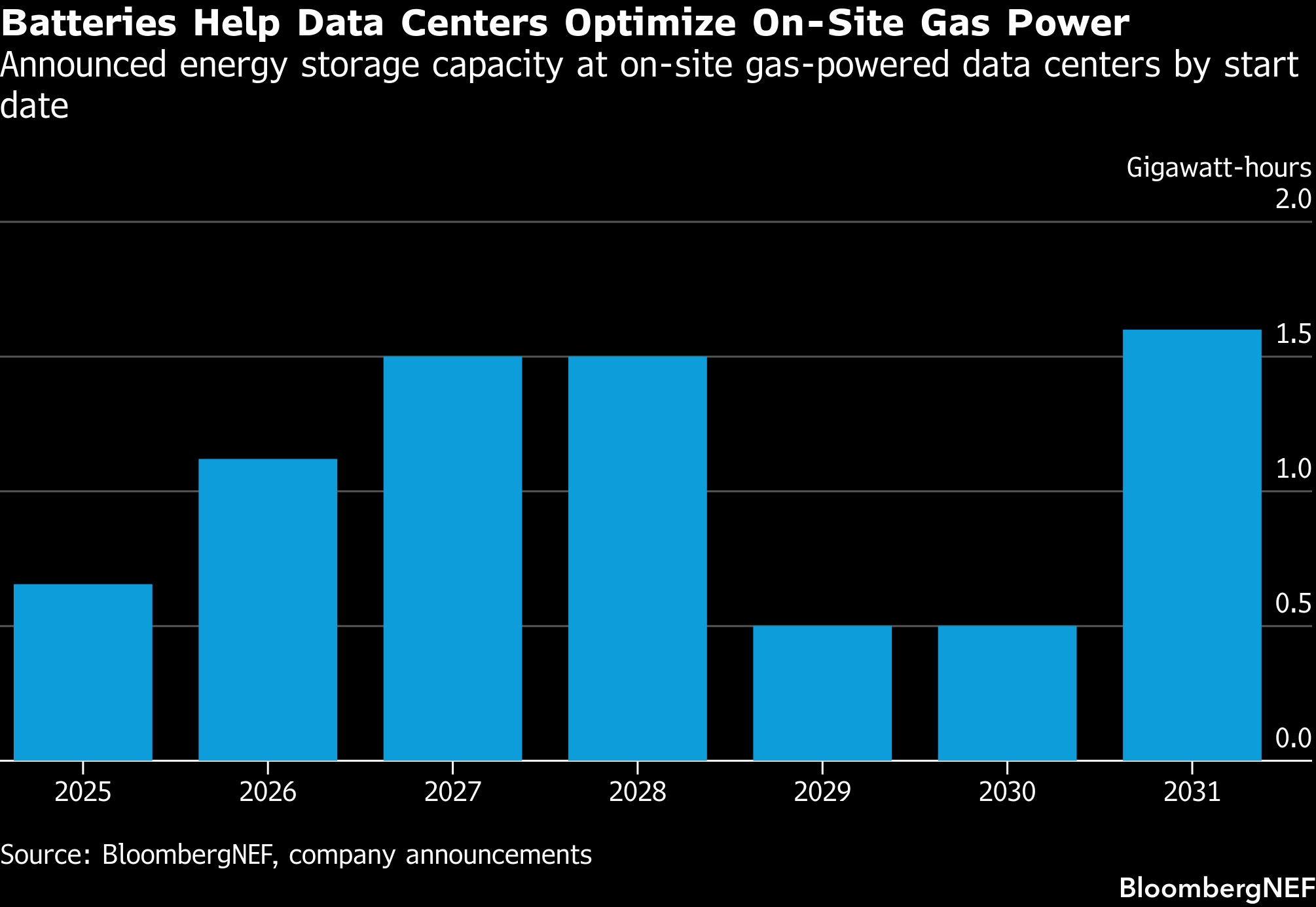
Some of the largest US data center projects are deploying batteries alongside gas generators. At xAI’s Colossus facility, rows of Tesla Inc. Megapacks are being installed next to gas turbines as part of a 1.2 gigawatt off-grid power plant that will supply the massive data center. In West Texas, Pacifico Energy’s GW Ranch off-grid data center will have 1.8 gigawatts of battery storage installed next to 7.65 gigawatts of gas-fired power generation. Williams Cos., a natural gas pipeline operator, plans to install Tesla batteries along with natural gas-fueled power plants its building for several data center projects. “Batteries really help support the turbines and give us the 99.999% reliability,” said Executive Vice President Rob Wingo at the S&P Global Power Markets Conference in Las Vegas last week. Using natural gas will add more planet-warming emissions into the atmosphere while also contributing to local air pollution. The West Texas project recently received the largest air pollution permit ever granted in the US, while Musk’s Memphis project has faced multiple lawsuits arguing the gas turbines are worsening air quality in historically Black communities.
Pacifico Energy and xAI didn’t respond to requests for comment on the environmental impact of their projects. A Williams spokesperson touted the use of “modern, high‑efficiency natural‑gas turbines with advanced emissions controls and continuous monitoring” at its off-grid sites. “Pairing gas generation with batteries improves how those generators operate — smoothing load swings and reducing start‑ups and ramping, which are the most emissions‑intensive conditions,” the spokesperson wrote.
Utilities are also building more energy storage facilities on the grid next to power plants “to help maximize the megawatts” and support data center load growth, said Noah Roberts, executive director of the US Energy Storage Coalition. Large batteries help utilities make the most of power that would otherwise be wasted and also help meet power demand while also lowering costs, he said.
Roberts pointed to the example of NIPSCO Generation, a utility in northern Indiana that is building two 1.3 gigawatt gas-fired power plants and an energy storage system with 400 megawatts of capacity to serve planned Amazon data centers.
And in Michigan, utility DTE Electric Co. has plans to build six energy storage systems to complement a 1.4 gigawatt data center for Oracle Corp. Doing so will help the utility boost the capacity of all generating resources by 25%, he said. Roberts called that project “a great example of where energy storage is completely agnostic to the type of energy that is providing electrons to the grid.”
Michigan regulators recently approved that project despite a challenge from the state’s attorney general over customer cost concerns.
Fluence Energy Inc., a global energy storage provider, is in talks with large natural gas companies to supply batteries that can help get data centers up and running before turbines arrive, said Chief Growth Officer Jeff Monday.
“We are seeing massive demand coming out of the hyperscalers and data center operators,” Monday said, noting that projects pairing batteries with gas generation are part of the fastest-growing part of the company’s energy storage pipeline.
Coupling batteries with natural gas also promises to extend the life and usefulness of fossil fuel plants. That is setting batteries up for a dual role as an enabler to putting more green energy on the grid and delaying the phase-out of fossil fuels.
“There is nothing about batteries that are inherently clean,” said Thomas. “Batteries are just a technology.”
(Updates to add BNEF projection for batteries and gas in paragraph 7. A previous version corrected the title of Fluence Energy executive in paragraph 16.)
©2026 Bloomberg L.P.