

China’s Wasting Too Much Renewable Power as Curtailments Rise


(Bloomberg) -- China is wasting renewable power at an alarming rate, approaching limits that the government had relaxed only two years ago to accelerate solar and wind usage.
The amount of solar power generated without being delivered to customers rose to 9.2% in January and February, from 6.1% in the same period last year, according to the National New Energy Consumption Monitoring and Early Warning Center. For wind, curtailments rose to 8.5%, from 6.2%.
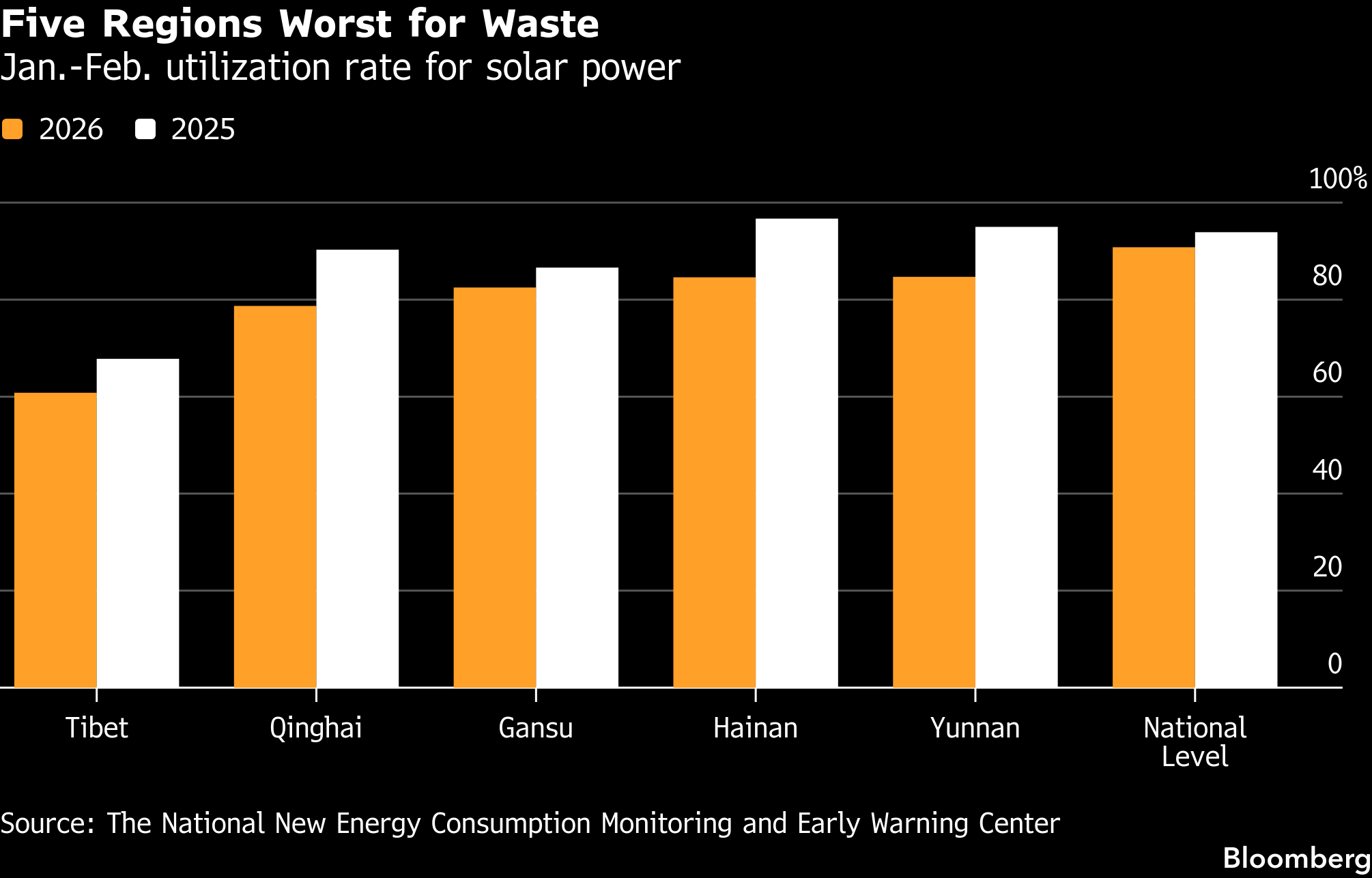
Those rates are pushing up against the ceiling raised by the government in 2024 — a clear signal that the grid is struggling to absorb all the extra power from the rapid growth in renewables.
Two years ago, the authorities allowed curtailments to rise to 10% from 5% for energy-rich regions, enabling record-breaking installations through 2024 and 2025. But persistent grid congestion and an oversupply of renewable power during off-peak hours has made the curtailment rate an increasingly urgent issue, threatening the financial viability of projects.
Large renewables hubs in sparsely populated inland regions like Tibet and Gansu, which rely on power lines stretching thousands of kilometers to China’s eastern megacities, face the worst curtailment rates.
There are seasonal factors behind the drop off in renewables utilization early in the year, according to Guosheng Securities Inc. It’s often windier in winter, while the daily window for solar generation is narrower. There’s also less industrial demand for electricity over the Lunar New Year holiday.
The situation is particularly concerning for solar power, which has already seen weaker installation growth this year. The slowdown could mark a turning point for the industry. The top solar lobby forecasts annual installations could fall to as low as 180 gigawatts, from the record 315 gigawatts delivered in 2025.
China has two levers to pull to keep the clean energy boom on track. It needs to keep spending more to expand and upgrade the grid, which the government has recognized as a priority in its latest five-year plan. More immediately, energy storage systems can plug the gap. Although the exponential growth in that market is expected to tail off given the amount of capacity already built, some companies are still projecting shipments to more than double this year.
On the Wire
China’s yuan hit a three-year high as the pause in Middle East hostilities eased geopolitical tensions.
Zimbabwe is considering ending a ban on lithium concentrate exports if miners agree to pay an extra tax on shipments and set up additional processing plants by the start of next year.
China will set up a sweeping new mechanism to ensure the security of its supply chains, targeting espionage and allowing Beijing to retaliate against foreign entities if they impose curbs on trade.
China’s central bank bought the most gold in more than a year in March, demonstrating that a key pillar of support for the precious metal remains intact as prices come under pressure amid the Iran war.
This Week’s Diary
(All times Beijing)
Wednesday, April 8
- CCTD’s weekly online briefing on coal markets, 15:00
- EARNINGS: Huayou Cobalt
Thursday, April 9
- China to release March aggregate finance & money supply data by April 15
- China’s monthly CASDE crop supply-demand report
Friday, April 10
- China’s inflation data for March, 09:30
- China’s weekly iron ore port stockpiles
- SHFE’s weekly commodities inventory, ~15:30
©2026 Bloomberg L.P.