

Austria Races to Secure Power Supplies as ‘Peak Water’ Looms


(Bloomberg) -- Austria’s economic model has long been anchored in Alpine water flowing through turbines to generate power for homes and businesses, but as climate change redraws the country’s hydrological map, it faces a structural shift and geopolitical tensions have heightened the sense of urgency.
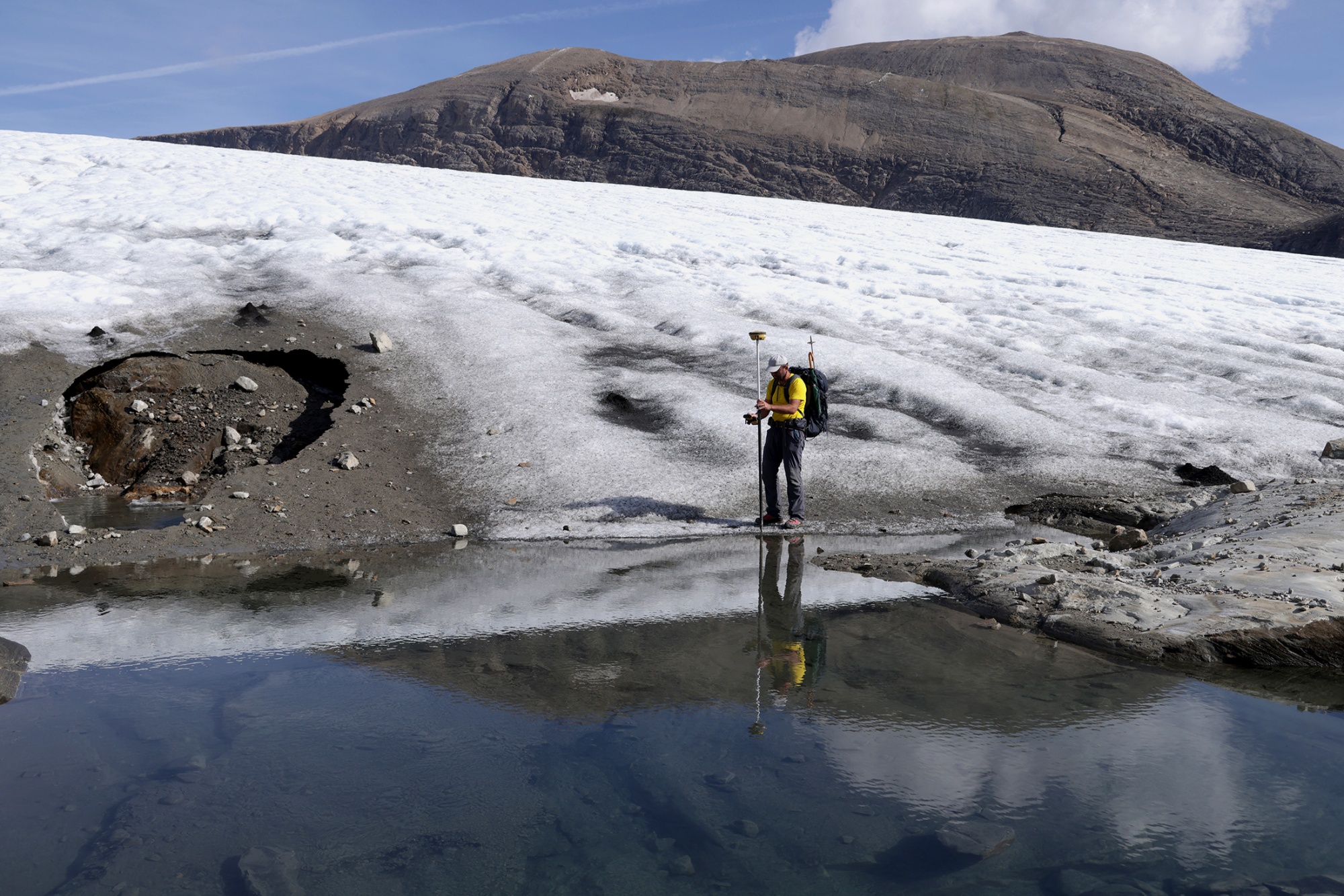
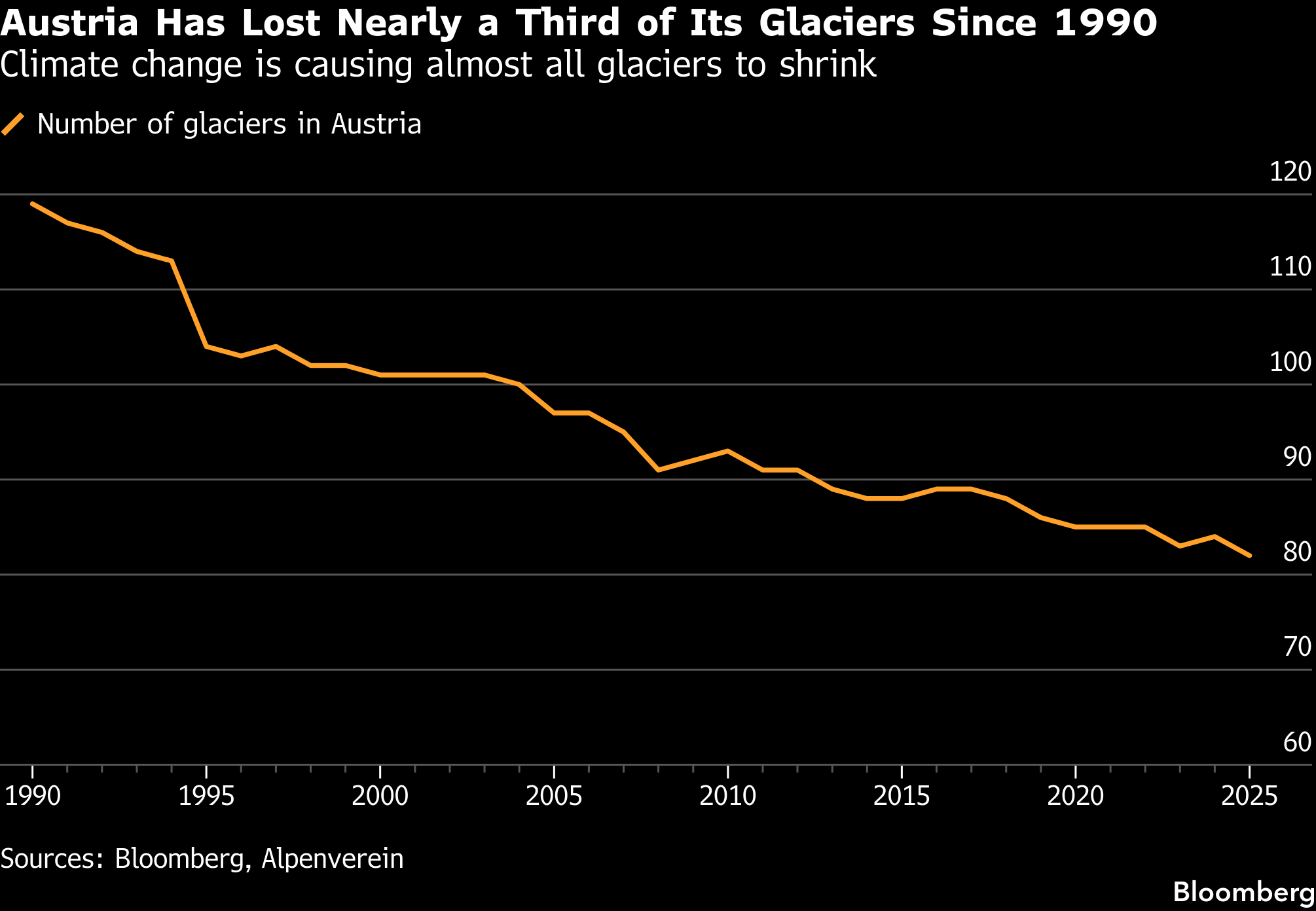
Scientists warn that the country is approaching a tipping point known as “peak water,” which means that as Alpine glaciers shrink, these frozen reservoirs will no longer be able to boost river flows and generate electricity to the same extent they once did.
“Almost all glaciers have been losing mass. That is consensus,” said Francesca Pellicciotti, a glaciologist at the Institute of Science and Technology Austria. “There will be less water for hydropower at some point.”
The concept is sharpening concerns in Vienna that reliance on hydropower — long seen as a pillar of energy security — may become a vulnerability just as conflict-driven disruptions heighten the risks of depending on imported fuels. For a country whose second-most valuable listed company — state-controlled utility Verbund AG — generates about 90% of its electricity from hydropower, the implications are rippling from energy markets to credit ratings.
Climate change is already causing more volatile precipitation patterns, but the prospect of declining water availability underscores the need to diversify into wind, solar and energy storage to cushion both climate-driven shocks and external supply risks. Iran’s closure of the Strait of Hormuz after the US and Israel attacked has highlighted how vulnerable export dependence energy systems can be.
With climate models suggesting that water supplies could peak over the next two decades, Austria faces a narrowing window to adapt. Although accelerated glacier melting has temporarily increased runoff, that trend will reverse as soon as 2040. Beyond that point, shrinking ice reserves will mean less meltwater feeding rivers and dam reservoirs.
A new generation of research is attempting to sharpen those projections. Pellicciotti is leading a $9.5 million project that combines artificial intelligence with physics-based models to simulate mountain water systems and identify tipping points in glacier-fed basins. The initiative — known as MountAInWater and partly funded by former Google Chief Executive Officer Eric Schmidt — aims to pinpoint when and where peak water may occur.
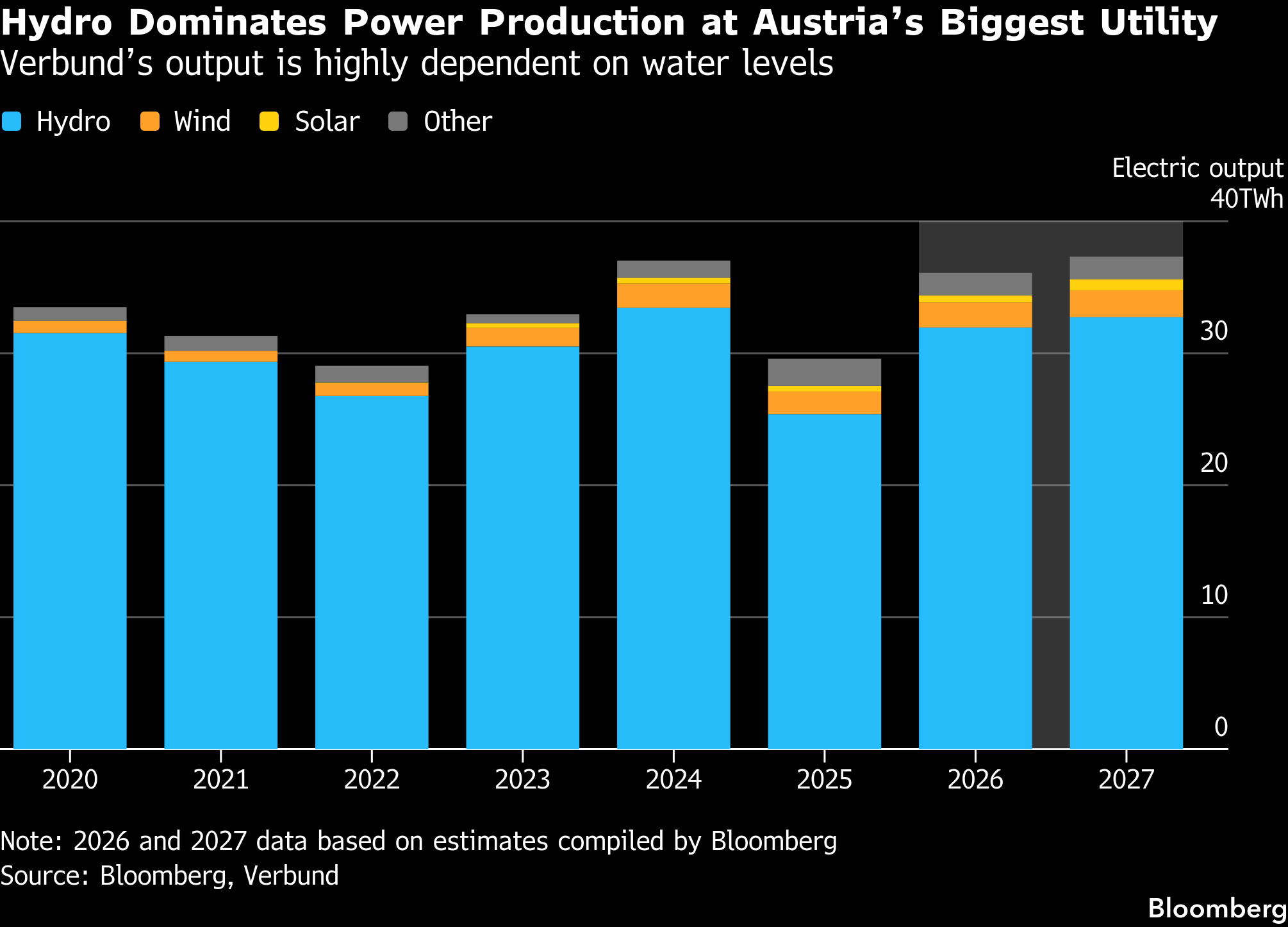
Warnings are already showing up in financial metrics. S&P Global Ratings last month downgraded Verbund to A from A+, citing weaker hydro conditions and declining electricity-generation prospects. The agency expects earnings to weaken over 2026 and 2027.
The credit downgrade highlights how climate risk is translating into measurable financial pressure. Verbund’s generation coefficient — a key measure of river flow relative to long-term averages — fell to 0.79 in 2025, significantly below normal levels. Lower water availability constrains power generation, potentially squeezing margins even as the company accelerates investment.
Verbund is expected to spend more than €2 billion ($2.3 billion) over this year and next on transmission and renewable expansion. Because of the push, debt is expected to more than double by 2028. At the same time, cash flows are set to weaken due to lower hydropower output and government-imposed electricity price caps.
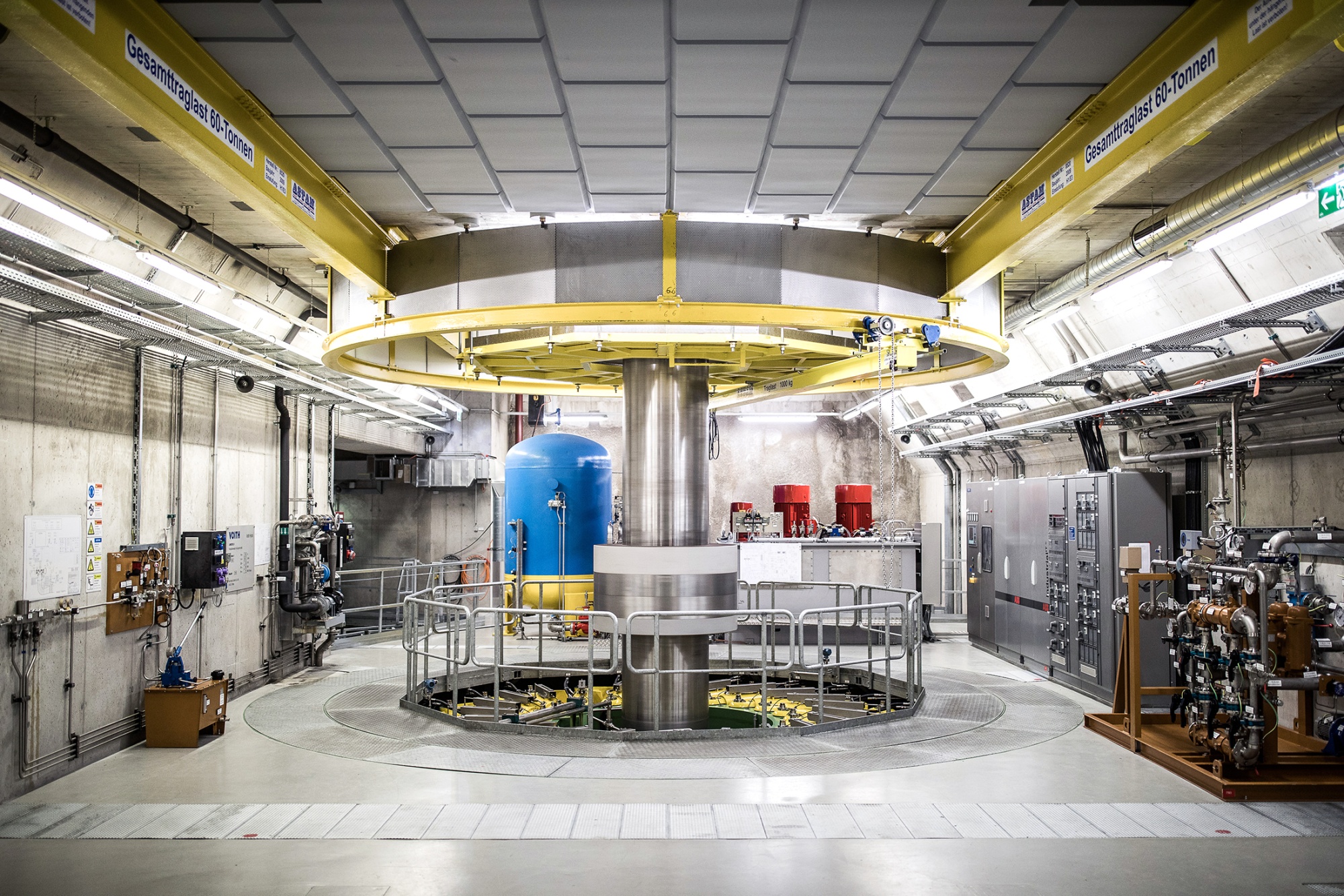
Austria’s hydropower network has long been seen as a strategic advantage, helping the country achieve one of Europe’s highest shares of renewable electricity and shielding it from fossil fuel volatility. But that strength is becoming more conditional as weather patterns shift.
Precipitation is increasingly falling as rain rather than snow, disrupting the steady spring melt that traditionally feeds rivers. As a result, utilities face more volatile inflows, with periods of drought punctuated by intense rainfall. This variability complicates reservoir management and reduces predictability in generation, according to Verbund.
The seasonal imbalance is particularly evident in winter, when hydropower output drops. That means in colder months, Austria has to turn to other sources.
“We can cover over 90% of our electricity from renewable energy,” Economy Minister Wolfgang Hattmannsdorfer said at a March 26 briefing. “But in winter, we still have to produce 20% of our demand through gas-fired power plants and import another 20%.”
That gap is driving a push to diversify the energy mix, with Austrian government pressing ahead with the Renewable Energy Expansion Acceleration Act. Known as the EABG, the proposed legislation aims at accelerating wind, solar and transmission projects.
Hattmannsdorfer said the law will introduce uniform nationwide procedures and prioritize renewable energy infrastructure — an attempt to cut through legal disputes. Some projects have taken more than a decade to secure approval under the current system.
“We are creating a fast track for projects of the energy transition — one law, one authority, one decision,” he said, describing a streamlined approach intended to replace overlapping federal, regional and local approvals.
To gain approval, the ruling centrist coalition will need a constitutional majority, meaning it will need to lock in support either from the Green party of the far-right Freedom Party. Both have already voiced concerns.
The climate-skeptic Freedom Party has long opposed wind power as unsightly and warned that federal authorities are seeking to curb the rights of provinces and municipalities, where it has more representation. The Greens, by contrast, want bolder targets for renewable power to be imposed on provinces.
“In times of global uncertainty, we shouldn't allow any kind of delays on domestic energy production,” Energy State Secretary Elisabeth Zehetner said last month.
The reforms reflect a broader shift in Austria’s energy strategy — from focusing primarily on decarbonization to incorporating climate adaptation. That means deemphasizing hydropower.
Verbund is already adjusting. The utility is diversifying into wind and solar, expanding facilities for storing power and investing in efficiency improvements at existing plants. It’s also broadening its geographic footprint in neighboring European markets to reduce exposure to local hydrological conditions.
Despite the pivot, hydropower remains central for Austria, but there’s an element of caution due to the uncertain timing of peak water. The risk is that a temporary boost in waters from melting glaciers will mask the longer-term decline and slow action. But once a critical threshold is reached, the loss of stored ice becomes irreversible.
For Austria, that moment would mark a turning point, eroding the competitive advantage of relatively low electricity prices. Expanding wind and solar could help smooth seasonal imbalances and create a more resilient energy mix.
While scaling those technologies quickly enough remains a challenge, Austria could chart a path for other hydropower-dependent economies. Its success will depend on whether the EABG legislation gets approved in a form that can help the country adapt before the peak passes.
“The key question is when peak water is coming,” Pellicciotti said. “After that, the water provided by glaciers will start declining.”
©2026 Bloomberg L.P.








