

Iran War Triggers Hunt to Secure New Fuel Supplies in Africa


(Bloomberg) -- Many African economies are running on weeks of refined fuel as the Iran war chokes off shipments through the Strait of Hormuz, forcing governments to scramble for alternatives.
About 600,000 barrels a day of oil products that typically flow to the continent from the Middle East are at risk, with tanker traffic through the critical waterway slowing to a trickle, according to the International Energy Agency. For some countries, those cargoes effectively meet all demand.
“We’re looking everywhere” for supply options, Jacob Mbele, director-general at South Africa’s Department of Mineral Resources said in an interview in Cape Town. “We’re comfortable that in the coming weeks or so, we are safe,” he said, adding that overall “the situation is fluid, it changes every day.”
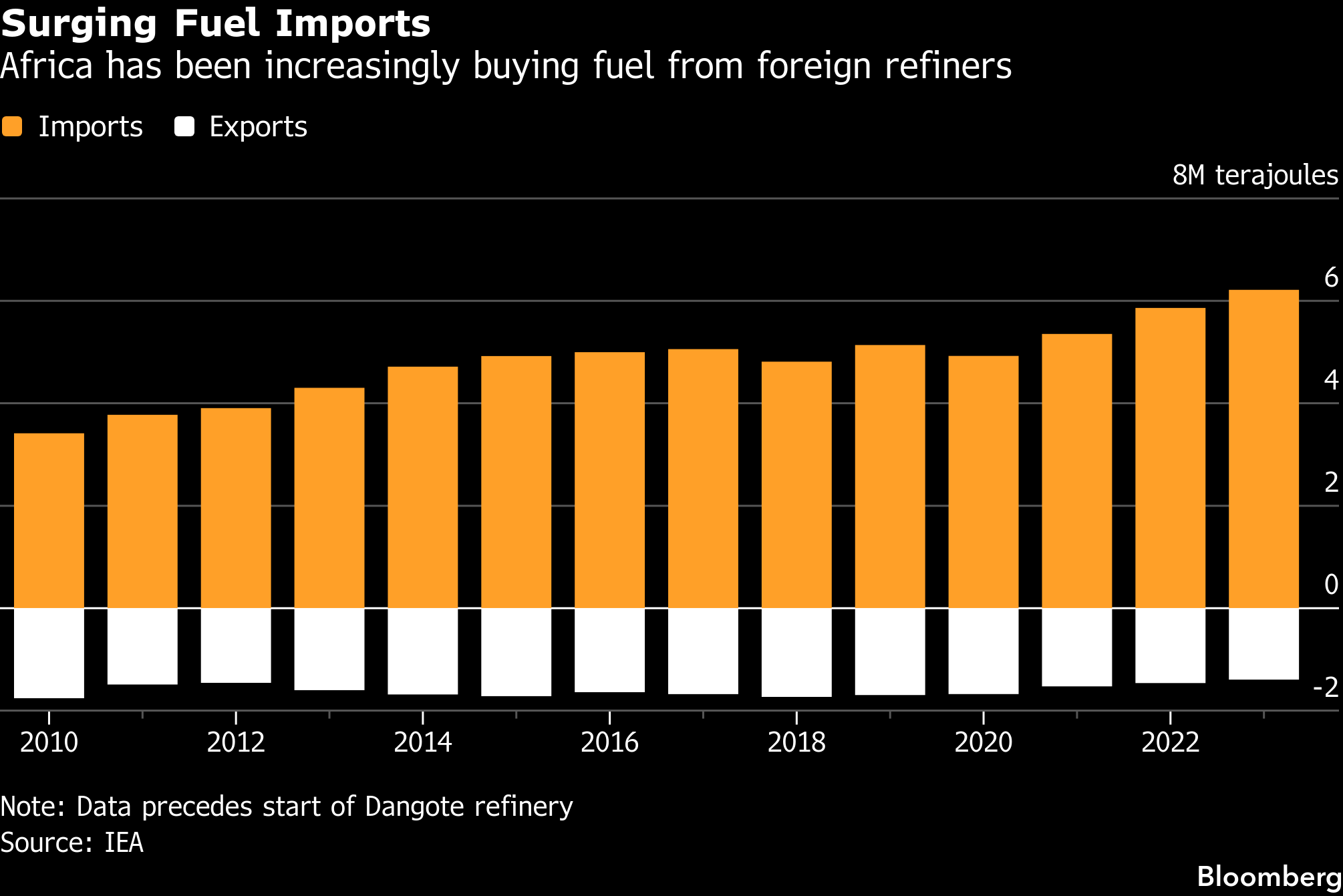
Securing fuel will be harder for developing nations as richer buyers may be able to outbid them. The squeeze is exposing how refinery closures and underinvestment have left much of the continent dependent on a single trade route now at the center of a widening conflict.
Africa, which accounts for about 7% of the world’s crude output, had seen refining capacity shrink by about a third in the past two decades before billionaire Aliko Dangote started his facility in Nigeria two years ago.
The refined-fuel supply crunch is especially severe across east and southern Africa, where the margin for error is thin. The two regions receive about 75% of their fuel imports from the Middle East, according to Elitsa Georgieva, executive director at energy consultancy CITAC.
Kenya, which consumes about 100,000 barrels of fuel each day and imports all of it, requires importers to hold 21 days of stock. That leaves it vulnerable to a loss of even a single shipment.
As a benchmark, the IEA requires members to hold at least 90 days of net oil imports. No African country is a member of the global energy watchdog.
The biggest fuel suppliers to Kenya are “rationing product,” said Martin Chomba, chairman of the Petroleum Outlets Association of Kenya. A few distributors are “experiencing stock outs in the villages,” he said.
Ethiopia asked its citizens to be frugal in their use of fuel as the government directs energy to “basic and essential needs,” Prime Minister Abiy Ahmed said in an X post on Monday.
Regulated prices of diesel and gasoline in many countries on the continent may obscure future risks, leaving fuel marketers on edge.
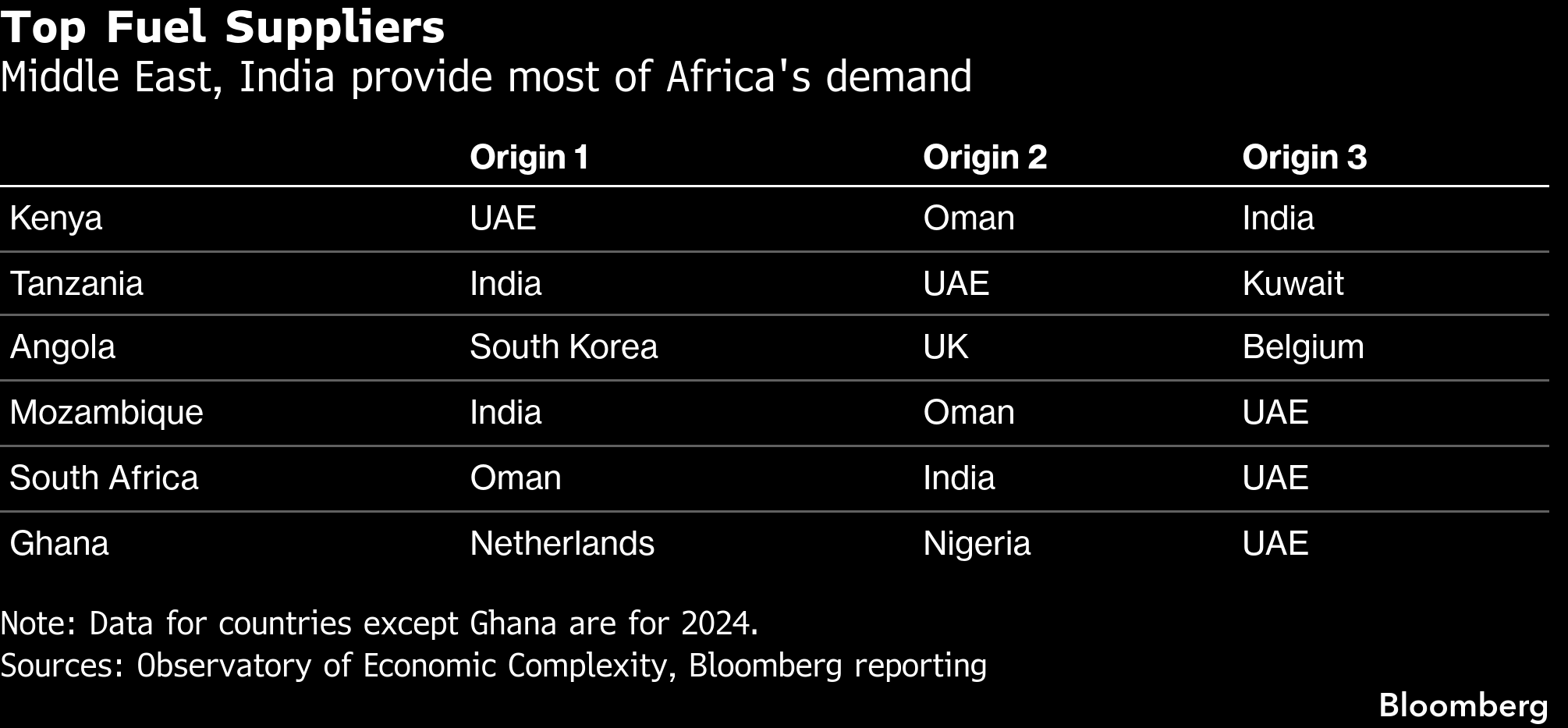
Here’s how sub-Saharan Africa’s top economies are dealing with the crisis:
Kenya
In East Africa, Kenya imports fuel to the port city of Mombasa, the site of a dormant refinery that shut because is was unprofitable. The nation that’s dependent on imports, renewed a supply contract last year with Saudi Aramco, Emirates National Oil Co. and Abu Dhabi National Oil Co. Oil marketing companies are required to keep three weeks of operational stock, with the countdown on that starting if an expected fuel cargo fails to arrive.
Officials haven’t responded to questions over details of the cargo and when supplies might run out.
South Africa
South Africa has lost about half its refining capacity in recent years after accidents and years of underinvestment left plants unable to meet cleaner-fuel standards, increasing its reliance on imports.
Saudi Arabia was its second-biggest oil supplier in 2024, according to the Department of Electricity and Energy. Oman, Bahrain and the UAE are key diesel providers as import dependence grows.
The remaining refineries meet less than half of about 612,000 barrels a day of demand — leaving little buffer just as disruptions hit the Middle East. The strain is compounded by the shutdown of Glencore Plc-owned Astron Energy’s 100,000 barrel-a-day Cape Town refinery for maintenance, with production only expected to resume in April.
Astron said it secured crude for the restart.
South Africa holds about 8 million barrels of strategic stocks, according to the state-owned Central Energy Fund, while roughly a third of domestic fuel output comes from Sasol Ltd.’s coal-to-liquids plant in Secunda east of Johannesburg.
Ghana
Even as one of Africa’s established oil producers, Ghana meets only about a third of its 125,000 barrels-a-day fuel demand from domestic refineries, according to the Chamber of Oil Marketing Companies.
The shortfall is covered with imports from as far afield as the Netherlands and the UAE, as well as regional supplies from Nigeria, said Patrick Kwaku Ofori, chief executive officer of the Chamber of Bulk Oil Distributors.
Sentuo Oil Refinery Ltd. operates the country’s only functioning plant, with capacity of about 40,000 barrels a day, according to the Ghana National Petroleum Authority. Output could rise once the Tema refinery completes maintenance expected in May.
Ghana currently holds about two months of fuel stocks, Ofori said.
“Ghanaians shouldn’t be worried in terms of fuel availability,” he said.
Nigeria
Dangote’s refinery is emerging as a rare bright spot. The 650,000 barrel-a-day plant outside Lagos has been ramping up to full capacity since starting operations in 2024.
Alongside smaller facilities, Nigeria is now well positioned to meet domestic fuel demand of about 493,000 barrels a day — with surplus volumes available for export. It also holds weeks of stock, giving it a buffer that few other countries on the continent can match.
Dangote is seeking to secure more crude locally, though the refinery has previously supplemented supply with imports from the US.
©2026 Bloomberg L.P.