

Chinese Exports Soared 22% Before Middle East War Broke Out

(Bloomberg) -- China’s export growth accelerated far faster than expected in the first two months of the year, putting shipments on a record path before US and Israeli strikes on Iran disrupted global trade.
Exports soared almost 22% from a year earlier, compared with a 7.2% median estimate in a Bloomberg survey of economists. Imports jumped nearly 20%, according to a statement released by the General Administration of Customs on Tuesday, leaving a surplus of $214 billion — an all-time high for the period.
The torrid start to the year means China’s sales abroad were still gaining momentum before the Iran war broke out at the end of last month. The escalating crisis in the Middle East now poses new risks for the world’s largest exporter as the economic fallout from the war spreads outside the region.
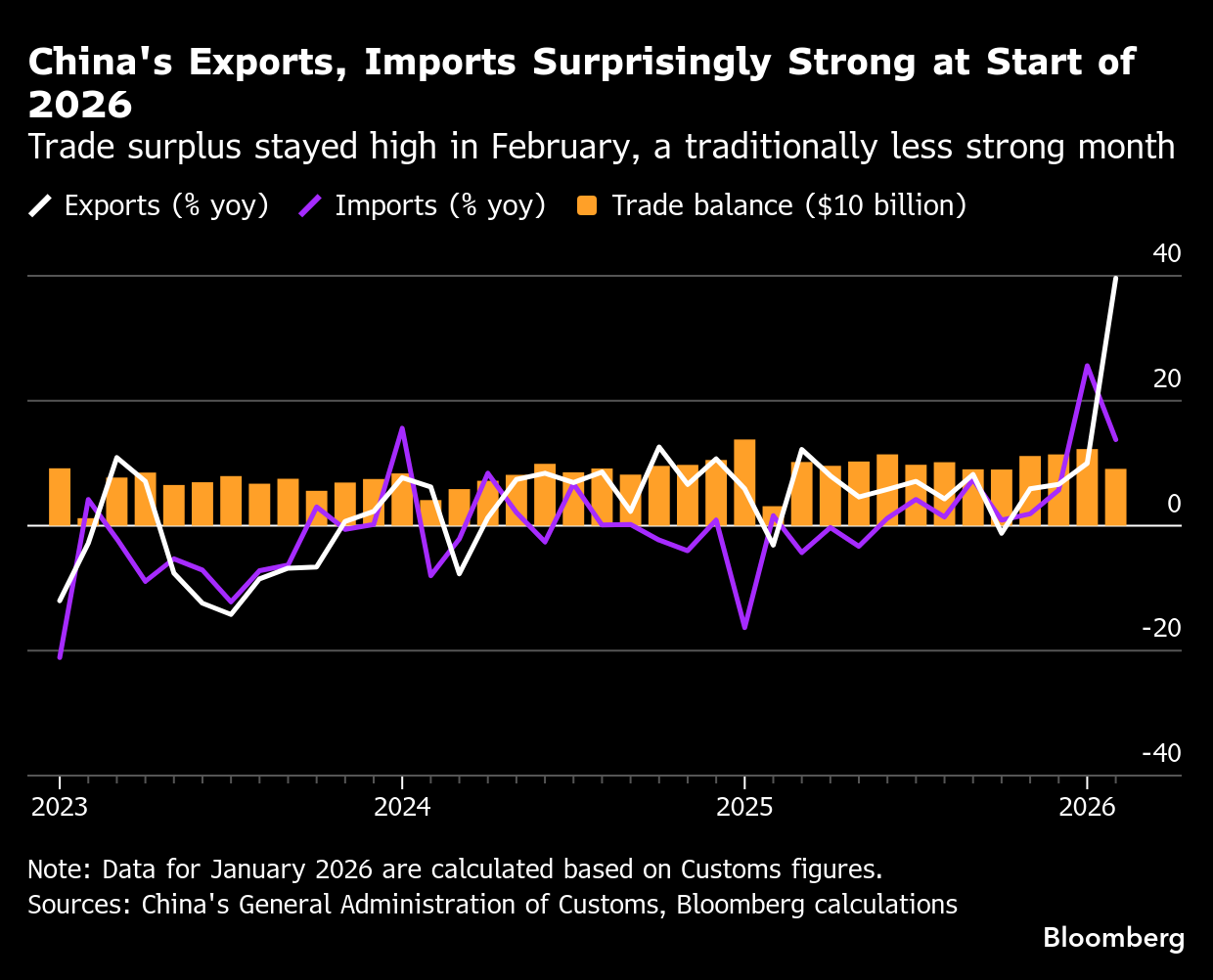
For Beijing, the possibility of a global demand shock from the hostilities could emerge as a major threat to its ambitions for growth this year, even after setting the most modest target since 1991. China last year relied on outbound shipments to drive the economy, with net exports contributing almost a third to the overall expansion in gross domestic product — the most in decades.
“An extended conflict in an oil-producing region will fuel inflation, reduce room for monetary easing, and negatively affect global growth outlook — that, in turn, will affect China’s exports,” said Ding Shuang, chief economist for Greater China and North Asia for Standard Chartered Plc. “Given the uncertainty about how long the war will last, I think it is too early to think about stimulus. In fact, the growth target for 2026 was lowered partly to deal with an unpredictable situation like this.”
Already, the world’s largest container carriers are rerouting ships to avoid the Persian Gulf, while major e-commerce platforms are warning of longer delivery times to the Middle East. The Strait of Hormuz, through which about a fifth of the world’s energy exports transit, remains all but closed.
In a severe scenario where China’s exports drop by 10%, such a downturn would shave off 0.31 percentage point from GDP growth, Bloomberg Economics estimates.
The first official trade figures for the year come just weeks before a summit between Chinese leader Xi Jinping and US President Donald Trump to discuss their tariff truce.
The US was the only major region to see a decline in Chinese exports in January-February, according to the latest data, with sales down 11%. Shipments to Africa surged nearly 50% during the period — the fastest increase globally — followed by a jump of over 29% to the Southeast Asian nations in the Asean group and a nearly 28% gain to the European Union.
What Bloomberg Economics Says...
“The surge in China’s export growth in the first two months provides an offset to weakness in domestic demand and — so far — helps to keep the economy on track for the government’s target of a 4.5%-5.0% expansion this year. With shipments to the US extending declines, other markets are playing a larger role in fueling the export machine.”
— Eric Zhu. For full analysis, click here
While China usually first publishes only combined trade figures for January and February to smooth out distortions caused by the irregular timing of the Lunar New Year holiday, this time it separately broke out the monthly total for February.
The total value of exports in January was almost $357 billion — the second highest tally for a single month on record, according to Bloomberg calculations based on official data. At the same time, the pullback in February was much less than is usual during the Lunar New Year break.
Similarly to nearby South Korea and Taiwan, the surging trade volumes in China likely reflect demand for tech products driven by a global boom in artificial intelligence, according to Societe Generale SA economist Michelle Lam.
“China should also benefit from AI supply chain-related goods,” she said. “That supports our view that there is no major growth risks despite modest stimulus this year, helped by export demand, with US-Iran situation risks to watch.”
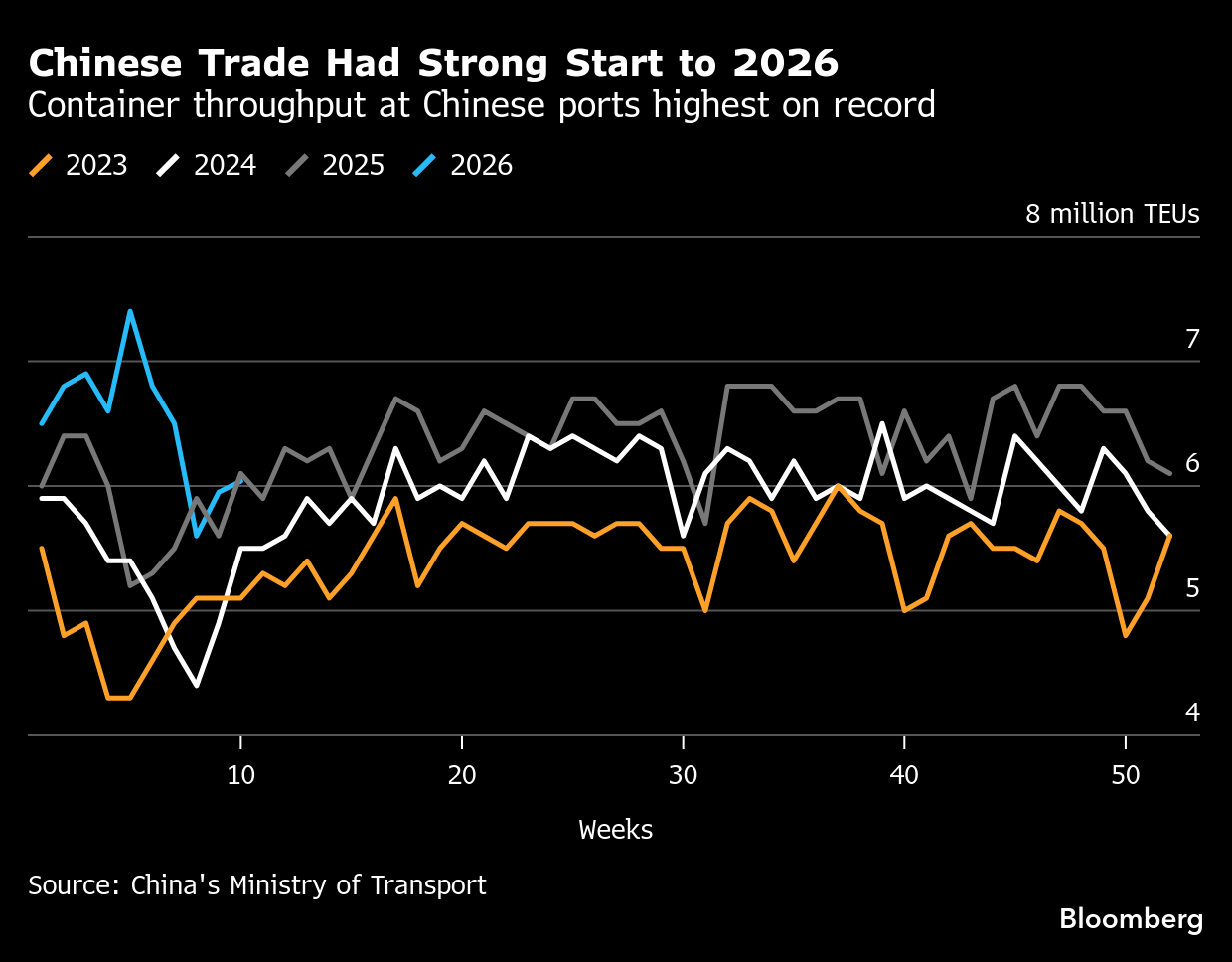
Exports of mechanical and electrical products soared more than 27% in the first two months, including a nearly 73% spike in sales of integrated circuits and a 67% increase in cars.
Imports of crude and refined products by volume rose almost 16% and over 43%, respectively, although the value of oil purchases slipped more than 5%.
China’s export growth probably benefited from a US Supreme Court ruling in February that struck down Trump’s reciprocal tariffs, according to Ding at Standard Chartered, because the verdict might have prompted companies to front-load orders in anticipation of other levies from the White House.
Imports of crude oil rose sharply, possibly triggered by the escalation in geopolitical tensions, he added.
China’s reduction in tax incentives for exporters from April 1 might be among factors prompting companies to rush goods out of the country, according to a leading solar panel manufacturer. The change is meant to promote industry consolidation and reassure trade partners concerned about surging Chinese exports.
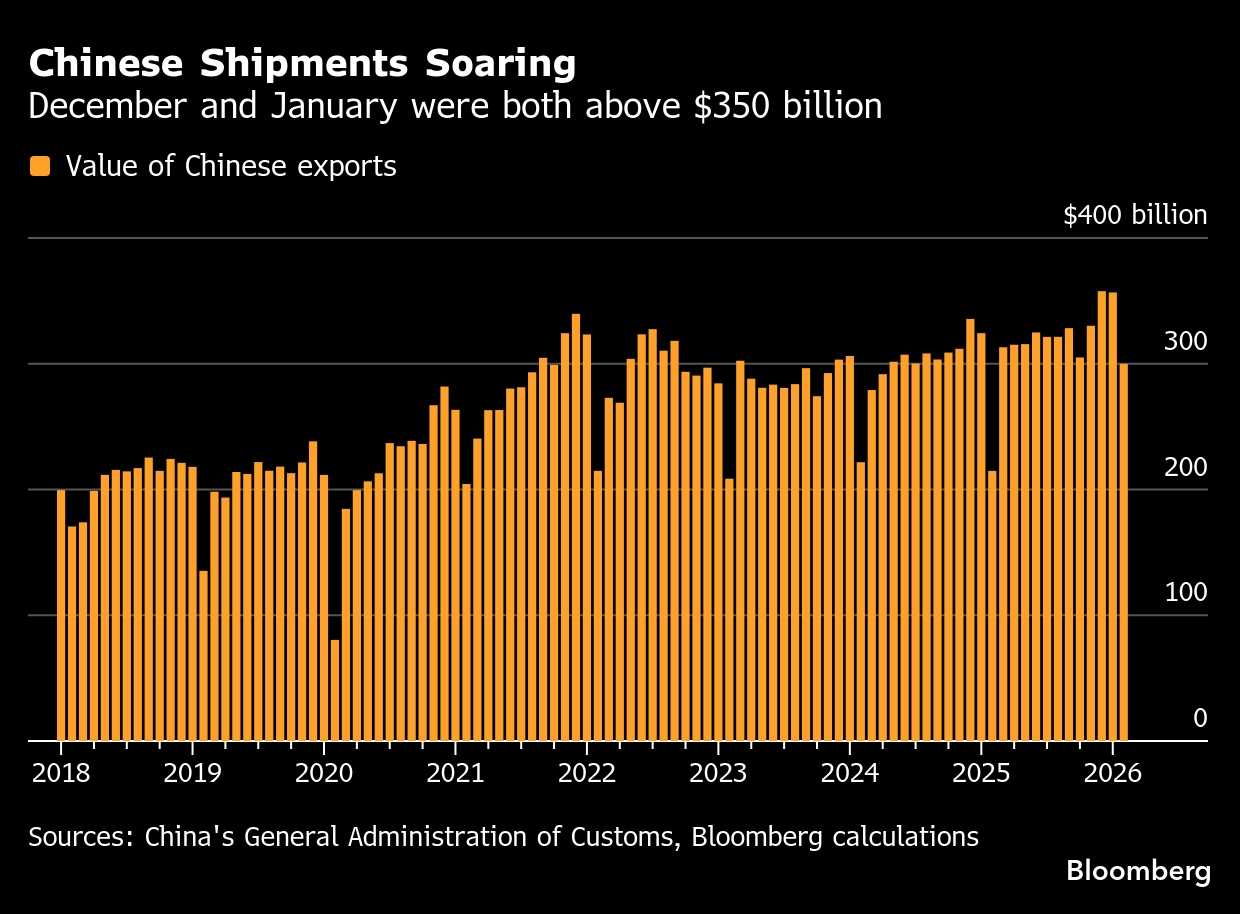
China’s export boom last year generated a record $1.2 trillion trade surplus despite the tariff war with the US, helping the economy overcome a domestic slowdown. But such growth will be harder to sustain in an era of rising protectionism across the world.
“China exports will likely remain quite resilient and stay as an important growth driver for China in 2026,” said Xiaojia Zhi, economist at Credit Agricole CIB in Hong Kong. Even so, “the latest Iran conflict and disruptions to global supply of energy and chemicals could negatively affect global trade flows, particularly related to Asia, in turn creating some headwinds for China in the next couple of months.”
(Updates with details, background, analyst comments starting in fourth paragraph.)
©2026 Bloomberg L.P.








