

China Close to Tapping Commercial Oil Stockpiles, FGE Says


(Bloomberg) -- China, the world’s biggest crude importer, is close to tapping its vast commercial oil reserves as the Middle East war shows no signs of ending, according to FGE NexantECA.
A drawdown in commercial and operational stockpiles amounting to as much as 1 million barrels a day may happen over the next four to six weeks, according to the industry consultant’s base case scenario. Processors — particularly in southern China — may be allowed to draw on commercial stockpiles to limit the extent of run cuts or prevent shutdowns, it said.
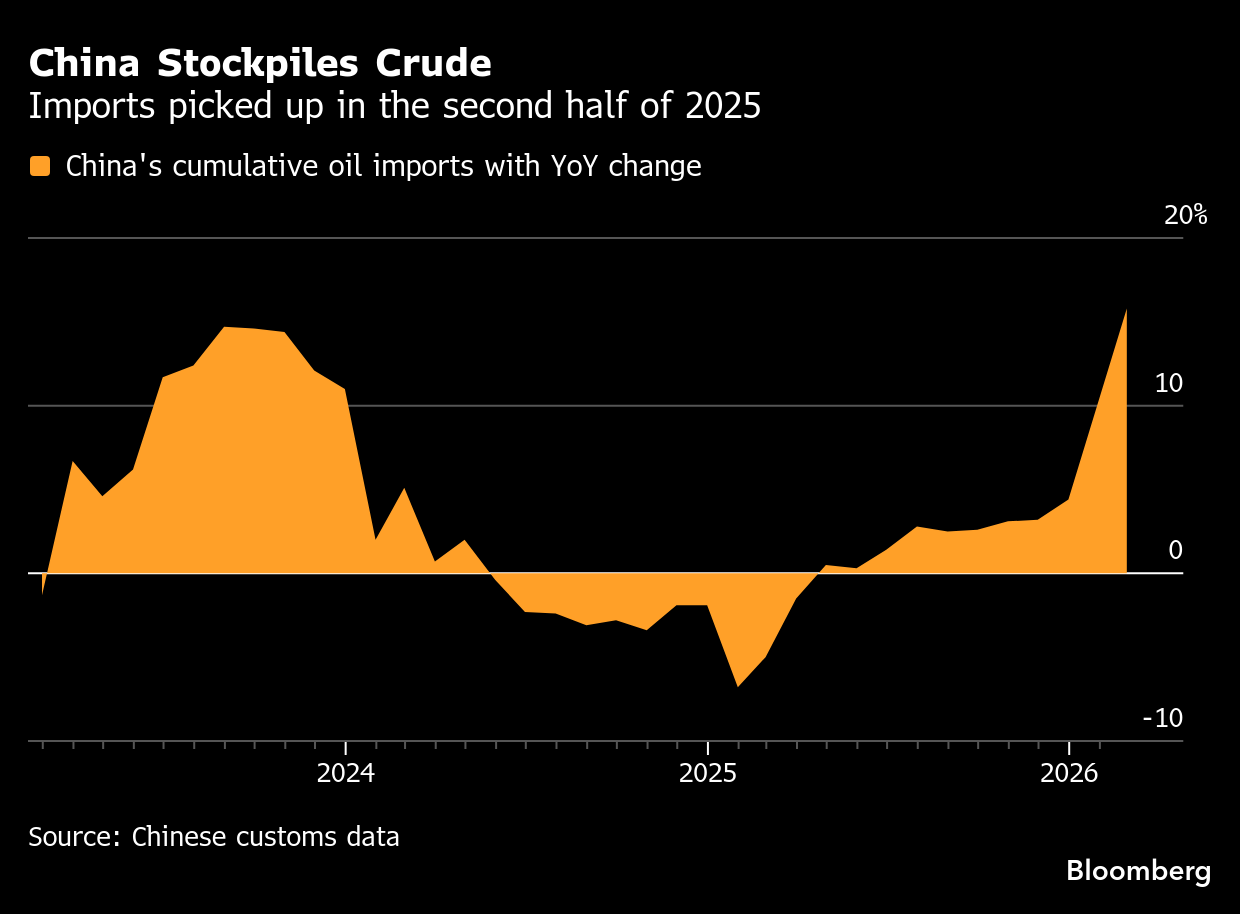
It’s a lever that China can afford to pull. After more than a year of aggressive stockpiling, Beijing has built up an estimated 1.4 billion barrels of reserves that could be tapped if the Strait of Hormuz remains effectively shut. Strategic inventories would likely be left untouched, but even drawing on commercial stocks would require layers of internal approvals.
“Given sailing times, it would be a bit early for Gulf disruptions to be felt in China,” said Antoine Halff, co-founder and chief analyst at geospatial analytics company Kayrros. China’s above-ground crude oil stocks dipped by about 7 million barrels between March 5 and 16, but this could be nothing more than “normal short-term volatility,” he said.
Kayrros estimated earlier this month that China’s above-ground commercial inventories were at 851 million barrels, and its strategic stockpiles were 413 million barrels. Erica Downs, a senior research scholar at Columbia University’s Center on Global Energy Policy, said last week the reserves totaled around 1.4 billion barrels.
Beijing told its biggest oil refiners to restrict fuel exports in the first week of the war, while Sinopec has reduced activity. Rystad Energy estimates run cuts across the country of 400,000 to 800,000 barrels a day in March and April, while FGE said it expects reductions of 1.5 million barrels a day from this week.
Such moves are likely to be “precautionary”, according to China-based GL Consulting, adding that state-owned refiners are expected to prioritize gasoline and diesel production over chemicals to safeguard domestic fuel supply. The impact from the disruptions will likely emerge gradually from late March into early April, GL said.
State-owned refiners, which rely more heavily on Middle Eastern crude, will probably feel the strain first, while independent processors are likely to maintain runs to profit from higher domestic fuel prices. The so-called teapots can more easily tap Iranian and Russian oil, although they are facing increasing competition from India for Russian crude.
For now, Beijing seems to be prioritizing export curbs and getting refineries to use their on-site reserves, said Columbia University’s Downs. “I suspect that China will resist tapping its commercial and strategic oil stockpiles for as long as it can,” she said.
(Updates headline, context in 2nd paragraph)
©2026 Bloomberg L.P.