

Tankers Trickle Through Hormuz After Spate of Iran Attacks


(Bloomberg) -- A handful of oil carriers appeared to transit through the Strait of Hormuz early on Wednesday, even after a spate of strikes on ships rattled owners and prompted at least one supertanker to turn around midway through its crossing.
Six tankers were seen beginning or completing Hormuz crossings just hours after three vessels came under attack — the largest number of incidents since an interim US-Iran peace deal came into effect last month.
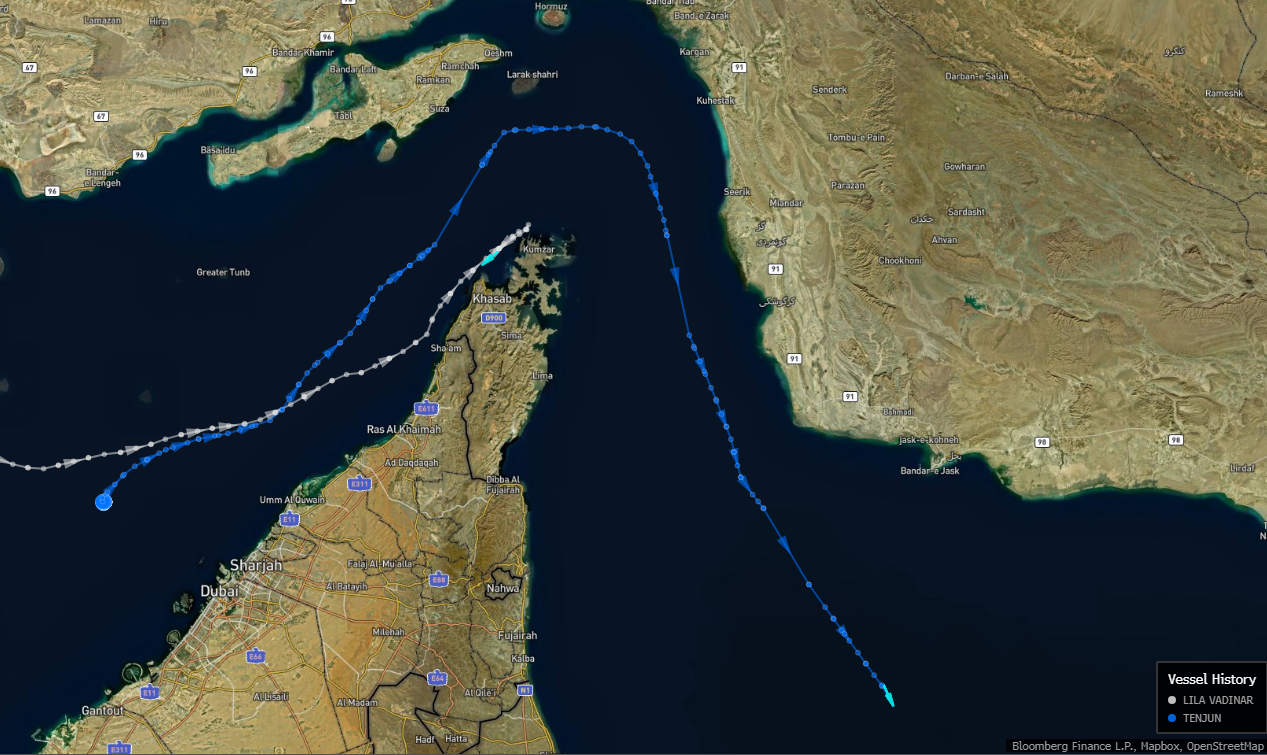
Still, in a sign of prevailing uncertainty, at least one of the six — an India-flagged supertanker, Lila Vadinar — made it to the tip of the Musandam peninsula but then turned back. The stop-start nature of the Hormuz reopening has reduced transit numbers over recent days and weeks, after a spike seen after the June agreement.
Liquefied natural gas traffic has largely ground to a halt after Tuesday’s strikes, which included an attack on a Qatari tanker. In normal times, about a fifth of global LNG supply goes through Hormuz, and worries around fresh disruption in the strait have pushed European gas prices up about 10% over last two days.
Tuesday’s attacks mark the biggest threat to date to a fragile peace agreement, as the US retaliated with airstrikes and scrapped a waiver that had temporarily allowed the sale of Iranian crude. Saudi Arabia has since named one Saudi-flagged tanker as the Wedyan.
As well as deciding whether or not to sail, shipowners now have to ponder which route to take, as the risk of angering either side rises.
The corridor that hugs the Omani coast is supported by the US military, but has increasingly come under attack by Iran as it continues to assert its dominance of the waterway.
The other option is a path that goes closer to the middle of the strait, a route which Tehran says it controls, but safe passage requires seeking the country’s approval. That exposes those who use it to compliance and secondary sanctions risks.
“Going forward, future tanker movements will increasingly reflect the prevailing security environment rather than legacy cargo commitments,” maritime risk company Marisks said Wednesday in a note to clients.
One very large crude carrier on charter to ExxonMobil Holdings Corp., the fully laden Tenjun, pushed through overnight on a route that Iran claims to have control over — even after news of the attacks emerged.
U-turns have become increasingly common as shipowners grapple with a changing situation and fluctuating Iranian demands, with some resuming their journeys along the Tehran-approved route. The Lila Vadinar had entered the Gulf late June and picked up a cargo of Kuwaiti crude before attempting to leave on Wednesday.
Bloomberg News couldn’t immediately determine the reason behind its about-face. Maritime database Equasis lists RFK Shipping IFSC Pvt Ltd in India as its owner, but provided no telephone or email contact details.
It was also unclear why the Tenjun took a route Iran claims to control. Exxon — which has taken the ship on time charter, according to brokers and tracking data — did not respond to emailed queries. A spokesperson for Japan’s NYK Line, listed as the ship’s beneficial owner, declined to comment.
The vessel transited the chokepoint at around the time when news of the third attack emerged, and is now sailing in the Gulf of Oman, headed for Singapore.
Behind Tenjun, a China-bound VLCC that earlier appeared to sail along the Omani coast is now taking the same route in the middle of the strait.
Hours earlier, three laden supertankers exited the Gulf and are now off Fujairah in the United Arab Emirates, though they did not turn on their transponders while sailing through the strait.
Traffic along the Iranian side was relatively quiet on Wednesday morning. Two Iran-flagged crude tankers sailed into the Gulf along the Tehran-backed route, with a bulk carrier claiming Chinese ownership behind them.
(Updates throughout with details of U-turn, Exxon-chartered vessel.)
©2026 Bloomberg L.P.








