

Saudi Oil Logistics Roiled Again by Houthis’ Red Sea Threat


(Bloomberg) -- Saudi Arabia is yet again being forced to overhaul how its oil gets to customers around the world, as Yemen’s Houthis make it harder for Riyadh to use a backup route that’s been vital to the global economy since the Iran war started.
The top exporter is sending tankers thousands of miles all the way around Africa. Millions of barrels of the kingdom’s crude are being shuttled north across the Red Sea, avoiding a narrow strait near Yemen at the southern end of the Red Sea. China, meanwhile, is being offered Middle East shipments for collection just outside the Arabian Gulf.
Saudi Arabia’s ability to switch crude exports to its west-coast facilities has been critical in blunting an oil price surge and shielded economies from an inflation spike as Iran effectively shut the Strait of Hormuz. Now, with Yanbu also under threat from the Iran-backed Houthis, the kingdom and its customers are having to make new arrangements.
The sprawling and costly workarounds are another illustration of the ongoing trade friction imposed by a war that’s expanded more widely, and dragged on far longer, than initially envisioned.
Double distance
The key issue has been the threat that the Houthis pose to tankers in the Bab el-Mandeb, the narrow waterway at the southern exit of the Red Sea.
After the militants announced a blockade of Saudi ports in July, many tankers collecting barrels at the country’s Yanbu installations on the Red Sea began avoiding the waterway, choosing instead to sail north through the Suez Canal to Egypt’s Mediterranean port of Sidi Kerir.
For those then sailing onward to Asia, it’s meant going all the way around Africa — more than doubling voyages to roughly 17,000 miles.
That’s still a popular option among many Asian buyers. Over the past week, several of the continent’s refiners pushed back against a Saudi Aramco request that they collect cargoes from Yanbu, citing the difficulty of finding ships willing to go there, and asked to pick them up at Sidi Kerir instead.
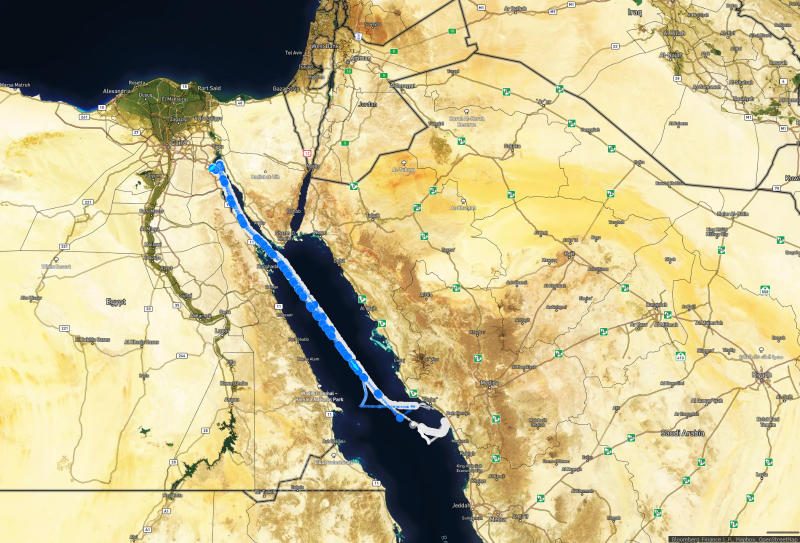
To facilitate that, Saudi Arabia needs to get its crude across the Red Sea and through Egypt — either via the Suez Canal or a pipeline that crosses the country. However, the waterway is too shallow to take fully laden supertankers, while the pipeline can’t handle all the Saudi oil that Asia would normally buy, compounding the logistics headache.
Over the past month, vessels controlled by South Korea’s Sinokor Group, Greece’s Dynacom Tankers Management Ltd., and Norway’s DHT Management AS have been seen shuttling cargoes from Yanbu to Ain Sukhna at the southern end of the pipe.
Empty oil supertankers are also avoiding the Bab el-Mandeb. Six Saudi ones that diverted away from the strait at the end of last month have taken the long way around Africa, and are now skirting the continent’s western coast as they head for western entrance of the Mediterranean.
New strategies
While many Asian refiners have been prepared to collect from Sidi Kerir, Saudi Arabia has started offering to sell to its Chinese customers from the Gulf of Oman, just outside Hormuz.
Satellite images and ship tracking show a large cluster of Saudi oil tankers waiting in the Gulf of Oman and, simultaneously, a pickup in activity at the kingdom’s side of the Gulf. The country’s state tanker company has a longstanding reputation in the shipping market for being a careful, risk-averse operator.
That points to the possibility the country might arrange for oil to be shuttled from the Gulf and through the strait near Oman or the United Arab Emirates.
Such a tactic has already emerged as a lifeline for the UAE and some other gulf producers. It has been synonymous with one player in particular: Sinokor, and the intensely private Korean shipping tycoon at its heart, Ga-Hyun Chung.
The firm is once again involved as Saudi Gulf flows pick up. Three of four supertankers that have carried approximately 8 million barrels of crude from Saudi’s gulf ports since Aug. 11 have been owned by Sinokor, according to shipping data compiled by Bloomberg.
Sinokor didn’t respond to an emailed request for comment.
Allocations
The logistics revamp is adding to the strain on Saudi Arabia as it attempts to keep the global market supplied.
The kingdom notifies countries’ weeks in advance about how much crude they’ll get under so-called term-allocation contracts.
For the key Asian market, those overall volumes remain well below what customers would normally receive before the Iran war began, according to traders. Saudi Arabia’s overall exports remain below pre-war levels.
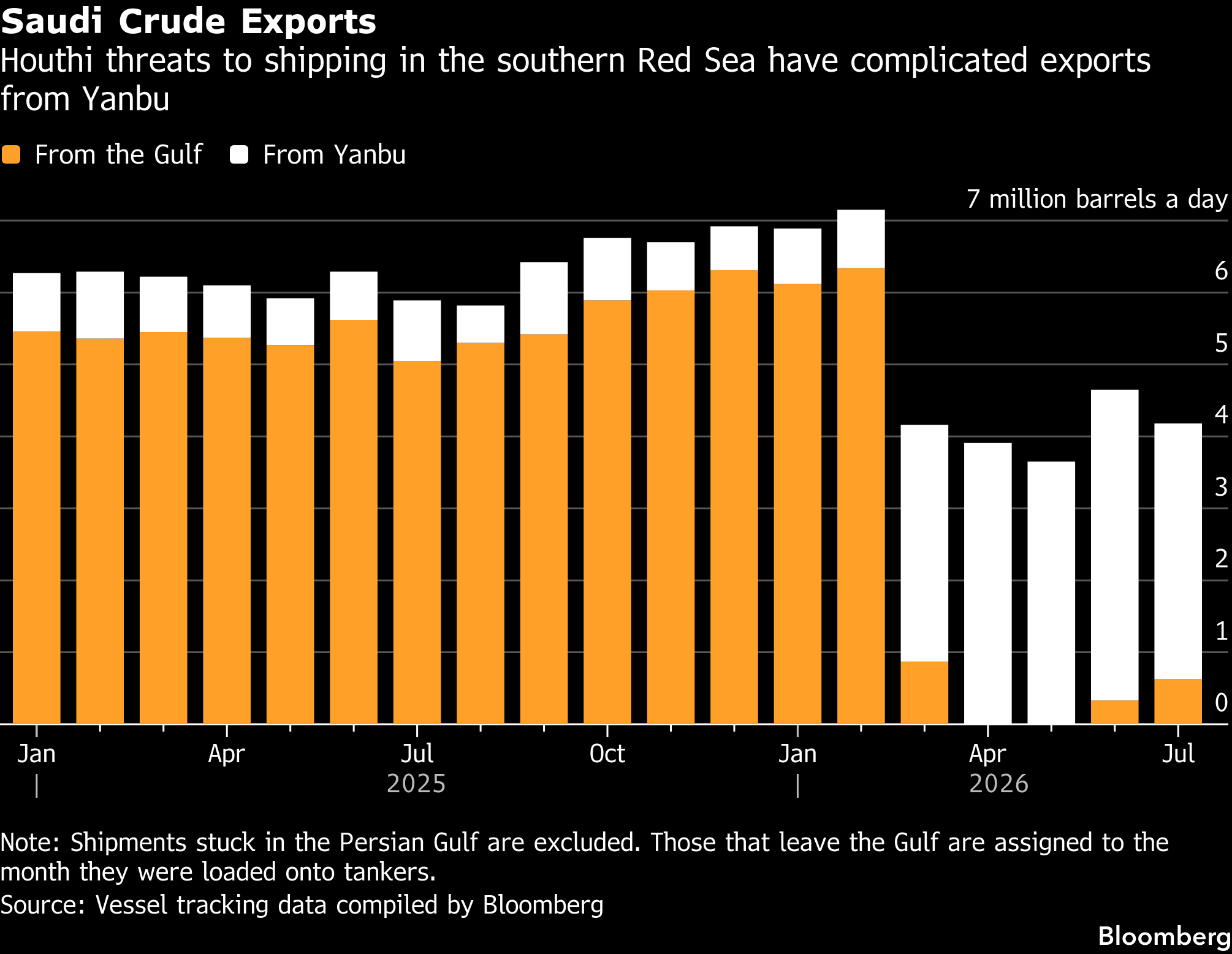
The logistics challenges increase the cost of delivering barrels, an expense that has to be borne somewhere in the supply chain. At least one East Asian refiner is considering dropping its loading of Saudi oil for next month due to the added expense.
Still, Japanese and South Korean refiners are largely set to collect their oil next month that’s loaded from the Sidi Kerir, traders said, as concerns about energy security trump the higher costs.
Despite the Gulf of Oman sales, China’s contractual oil-buying is likely to remain solidly below pre-war levels as shipping disruptions around Middle Eastern routes add to transport costs.
By contrast, European oil refineries may benefit from the extra expense that Asia is incurring. Over the past week, several of them received their full allocations of Saudi Arabian crude for September, allaying concerns when the supply-nominations process was delayed by about a week.
Saudi Aramco declined to comment. The country’s energy ministry didn’t respond to a request to do so.
©2026 Bloomberg L.P.