

Chevron in Talks to Expand in Venezuela Amid Broader US Push


(Bloomberg) --
Chevron Corp. is in talks to expand in Venezuela, the latest sign of how US interests are trying to tighten their grip on the Latin American nation’s oil industry.
The Houston-based company is negotiating to add two new oil fields to its operations in the country, according to people familiar with the matter, who asked not to be identified because the talks aren’t public. Other US energy companies are also in discussions to make new investments in the sector, they said. Chevron declined to comment.
The talks come as the Trump administration negotiates with Venezuelan leaders about taking a significant stake in the nation’s oil fields, which are among the largest in the world. Leases as long as 100-years on several oilfields being discussed, according to people familiar with the matter.
The potential deal - which has little or no historical precedent - comes after US forces seized Nicolás Maduro in January and effectively handed control of Venezuela to his former vice president Delcy Rodríguez, who has since become allied with the Trump administration. In the months following, President Donald Trump has pushed for US companies to rebuild the nation’s oil industry.
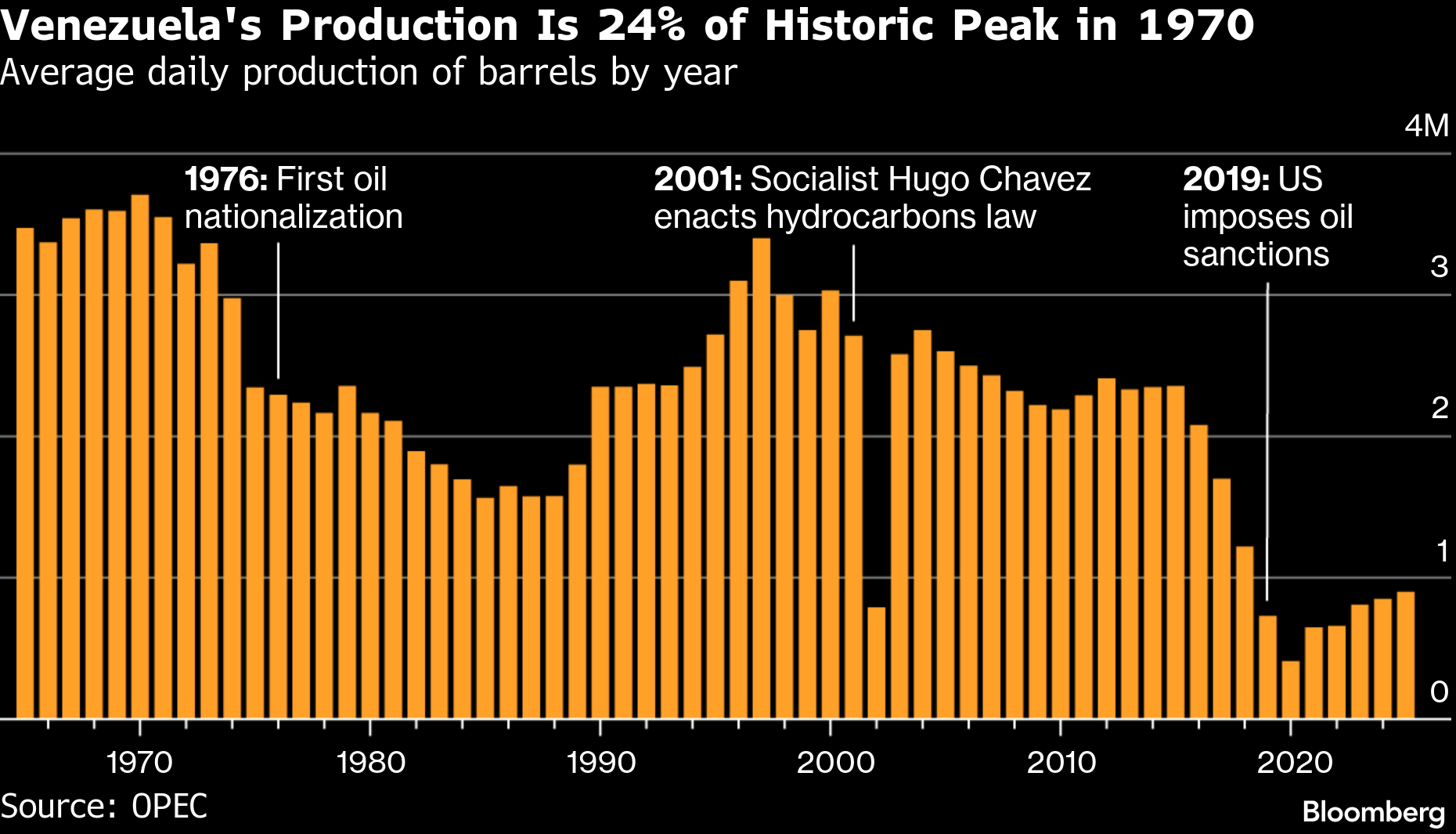
It remains to be seen, however, how quickly Venezuelan production can grow as Chevron and other producers prepare to sign new oil deals. While the nation has some of the world’s largest reserves, producers will have to contend with degraded infrastructure, unreliable electricity and legacy environmental liabilities. Analysts and industry experts say it could take more than a decade to restore production to the roughly 3 million barrels a day Venezuela pumped before its oil industry began a decades-long collapse.
Meanwhile, some prominent Venezuelan figures — including Harvard University professor and ex-Venezuelan minister Ricardo Hausmann — are questioning the constitutionality of a foreign power taking control of the nation’s reserves.
Chevron already has joint ventures with Venezuela’s state oil company and is the only US oil major active in the country.
The company currently accounts for around a fifth of Venezuela’s oil production. It has been in the country for decades, remaining after the government expropriated assets belonging to ExxonMobil Holdings Corp. and ConocoPhillips in 2007.
The Wall Street Journal reported earlier that Chevron was in talks to expand in Venezuela. The newspaper also said other companies were nearing deals to invest in Venezuela and that Halliburton Co. is in talks to bring oil equipment there.
US officials are discussing leases lasting as long as 100 years on several Venezuelan oil fields, according to people familiar with the matter.
Gaining greater access to Venezuela’s vast oil reserves would boost US supplies at a time of intense market volatility caused by the war in Iran, and Tehran’s efforts to choke commercial shipping through the Strait of Hormuz. It could also help as the US struggles to refill its depleted Strategic Petroleum Reserve, which stands at roughly 41% of capacity, its lowest level in more than four decades.
Since the capture of former Venezuelan President Nicolás Maduro, Washington has controlled Venezuelan oil sales while easing sanctions to allow US companies and oil field contractors to do business in the country. Venezuelan oil production has already increased by nearly 300,000 barrels a day since Maduro’s ouster, according to data compiled by Bloomberg.
More production could be unleashed after foreign producers finalize new contracts with the Delcy Rodriguez administration. Oil field giant SLB and independent producer Hunt Oil Co. signed contracts with the Venezuelan government this month.
©2026 Bloomberg L.P.