

Trump Insists on Hormuz Opening as He Escalates Iran Threats


(Bloomberg) -- President Donald Trump insisted that freedom of navigation through the Strait of Hormuz be part of any deal to end the Middle East war and escalated threats to obliterate key Iranian infrastructure if his terms aren’t met before a Tuesday deadline.
Trump said Monday that talks with Iran are “going well” and that reopening the strait as “a very big priority.” The president in recent weeks has said an agreement on the strait wasn’t among his core prerequisites for ending the conflict.
“We have to have a deal that’s acceptable to me, and part of that deal is going to be we want free traffic of oil and everything,” he said at a White House news conference.
Trump laid bare the consequences Iran would face if it doesn’t reach a deal by his Tuesday 8 p.m. Eastern Time cut-off, saying the US military could destroy “every bridge in Iran by 12 o’clock tomorrow night.” Power plants would be rendered “burning, exploding and never to be used again,” he said.
Attacking civilian infrastructure is barred by the Geneva Conventions, but Trump said he was “not at all” concerned about committing war crimes.
“I mean complete demolition by 12 o’clock, and it will happen over a period of four hours, if we wanted to,” he said. “We don’t want that to happen.”
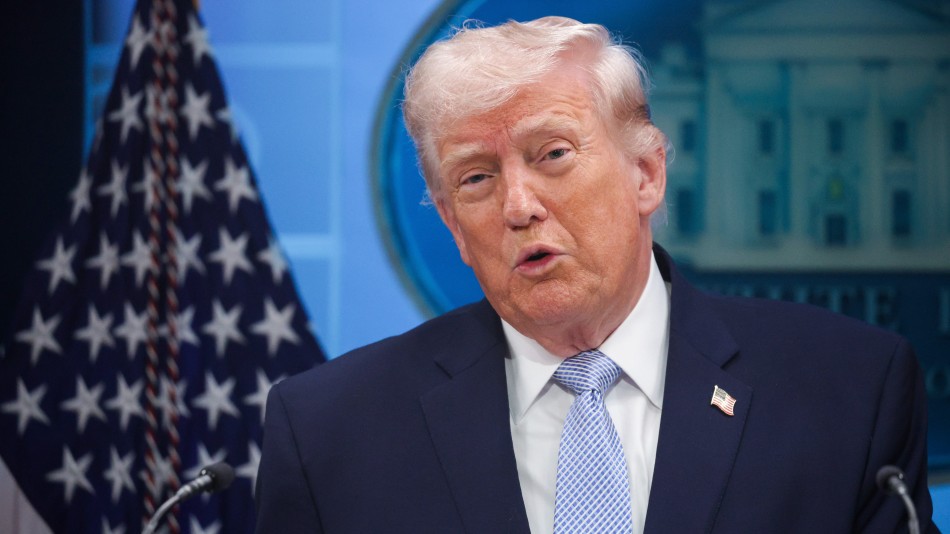
The president’s self-imposed deadline marks the latest pivotal moment in the war, now in its second month, which has killed thousands and triggered the largest-ever disruption to the global oil market. The president has struggled to find an off-ramp to the conflict — increasingly unpopular with Americans who are seeing average gasoline prices above $4 a gallon.
Iran has warned that it would respond to the kind of strikes Trump is threatening against civilian targets by ramping up its own attacks on energy infrastructure in the Gulf — a move that could heighten the global fuel squeeze and amplify damage to the world economy.
The president’s comments on the strait appeared to be at odds with past remarks from his administration about whether he’d be willing to end the war with the strait still closed. Last week, White House Press Secretary Karoline Leavitt didn’t list reopening Hormuz as a core US military objective.
Oil prices rose as Trump threatened more strikes, renewing traders’ fears that flows through the strait would remain curtailed for longer. Global equities — after gaining Monday on ceasefire hopes — fluctuated as uncertainty about the war kept investors on the sidelines.
Singapore’s top diplomat warned the economic fallout from the war could worsen and investors have yet to adjust. “I’m quite sure the markets are not fully pricing the worst-case scenario,” Foreign Affairs Minister Vivian Balakrishnan told Bloomberg Television at an Investment Management Association of Singapore conference.
At the press conference, Trump mixed threats with an upbeat assessment of diplomatic conversations, even though Tehran earlier rejected a ceasefire proposal and instead demanded a permanent end to the war.
Trump said Vice President JD Vance is involved in the conversations and also mentioned special envoy Steve Witkoff, who had sought an agreement with Tehran before the US and Israel began the war in late February.
“I can tell you that we have a active, willing participant on the other side,” Trump said. “They’re negotiating, we think in good faith — we’re going to find out.”
Trump said it was “highly unlikely” that he’d move the deadline again.
Earlier Monday, Iran refused to agree to ceasefire terms relayed via Pakistan, which has been mediating efforts to end the conflict.
Leaders in Iran have instead called for a permanent end to the war, reconstruction efforts and the lifting of sanctions, in addition to protocols for ensuring safe passage through Hormuz, according to Iran’s state-run Islamic Republic News Agency.
The agency reported Monday, citing a spokesman for the nation’s joint military command, that Iran’s offensive against the US and Israel wouldn’t be affected by Trump’s threats.
Iran has said it would only allow strait operations to resume when it is compensated for damage from the war. Tehran has continued striking energy targets in neighboring Gulf countries, including Kuwait’s oil headquarters.
Axios reported that Pakistan, Egypt and Turkey are pushing to secure a potential ceasefire — lasting about 45 days — to head off threatened American strikes on Iran’s energy infrastructure and retaliation by the Islamic Republic against countries in the region.
In an expletive-laden post on Sunday, Trump amped up his threats to destroy Iran’s power plants and blow up “everything over there” before announcing his new deadline. The move adds to a series of extensions since he began issuing similar ultimatums on March 21 to force Iran to reopen the strategic waterway.
The president initially called his news conference to tout the success of a pair of daring US missions over the weekend to rescue two airmen whose jet was shot down in Iranian airspace. Trump said the operations involved more than 175 aircraft and hundreds of military personnel.
Yet that incident, combined with Trump’s threats, cut against the aura of invincibility the president and his advisers have sought to project.
Trump and other officials appeared to contradict each other over the threat posed to American planes flying in the country. Defense Secretary Pete Hegseth said the US military controls the skies in Iran. But Trump and Joint Chiefs of Staff Chairman Dan Caine said US aircraft involved in the rescue operation had been hit by enemy fire. And Trump later said the two pilots’ fighter jet was shot down by a shoulder-fired missile.
The president also lamented that he would like to take Iran’s oil for the US but that the American public wants to wind down the conflict.
“I’m a businessman first,” Trump said when asked about the trade-off between seizing the oil supplies and public opinion. “And I’ve said, why don’t we use it — to the victor go the spoils? And we don’t have that.”
(Updates with markets and comment on worst-case scenario from paragraph 10.)
©2026 Bloomberg L.P.








