

Oil Tankers Start to Dash for Hormuz as Shipowners Seek Answers


(Bloomberg) -- A handful of oil tankers were racing toward the Strait of Hormuz on Friday after Iran declared it open, even as industry groups urged caution and several shipowners and traders said they needed more clarity about the status of the waterway before making any decisions.
The oil market was left reeling by a stream of headlines, after Iranian Foreign Minister Abbas Araghchi sent prices plunging with the announcement that the Strait of Hormuz was “completely open” as long as the ships followed the previously announced routes through its waters — a statement that was quickly repeated by US President Donald Trump.
However, Iranian media later reported that ships and cargoes linked to “hostile” countries would not be allowed through, that any transits must be arranged with its authorities, and that it would close the strait if the US blockade of its own shipping continues.
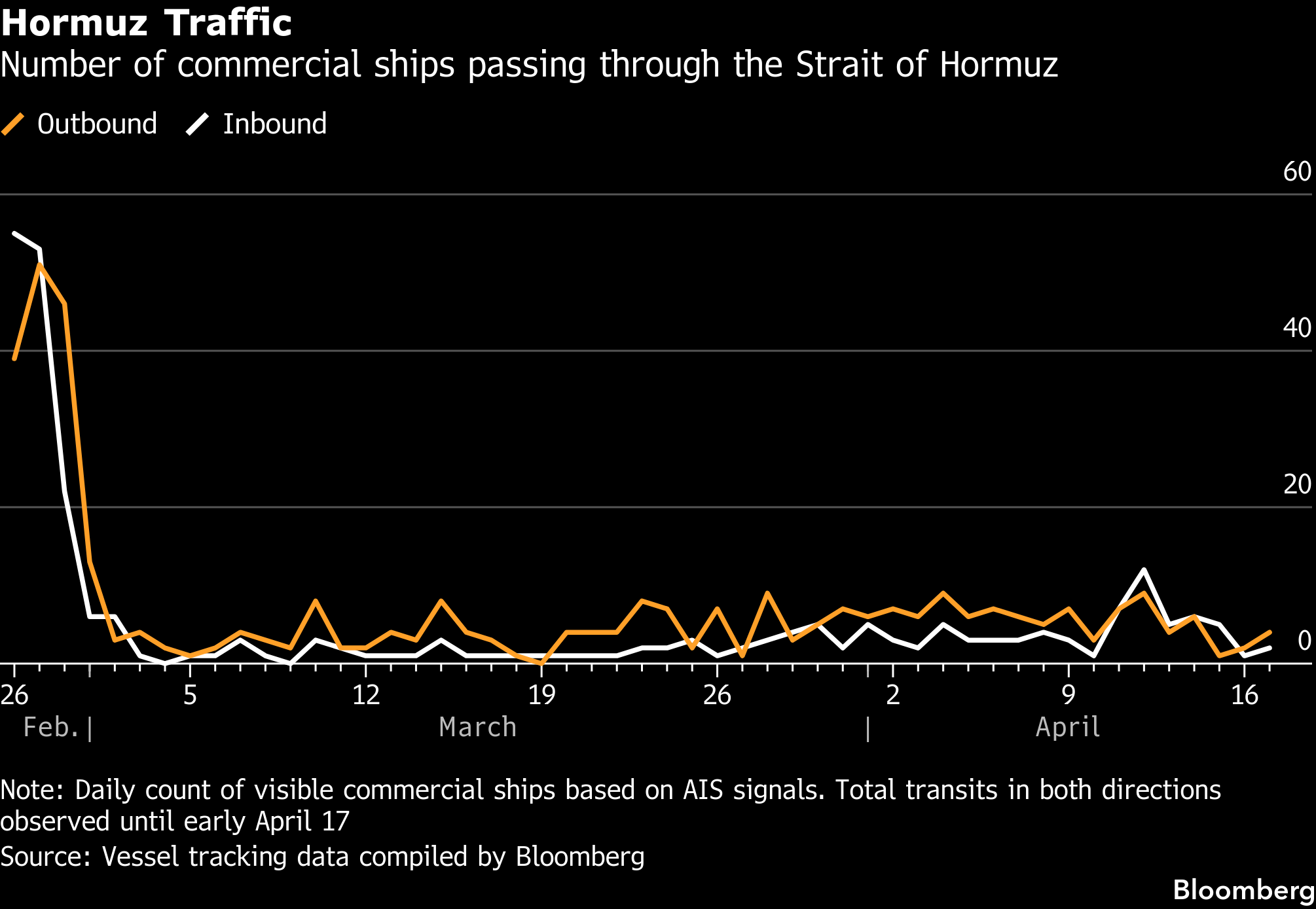
A full reopening of the strait would free up millions of barrels of crude oil and fuel stuck inside the Persian Gulf, in turn allowing the region’s producers to begin ramping up shuttered production. The effective closure of the strait already eliminated well over 400 million barrels of oil and fuel shipments as well as a swath of natural gas cargoes, driving up prices and eating away at global growth.
Bloomberg spoke to over a dozen ship owners, agents, brokers and traders, most of whom indicated that they intended to take a wait-and-see approach for now. The world’s largest international shipping association, Bimco, said it believes shipping companies should consider avoiding the area.
However, by late Friday, at least eight tankers inside the Persian Gulf appeared to be heading towards the strait, according to vessel tracking data compiled by Bloomberg.
Five tankers that were previously anchored north of Dubai were already moving into the Strait of Hormuz by Friday afternoon, while a further three were sailing east in the direction of the waterway. The vessels were too far out to assess whether they were heading towards the Iranian-approved route through its own waters that has become the most common path in recent weeks. There’s also no clarity on whether they really intend to transit — ships have sometimes moved towards the strait during the conflict only to stop once they get there.
Shipowners take varying approaches to risk tolerance — some are highly conservative while some Greek companies have continued sneaking tankers out of the Gulf even during the conflict. Crews too have a big say in transits, and vessels’ captains are the ultimate arbiters of what is safe. Even for those that do take Araghchi’s post on X at face value, they would need to secure insurance for transit at an acceptable price.
“The market will treat it with cautious optimism rather than full confidence,” said Capt. Farhad Patel, director of Sharaf Shipping Agency in Dubai, a firm that works with many owners in the area. “While this move should help restore some vessel movement and ease immediate pressure on energy flows, the operating environment remains highly controlled and sensitive.”
Routing restrictions, inspections, and parallel enforcement measures in the region mean this is not yet a return to normal trading conditions, Patel said.
In the initial hours after the announcement, some shipowners said privately that they wouldn’t want to be the first to find out whether the route really is safe and fully open.
“Would you be the first penguin off the ice floe to test the water?” one asked.
At least 135 million barrels of crude and refined products are held on tankers stuck in the Persian Gulf, according to ship tracking data compiled by Bloomberg. That includes cargoes loaded in the final days of February and the first half of March, before all the available vessels were filled.
Even if the strait is fully opened, it will take weeks for ships leaving the Gulf to reach their destinations, and months or years for the energy rich region’s oil and gas production to return to normal.
Several people involved in moving cargo through Hormuz pointed out that Iran is thought to have placed sea-mines on the traditional route that’s closer to Oman, showing that full freedom of navigation is not a given. Trump said in a social media post they are being removed.
Jakob Larsen, chief safety and security officer at Bimco, said that Trump’s announcement that the Strait of Hormuz is fully open “is inaccurate.”
“The status of mine threats in the Traffic Separation Scheme is unclear and Bimco believes shipping companies should consider avoiding the area,” Larsen added, referring to the traffic management system in the strait.
UK Maritime Trade Operations, which acts as a liaison between the Royal Navy and the shipping industry, said in an advisory that “the regional security environment remains volatile, with ongoing military activity and continued threat to commercial shipping.”
Another question mark is insurance. Multiple owners said they would begin trying to negotiate prices to cover them for transits, while some said that prices need to come down before they attempt a crossing.
Tollbooth Route
Iran previously said shippers needed to pay a “toll” in order to pass through its approved route, something that many owners and the International Maritime Organization have rejected.
Araghchi’s comments made no mention of that. Nor did it say if owners would need to contact Iranian authorities for transit, another sticking point for some in the shipping industry.
“We are currently verifying the recent announcement related to the reopening of the Strait of Hormuz, in terms of its compliance with freedom of navigation for all merchant vessels and secure passage using the IMO established traffic separation scheme,” the IMO’s secretary general, Arsenio Dominguez, said in a statement.
While Trump said in a follow-up post that Iran has agreed a permanent reopening, and that it will never shut Hormuz again, that went beyond Araghchi’s statement.
The Iranian foreign minister said that it has agreed to open the channel in response to a ceasefire in Lebanon, something that is dependent on Israel not carrying out further attacks. According to the semi-official Fars news agency, Iran said that it will close Hormuz if the US doesn’t end its blockade.
“Owners need to get confident and then send vessels in en masse,” said Neil Crosby, head of Research at Sparta Commodities. “All of this takes time, and risk of a deal collapse half way to the Strait is also there.”
©2026 Bloomberg L.P.