

Oil Falls With US Delegation Headed for Talks, Hormuz Blocked


(Bloomberg) -- Oil prices fell on fresh hopes that elusive peace talks between the US and Iran may materialize after all and pave the way for the resumption of energy flows though the vital Strait of Hormuz.
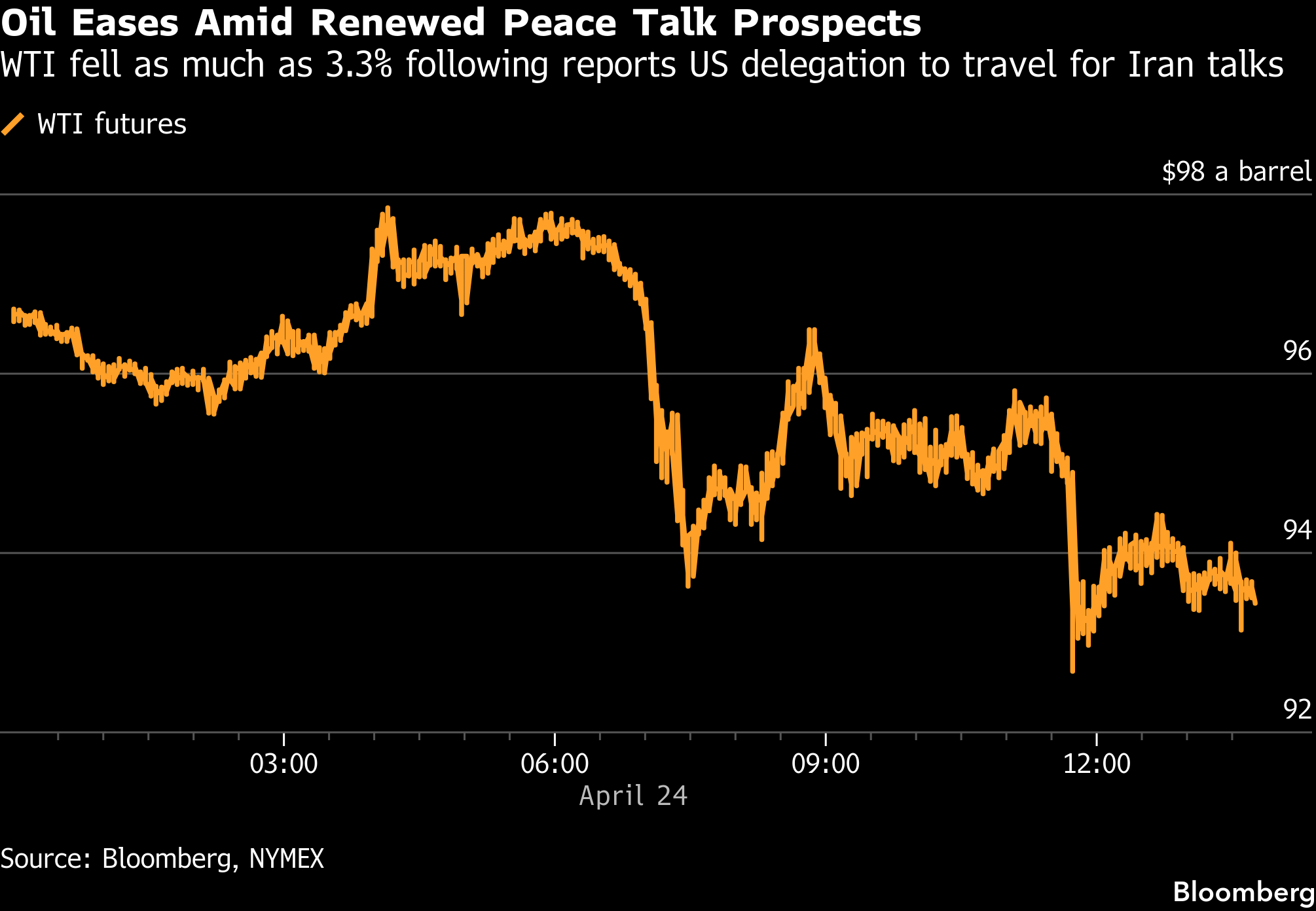
West Texas Intermediate futures fell as much as 3.3%, before recovering slightly to trade near $94 a barrel after the White House said it was sending two envoys to Pakistan with the intention of talking with Iranian officials also slated to be in Islamabad.
Tehran, however, sounded a more pessimistic tone on potential discussions on ending the war launched by the US and Israel in late February. No talks are slated to take place between US and Iranian officials during Iranian Foreign Minister Abbas Araghchi’s trip to Pakistan, the semi-official Tasnim news agency reported earlier.
Still, the development erased some of the geopolitical premium that had been added to prices earlier this week, driven by uncertainty over talks, escalating rhetoric and rising military threats. Traders had been closely tracking the movements of both delegations for signals on whether peace talks will again take place and offer some relief as the strait — which connects the Persian Gulf to global markets — remains largely shut.
Recent developments “suggest that traders are getting increasingly comfortable with the idea that the kinetic phase of the US-Iran conflict is ending, or has already ended, and that an economic war is becoming entrenched,” said Thierry Wizman, Global FX & Rates Strategist at Macquarie Group.
US President Donald Trump’s Truth Social posts — as well as his decision to continue a naval blockade of Iranian ports — have been detrimental to negotiations through mediators such as Pakistan, according to two US officials familiar with the matter.
The blockade, a major sticking point in bringing Tehran to the negotiating table, is choking off Iranian crude exports — the only flows out of the Persian Gulf since the war began at the end of February. A US-sanctioned supertanker laden with Iranian oil appeared to halt its transit through Hormuz on Friday.
“All they have to do is abandon a nuclear weapon and in meaningful and verifiable ways,” US Defense Secretary Pete Hegseth said Friday. “Or instead, they can watch their regime’s fragile economic state collapse under the unrelenting pressure of American power, a blockade as long as it takes. Whatever President Trump decides.”
Trump said in a social media post this week that he had ordered the US Navy to “shoot and kill” boats laying mines in the strait.
Crude oil production in the Persian Gulf will take “a few months” to mostly restore, assuming a full reopening of Hormuz and no renewed strikes, Goldman Sachs Group Inc. analysts including Daan Struyven said in an April 23 note. The bank sees output being curtailed by about 14.5 million barrels a day, or more than 50% in April.
“Even a full reopening may still leave flows taking several months to normalize, creating additional tightness, especially in diesel and jet fuel, and forcing countries and companies to curb demand,” Saxo Bank’s Hansen said.
©2026 Bloomberg L.P.