

Two More Indian LPG Ships Transit Hormuz Along Iran Coast


(Bloomberg) -- Two additional Indian-flagged vessels carrying liquefied petroleum gas are making their way through the Strait of Hormuz, ship-tracking data show, following a route taken by other ships approved by Iran that hews closely to the country’s coastline.
The Jag Vasant and the Pine Gas, two India-flagged very large gas carriers, traveled northwards from the UAE coast toward Iran’s Qeshm and Larak islands early Monday, the data show.
The two signaled Indian ownership with their transponders instead of a destination — a precautionary measure followed by other ships making the crossing — but are likely to be heading to India, which has been facing acute shortages of LPG and has been in talks with Tehran to secure cargoes of the fuel, used primarily as cooking gas.
Two other Indian-flagged LPG vessels made the transit earlier this month.
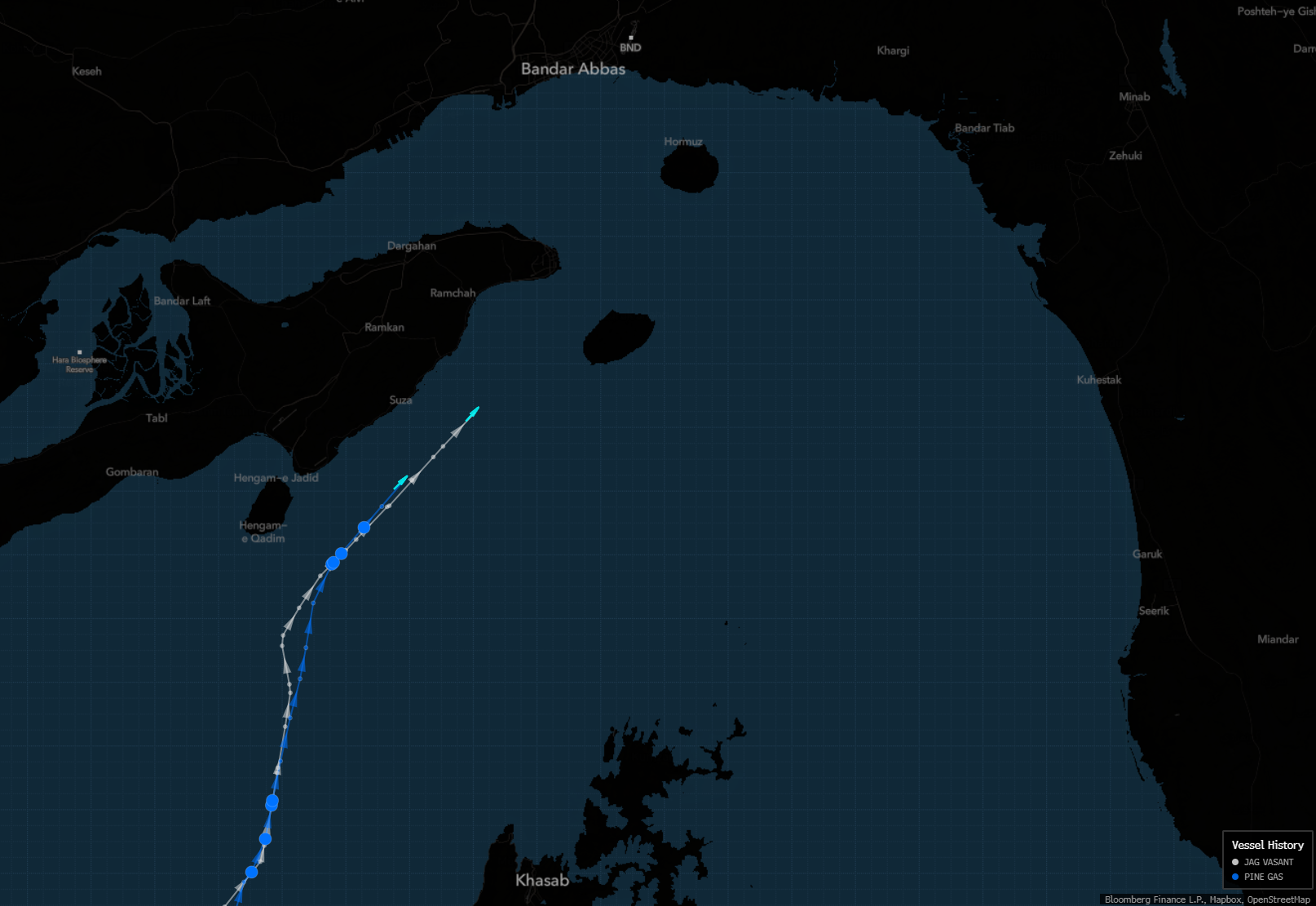
A full Hormuz transit can take up to 14 hours. If Jag Vasant and Pine Gas continue on their current trajectory unhindered, they are likely to reach the other side of the strait in the Gulf of Oman by Monday evening.
A vital waterway that connects oil and gas producers in the Persian Gulf with the wider world, Hormuz has been all but closed since US and Israeli strikes began at the end of February. Since then, Tehran has all but halted traffic with ship attacks and threats. The only vessels to make it through have been linked to Iran, China or a small number of other countries that have sought to negotiate safe passage, including India.
A number of the vessels that have managed to get through have taken a similar route that follows the Iranian coastline, suggesting a traffic-control system imposed by Tehran. In normal times, ships exiting the gulf would stay closer to Oman, but one sailing that more conventional route came under attack earlier this month.
India’s last two carriers were granted safe passage after a deal with Iran. The Iranian Navy guided one of those tankers, a senior office onboard the vessel told Bloomberg News.
Indian Prime Minister Narendra Modi spoke to Iranian President Ahmad Masoud Pezeshkian at the weekend — just prior to this crossing — and emphasized the importance of keeping shipping lanes open, while Foreign Minister Subrahmanyam Jaishankar held a phone call with Iranian counterpart Abbas Araghchi, according to a social media post on Saturday.
Jag Vasant had entered the Persian Gulf via Hormuz on Feb. 26, ship-tracking data show. It then filled up with LPG from Kuwait just hours before the war broke out on Feb. 28, and had been stuck since. Pine Gas entered on the same day, and picked up its full load from Ruwais from the UAE.
Jag Vasant was chartered by Bharat Petroleum Corp. Ltd. and Pine Gas by Hindustan Petroleum Corp. Ltd., according to people familiar with the matter. The two state-owned refiners did not immediately respond to emails seeking comment.
The two, together with the earlier pair, will encourage Indians struggling to find cylinders. Still, the four carry what India consumes in just two to three days, said Shiv Samrat Kapur, managing director at the India-based unit of Sentosa Shipbrokers.
“Iran is using the strait as a tool of maritime diplomacy, forcing nations to choose between Western alignment and energy stability,” he said. “The transits have proven India’s capability to maintain neutral relationships during these times of geopolitical uncertainty.”
India has also asked ports to prioritize the berthing of LPG carriers. Last week, the Deendayal Port Authority, at a port more popularly known as Kandla, notified that all agents must offer LPG vessels priority, according to a notice seen by Bloomberg News. That was based on a March 10 directive issued by the Ministry of Ports, Shipping and Waterways to “safeguard uninterrupted supply of LPG to household across the country.”
(Adds Modi call in paragraph nine, ownership in paragraph 11.)
©2026 Bloomberg L.P.