

UAE’s Oil Output Surged to Record High in June, IEA Says


(Bloomberg) -- The United Arab Emirates boosted crude oil production to an all-time high last month, the most compelling evidence yet of how Abu Dhabi responded more boldly than any of its Persian Gulf neighbors to disruption caused by the Iran war.
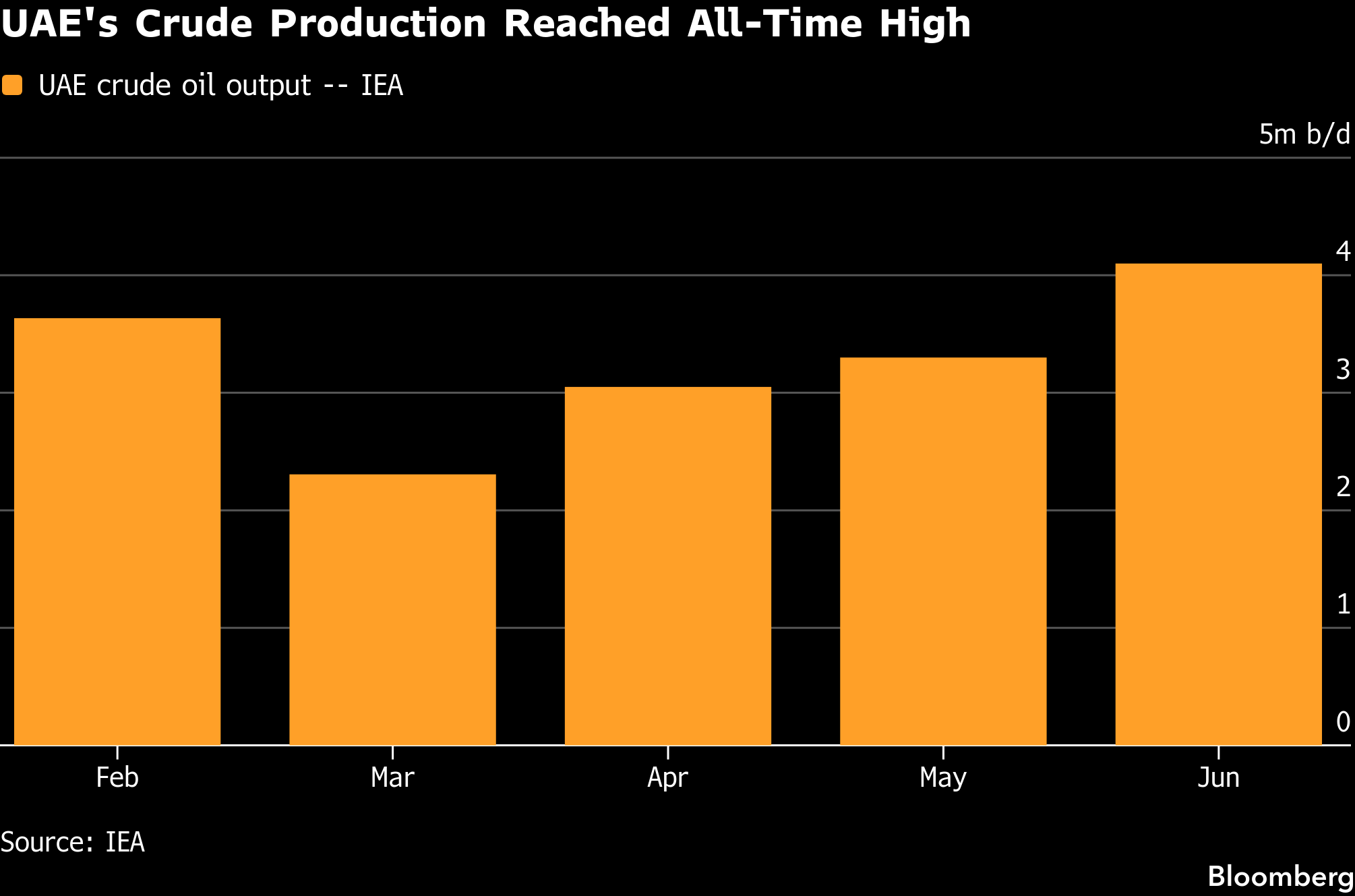
The country pumped 4.1 million barrels a day on average in June, the International Energy Agency said in its monthly report. That surpasses the peak daily output 4 million a day in 2020 when it had boosted supply during a brief price war over OPEC+ policy, and follows its exit from the group earlier this year.
The UAE’s bold tactics since the war began are becoming increasingly apparent, from using its own large fleet to hiring extra ships controlled by Sinokor Group, a South Korean firm that now runs the world’s largest fleet of oil supertankers. Many of the vessels have operated “dark,” with their digital transponders turned off to get barrels out of the Persian Gulf unseen.
The vigorous recovery, most of which came before a spate of attacks on commercial shipping in the Strait of Hormuz this week, underlines the country’s unshackling from limits set by the Organization of the the Petroleum Exporting Countries. Oil traders have been keeping close watch on how high the UAE might take it supply after it left the producer group at the end of April.
The country had already restored its exports to pre-war levels last month, according to tanker tracking data compiled by Bloomberg. Saudi Arabia, the biggest producer in the region, was also getting close as it resumed shipments from the key Ras Tanura terminal inside the Persian Gulf.
The rebounding flows, along with the precarious peace agreement between Washington and Tehran that had allowed a surge of tankers to pass through Hormuz, had helped flip world markets from tightness to signs of oversupply in key regions and erased the war-time rally in crude prices.
The recovery picture was muddied on Wednesday, however, when President Donald Trump declared the ceasefire effectively void after the two sides traded hostilities in the region. US forces struck sites in Iran for two consecutive days, and Tehran fired upon Bahrain and Kuwait. Brent futures topped $80 a barrel earlier this week, but eased to near $76 a barrel on Friday.
The Gulf’s other major producers also increased output last month, though fell short of pre-war levels, according to the IEA. Saudi Arabia pumped 7.3 million barrels a day in June, 900,000 a day higher that the previous month. Kuwait’s increased to 1.4 million barrels a day on average and Iraq’s to 2 million a day.
Even as crude flows have risen, refinery activity in the Gulf has been more sluggish to respond, with product exports still less than half the levels prior to the conflict, the IEA said.
(Updates with OPEC context in the fourth paragraph.)
©2026 Bloomberg L.P.








