

New York City’s Aging Power Barges Show the Blackout Risk Is Real


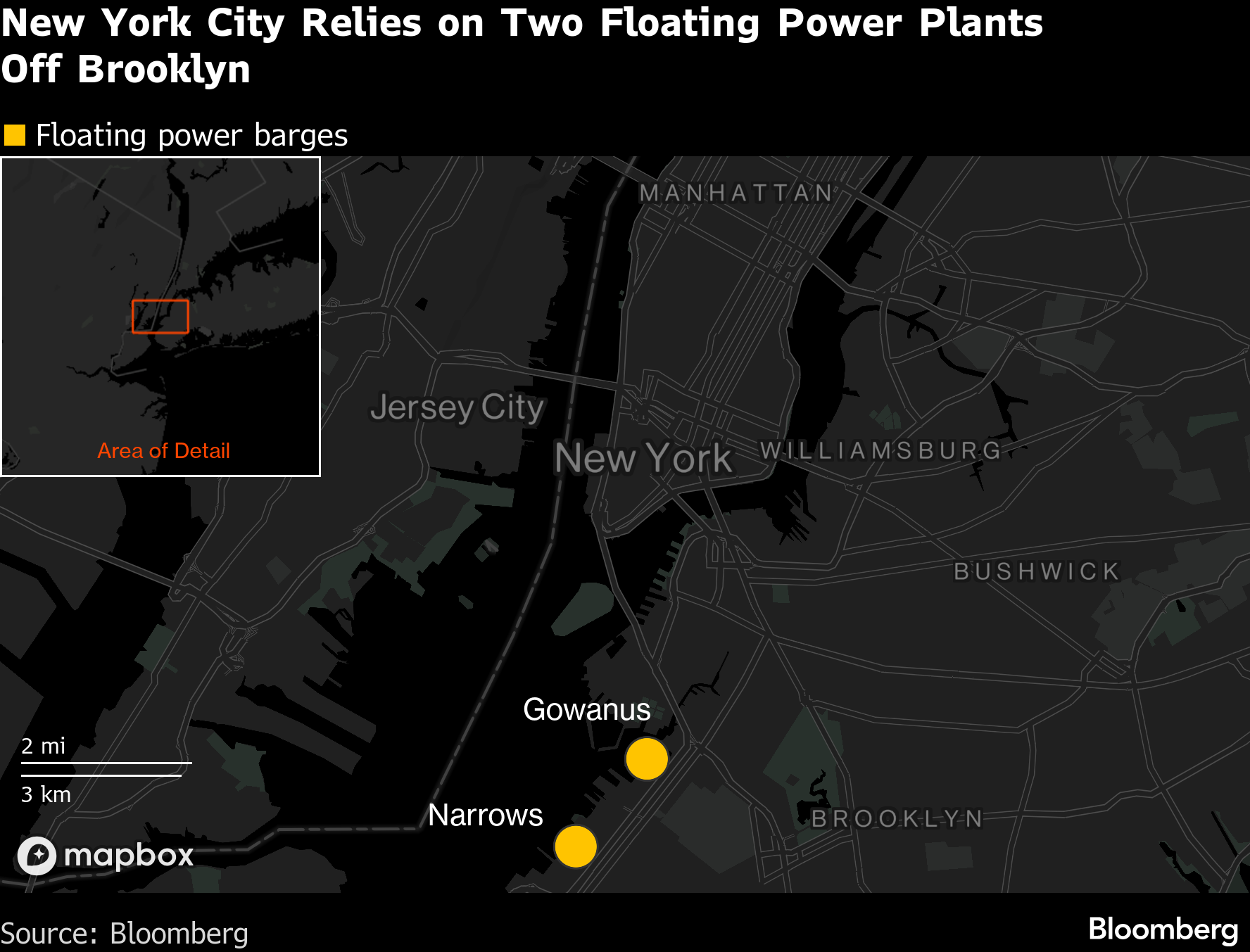
(Bloomberg) -- As another spell of intense heat gripped New York City last month, two floating power stations off Brooklyn’s Sunset Park heaved into life.
The Narrows and Gowanus plants on the East River are a last line of defense against blackouts, which risk upending daily life for millions of New Yorkers. But with power demand surging, they’re now being called upon constantly to help keep the city’s lights on.
That might not be a problem if they were state-of-the-art. But both are over half a century old. Their continued usage is the embodiment of an aging grid that is rapidly becoming unfit for the 21st century, even as the economy electrifies. That raises the odds of a “catastrophic failure,” according to Gary Cunningham, director of market research for Tradition Energy.
“There comes a point where, if you’re operating older resources at their maximum for protracted periods of time, they will fail,” Cunningham said, adding that the system is already near its limits and could have to drastically reduce demand in the future. “New York is probably in the worst position as far as the need to do strategic blackouts.”
America is entering a new era. After two decades when demand for electricity was stagnant, it’s booming again. Electric vehicles, heat pumps and data centers for artificial intelligence are straining the grid throughout the year like never before. Extreme weather fueled by climate change is another stressor.
The need to upgrade the power grid is urgent in New York, a city of more than 8 million that is struggling with brutal heat this summer.
As temperatures climbed to 100F (38C) in early July, Consolidated Edison Co., which runs the city’s electric utility, told hundreds of thousands of customers to conserve energy as it worked to repair equipment. It said it would distribute dry ice to those who had lost power in the borough of Queens.
“New York’s electricity system, whether it’s upstate or New York City, we have the oldest energy infrastructure in the United States,” said Gavin Donohue, chief executive officer of the Independent Power Producers of New York Inc. “The state of the infrastructure certainly has everybody in this business concerned.”
A ConEd spokesperson said its system performed reliably through the July heat dome, “reflecting the value of continued investments in grid modernization and resilience,” and that despite scattered brief outages, “the vast majority of the 3.7 million customers we serve had uninterrupted service during record-breaking heat.”
Curt Morgan, the chief executive officer of Alpha Generation LLC, which operates the so-called peaker plants, said in a statement that they “provide the dependable, dispatchable power that keeps the city running.” He added that the plants get “significant investment” each year and their sites can be part of the city’s future electric system since they are “ideal for repowering with new technology.”
Ken Lovett, senior communications advisor on energy and environment for Governor Kathy Hochul, said in a statement that her priority “is keeping the lights on and costs down for all New Yorkers. That’s why she is taking an all-of-the-above approach to energy that includes advancing more wind, solar, and nuclear power and other forms of energy to increase grid capacity.”
A spokesperson for the New York State Department of Public Service said a number of workstreams have been put in place to address grid reliability concerns, including a pathway to 4 gigawatts of new nuclear power. New York City Hall didn’t respond to a request for comment.
The dependability problem has been building for decades, analysts say.

A decision by former New York Governor Andrew Cuomo to shut down the 2.1 gigawatt Indian Point nuclear reactors has left the state scrambling to find alternatives. It made a big bet on renewable energy, but that is being stymied by the Trump administration. Of the 6 to 8 gigawatts of offshore wind originally planned, only around 1 gigawatt will now see the light of day, Cunningham said.
On top of that, a landmark plan to bring huge amounts of clean hydropower down from Quebec is at risk of falling short of expectations. Although it was brought online in June, the Champlain Hudson Power Express transmission line has already been beset by technical problems and is delivering far less power than its 1.25 gigawatt promise. Nuclear maintenance in Ottawa later this year — which risks diverting power from Quebec and New York — and the ever-present threat of drought could undermine those supplies further.
Meanwhile, demand on New York’s grid is surging, hitting 31 gigawatts on July 2, less than 3 gigawatts shy of the record set in 2013. Other networks in the US have broken record highs this summer, including the main Texas grid and the country’s largest, which spans from Chicago to Washington, DC.
New York’s grid operator is already sounding the alarm. In a report published in June, New York Independent System Operator said the system could be deficient of power as soon as this summer, and will remain that way for the next five years. CEO Rich Dewey compared the impact of the energy transition to when the grid was first being built out at the end of the 19th century and the rapid expansion after World War II.
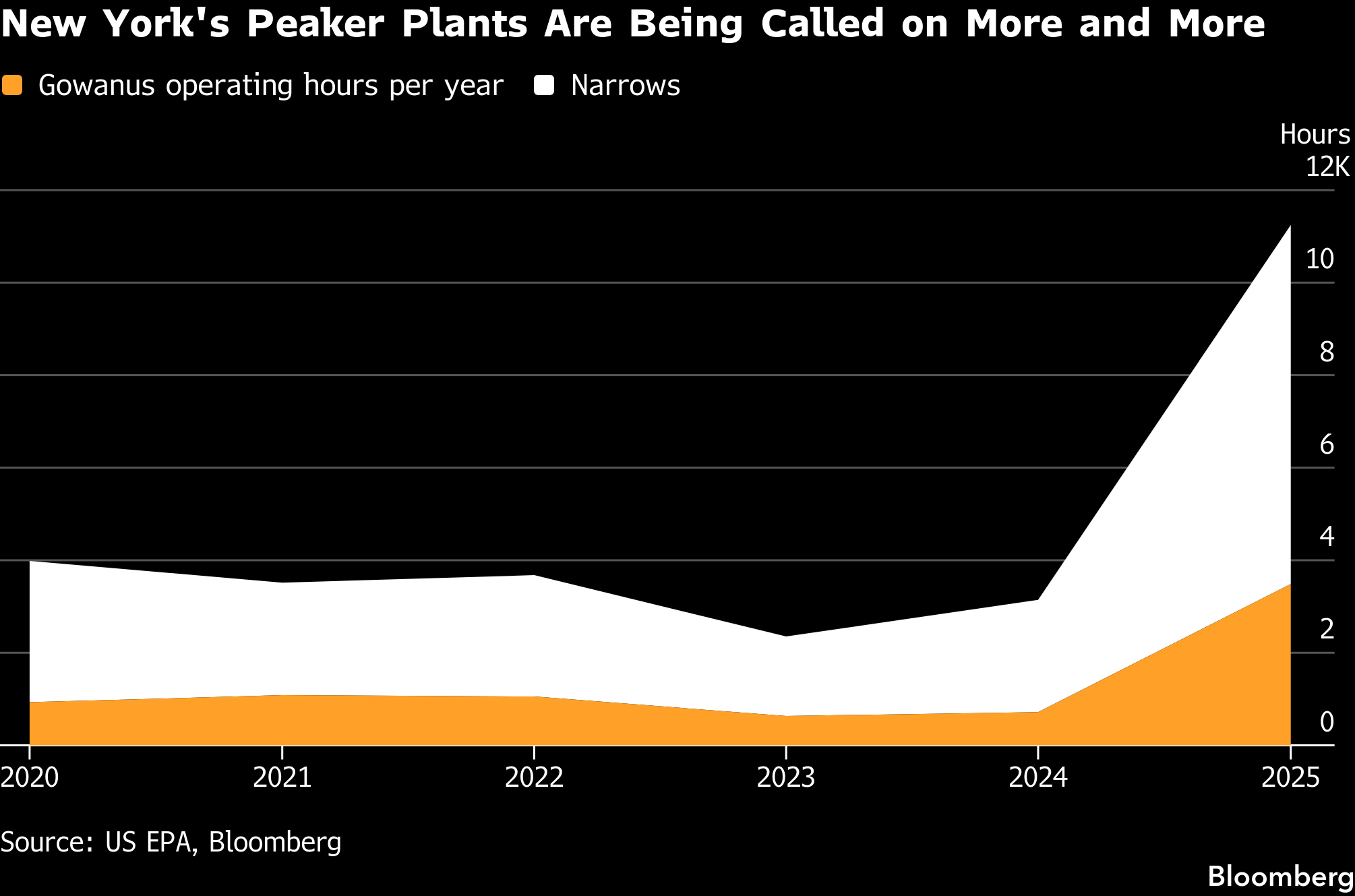
Instead, New York will have to lean on Narrows and Gowanus to maintain reliability, NYISO’s report said. Narrows, for example, last year was required to provide three times as much power as it did in 2024. Experts say they’re already on track to surpass that. The lifetimes of the two facilities have been extended until 2029 at the earliest, even as calls grow to replace them.
Given their age and vintage, keeping them going requires careful maintenance and sourcing of parts. Dewey also acknowledged the increasing risk of them failing.
Investment in and upgrades to the grid “actually should have been put into place and then put into motion years ago,” said Kevin Lanahan, NYISO’s vice president of external affairs and corporate communications. “We’re now starting to see the system perform in ways that give us great concern. We can’t wait any longer.”
It all adds up to higher costs for ratepayers as a growing affordability crisis hampers New York’s emissions-cutting goals. Those have already been postponed by a decade to 2040.
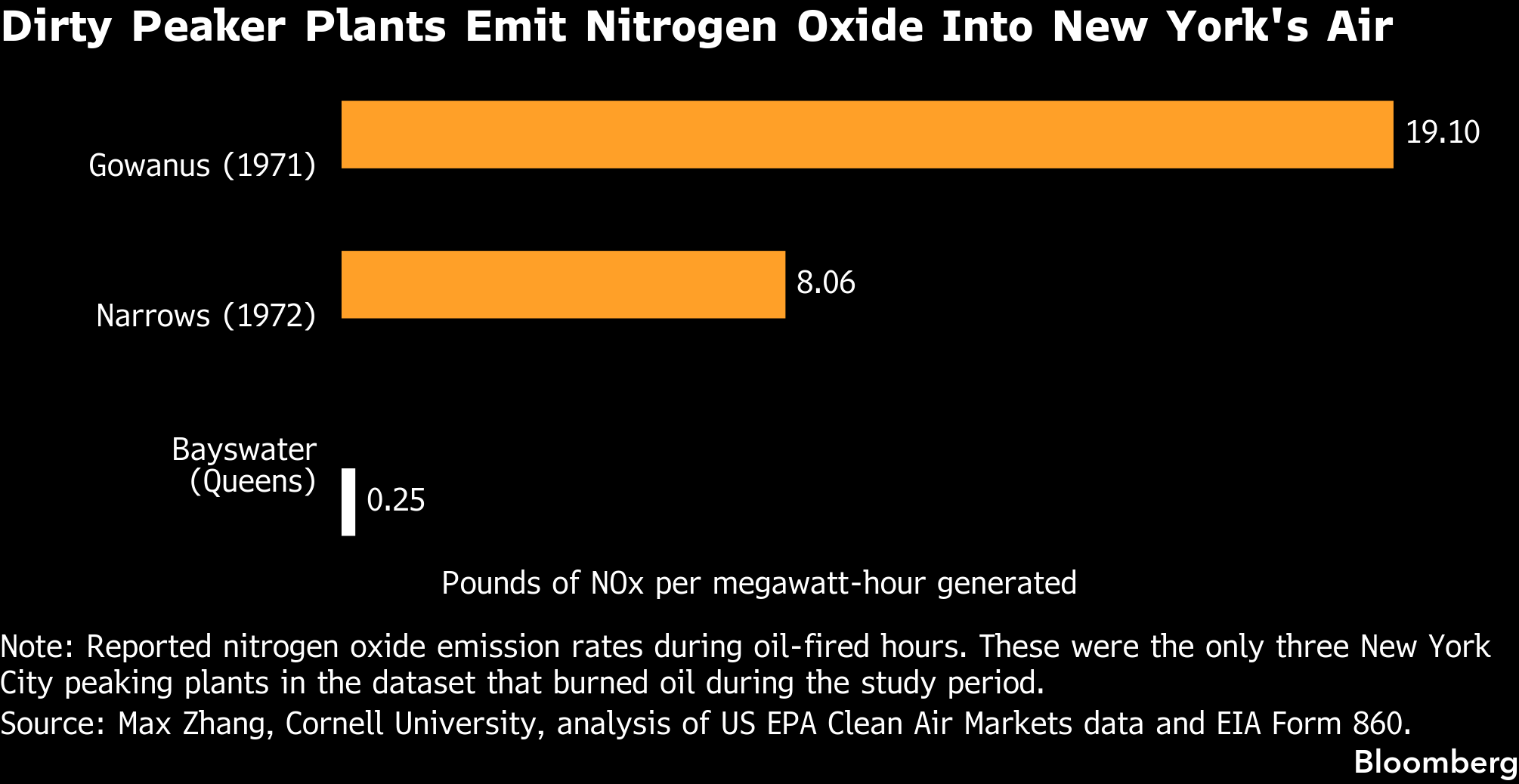
The peaker plants also emit heavy amounts of nitrogen oxide, a gas that contributes to planet-warming pollution, smog and breathing difficulties. The older turbines in 2024 to 2025 produced approximately 38 times more nitrogen oxides per unit of fuel and required approximately 74% more fuel to generate the same amount of electricity than more modern equipment, according to Max Zhang, a professor at Cornell University.
Further challenges for New York’s power system are that renewable generation tends to be located far away from the main population centers and winter power demand is set to jump by more than a third over the next decade as heating is electrified, according to Helen Kou, an analyst at BloombergNEF.
“Winter is also when gas prices are quite volatile, particularly across the Northeast,” Kou said. “It just adds to the constraints and overall higher power prices in the market.”
During the summer, Narrows and Gowanus usually use gas, but this winter saw the two facilities burn diesel for more than 400 hours, according to Environmental Protection Agency data, with gas proving almost impossible to purchase on the spot market. That raises costs and emissions. Just the cost of the extra emissions permits alone could add over $100 to consumer bills per year on top of the additional fuel costs, according to Bloomberg calculations.
With extreme weather events increasing due to climate change, pressure will rise as New Yorkers turn on their air conditioners to cope with the swelteringly sticky summer heat. Critics say environmental law is also holding back development of natural gas plants in the state.

Some fear the tight situation will also mean New York falls further behind in artificial intelligence. Last month, Hochul signed the first statewide moratorium on data centers. While public skepticism was a key driver, there are also questions over whether New York could even develop enough new generation to power the facilities.
“If they’re going to see economic growth like much of the country is, if they want to see manufacturing and data centers, they’re going to need to have a sufficient amount of power,” said Todd Snitchler, chief executive officer of the Electric Power Supply Association. “There is going to have to be a difficult conversation.”
©2026 Bloomberg L.P.